South Korea's reliance on Middle Eastern crude fell sharply in the first half of this year compared with the same period last year. However, some in the industry argue the shift reflects emergency government intervention and refiners' crisis-driven responses rather than any lasting private-sector-led diversification of crude supply sources.
Mideast crude share drops 6.4 percentage points to 62% in H1
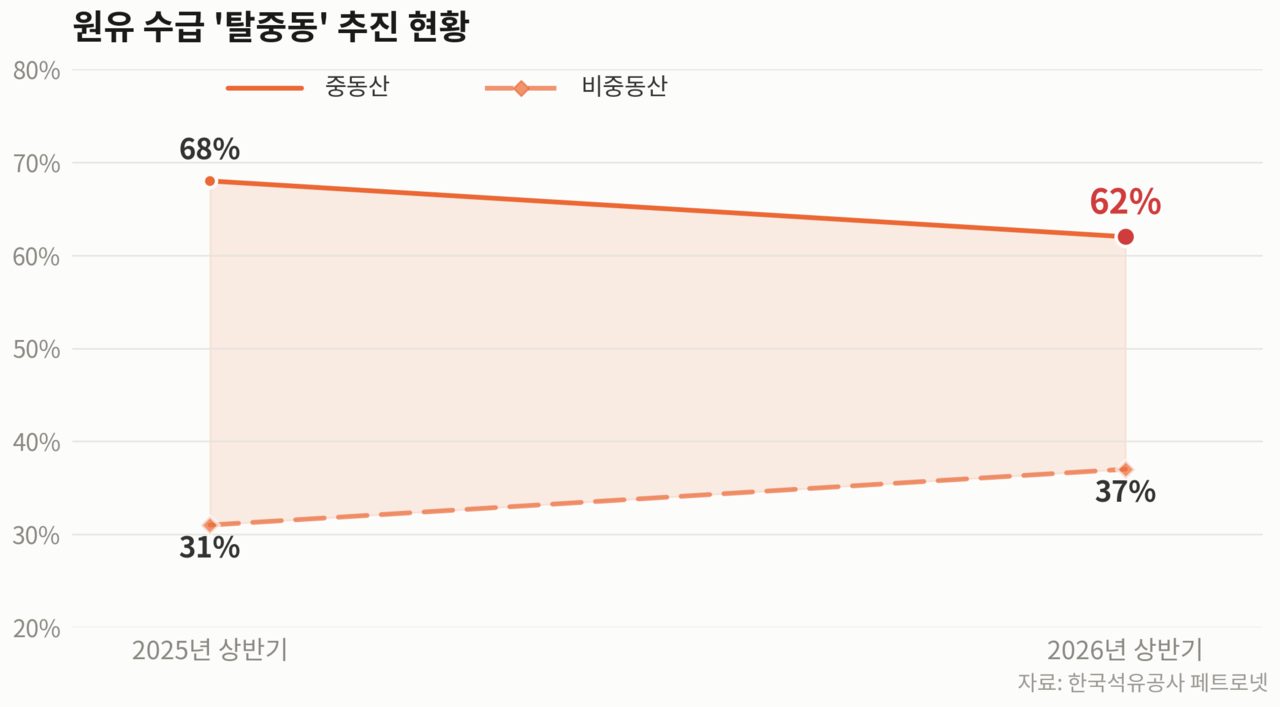
According to data from Korea National Oil Corp.'s Petronet released Tuesday, Middle Eastern crude accounted for 62.3 percent, or 291.17 million barrels, of South Korea's total crude imports of 467.11 million barrels in the first half of this year. That is down 6.4 percentage points from 68.7 percent in the first half of last year and 4.7 percentage points below last year's full-year average.
US and African crude made up the difference. The United States recorded the largest increase in volume among all suppliers compared with the first half of last year, with South Korea importing 95.87 million barrels of American crude — 11.9 million barrels more than a year earlier — pushing the US share from 16.5 percent to 20.5 percent.
Algerian crude (11.39 million barrels) and Congolese crude (5.55 million barrels) also posted year-on-year volume gains, though all non-US suppliers remained below a 3 percent share. Canadian crude, whose imports the government has been formally expanding as part of an energy supply chain cooperation agreement with Ottawa, was limited to a 1.5 percent share.
H1 Mideast retreat was government-driven — and has already reversed since May
The surge in US crude imports is widely attributed to the government's declaration of a "de-Mideast" supply chain policy and its direct procurement negotiations following the outbreak of the US-Iran war last February. Yet industry officials warn the trend is unlikely to hold. Ultimately, they say, the shift was the product of direct government intervention during a crisis and emergency responses by refiners — not a structural change — leaving the outlook for the second half uncertain.
A key structural constraint is that South Korean refineries are already optimized for Middle Eastern crude. Processing the region's heavy, high-sulfur crude requires specialized upgrading equipment that lighter crude from other regions does not need. "South Korea has long-term contracts with major Middle Eastern producers and has invested astronomical sums to configure its refining facilities for their crude," a refining industry official said. "Switching to crude from other regions reduces production efficiency."
![[Herald DB]](https://wimg.heraldcorp.com/news/cms/2026/08/11/news-p.v1.20260811.537ec65bb7784729a74bed6f49c6b66f_P1.png)
In practice, supply diversification lost momentum sharply after April. The Middle East's share of crude imports fell steadily — from 70.6 percent in January to 69 percent in February, 65 percent in March and 50 percent in April. It rebounded to 54 percent in May and climbed to nearly 60 percent in June, suggesting dependence is once again rising.
Analysts say the April low reflected the temporary effect of emergency crude volumes the government secured from Middle Eastern countries through a special economic envoy mission dispatched immediately after the war broke out — an effect that has since faded. "The increase in non-Mideast crude in the first half was driven more by the government than by the private sector," an industry official said.
Experts urge overhaul of sunset-clause supply policy and refinery investment support
![Ships navigate the Strait of Hormuz. [Reuters]](https://wimg.heraldcorp.com/news/cms/2026/08/11/news-p.v1.20260806.3732b8fe8be544c8b29864bc5f2169cd_P1.jpg)
Experts say refinery investment must come first if supply diversification is to be achieved over the long term. Kim Tae-hwan, a research fellow at the Korea Energy Economics Institute, said private refiners lack the incentive to voluntarily diversify their supply sources given the economic advantages Middle Eastern crude offers. "The current support system for crude supply diversification, which is renewed in three-year increments under a sunset clause, needs to be restructured to give companies greater predictability when planning facility and infrastructure investment," Kim said.
Japan is frequently cited as a model, particularly for its active approach to refinery investment. Yoo Gwang-ho, a researcher at the Korea Institute for International Economic Policy's Center for Area Studies 2, said Japan has strengthened investment support for advanced cracking units and quality-adjustment equipment to prevent the efficiency losses that occur when processing US shale oil or Central Asian crude — whether blended with Middle Eastern crude or used alone.

klee@heraldcorp.com