
On Sunday, the mercury climbed to 42.5 degrees Celsius in Yangsan, South Gyeongsang Province — the highest temperature ever recorded in South Korea's meteorological history. The extreme heat that had been hammering the southern Korean Peninsula has now spread to the central regions, pushing Seoul's peak temperature close to 40 degrees. The abnormal heat this summer is not confined to the Korean Peninsula. Austria hit 41.2 degrees, Slovakia 41.4 degrees and Poland 38 degrees, with many Central European countries setting new all-time temperature records this year, while wildfires fueled by prolonged heat waves are ravaging the western United States, where temperatures reached 47 degrees.
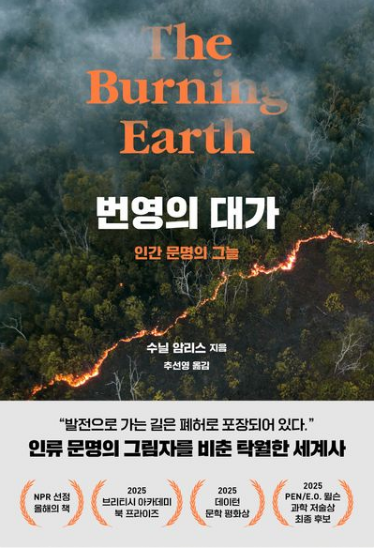
Few dispute that the climate crisis is the result of reckless development driven by human greed. A small ruling class has reshaped the natural world — through war, exploration, the expansion of farmland, increased fossil fuel use and the growth of global trade — to satisfy its own desires. As a result, Earth's systems have been pushed to a point where the natural world humanity has destroyed can no longer recover. Sunil Amrith, a distinguished professor of history at Yale University and an environmental historian, writes in his new book "The Cost of Prosperity: The Shadow of Human Civilization" that "the crisis of the Earth is the result of an energy-hungry economic system transforming living nature — sometimes with the liberatory intention of expanding human freedom — into lifeless commodities."
Amrith quotes novelist Samantha Harvey's observation that "human lack is what has changed everything," and analyzes today's crisis as the accumulated result of humanity's long-held choices in its relentless pursuit of greater prosperity and freedom. He identifies three historical turning points in human civilization: the expansion of the Mongol Empire in the 13th century, the Age of Exploration in the 15th century, and the Industrial Revolution and the World Wars of the 19th and 20th centuries.
Amrith argues that the 13th century, when the Mongol Empire was at the height of its power, marked the beginning of humanity's large-scale negative impact on nature across the globe. Kublai Khan connected Europe and Asia, moving not only people but also crops, animals and pathogens from continent to continent, linking previously isolated natural environments and civilizations. The surge in exchange between East and West brought economic prosperity, which in turn drove population growth. China's population more than doubled from about 60 million to about 140 million between 900 and 1200, while Europe's population nearly tripled from about 25 million to about 70 million over the same period.
The sudden surge in population, the growth of livestock herds and the clearing of forests for farmland disrupted Earth's restorative systems for the first time. In the 14th century, just after this era of prosperity, extreme rainfall, heavy snowfall and earthquakes arrived. A mutation of Yersinia pestis — the bacterium that causes plague — living in wild rodents on the Central Asian steppe swept across Europe. The death toll from the plague across the Eurasian continent is estimated at between 75 million and 200 million. The historical pattern — reckless development, followed by economic prosperity, followed by climate crisis and the spread of new infectious diseases — feels strangely familiar.
Rather than treating that catastrophe as a lesson, humanity repeated its mistakes. In the 15th century, Europeans sailed to the New World in search of gold, silver and spices, bringing with them livestock such as horses and cattle, crops such as wheat and sugarcane, and diseases including smallpox, measles and typhus. As a result, 90 percent of the indigenous population of the Americas perished from those diseases. Amrith describes the discovery and colonization of the New World as "a historical turning point at which humans began in earnest to move and redistribute nature from continent to continent." In other words, a fundamental shift in humanity's view of nature had taken place — nature was no longer a threatening variable but a resource to be exploited.
The Industrial Revolution and the World Wars of the 19th and 20th centuries brought yet another shift in human consciousness. The Industrial Revolution drove large-scale use of fossil fuels, rapidly raising atmospheric carbon dioxide levels, while the construction of cities and railways accelerated the destruction of forests and grasslands. Nitrogen fertilizers that saved humanity from famine devastated river and ocean ecosystems, and mass production and mass consumption pushed humans to consume natural resources faster than the planet could replenish them. Japan's coal output increased twentyfold in the late 19th and early 20th centuries, while Myanmar's rice paddy area expanded from 2.64 billion square meters to 24.09 billion square meters. Over the same period, the proportion of carbon dioxide in the atmosphere rose by 30 percent.
Fires during World War II in 1944 and 1945 alone released more than 500,000 metric tons of soot into the atmosphere. Amrith writes that this was "theoretically enough to reduce the amount of solar radiation reaching Earth," adding: "While it is impossible to definitively prove the impact World War II had on the Earth's climate, we can see that it had an enormous effect — that humanity had begun to exert its power at the level of the planet itself." Through three turning points, humanity connected the world, exceeded the limits of nature and ultimately altered the planet itself.
Yet Amrith does not offer only a pessimistic picture. His survey of 800 years of human history is not meant to assign blame but to ask where humanity should go from here. Citing Ecuador's revised constitution and environmental movements within the gaming and K-pop industries, he writes: "'Ecological grief' is emerging in communities around the world. More and more people are realizing that without the world, 'we' cannot exist." He adds: "The struggle we must undertake is to inscribe in our hearts the awareness that we are living beings, and to integrate that awareness into a new ideal of human flourishing on Earth. Only then can we reclaim our freedom."
"The Cost of Prosperity: The Shadow of Human Civilization" / by Sunil Amrith, translated by Chu Seon-yeong / Ibom
carrier@heraldcorp.com