![President Lee Jae Myung. [Yonhap]](https://wimg.heraldcorp.com/news/cms/2026/08/10/news-p.v1.20260805.16fe9d6a0a64464080439423e51a23f2_P1.jpg)
The financial investment industry is calling for revisions to the government's individual savings account (ISA) overhaul, part of the 2026 tax reform package announced Monday. While the industry broadly supports the policy goal of channeling more funds into domestic markets, critics argue there is no need to curtail the flexibility and choice available to existing ISA holders in the process.
Market watchers are now focused on whether the reform will be revised to keep the existing ISA intact while adding a separate "productive finance ISA" as a new vehicle. The shift in tone follows remarks Sunday by Han Jeong-ae, policy chief of the Democratic Party of Korea, who said it appeared there would be no need to touch the existing ISA. The ruling party has so far indicated it favors preserving the current ISA while introducing the new account alongside it, though the specifics — which conditions to retain or modify, and how the two accounts would relate to each other — have yet to be determined.
Since the tax reform plan was unveiled Monday, voices inside and outside the industry have consistently argued that the government's proposal goes too far by altering the contract terms and contribution structure of the existing ISA to boost incentives for domestic investment. The core objection is that giving investors new domestic investment opportunities and changing the operating conditions of existing accounts are separate issues — and that there is no reason to reduce the options available to current account holders.
The central controversy in the government's plan is that it concentrates benefits on a new domestic-investment-only ISA while reducing the flexibility of the existing one. Under the proposal, the standard ISA would be limited to a three-year contract term, extendable to a maximum of five years, and the carryover of unused annual contribution limits would be abolished. The new productive finance ISA, by contrast, would offer full tax exemption on interest and dividend income, a total contribution limit of 200 million won ($141,000), and an investment period of up to 10 years. It would be restricted to domestic shares, domestic equity funds, national growth funds and business development companies (BDCs), with domestically listed overseas equity ETFs excluded from eligible investments.
The question is how effective this approach would actually be. Expanding incentives for domestic investment and narrowing the options within the existing ISA are distinct matters. Investors do not make decisions based on tax treatment alone — they weigh expected returns, asset selection and market outlook together. It is therefore far from certain that stronger domestic incentives would redirect overseas investment demand back into Korean markets.
Kang Jin-hyeok, a researcher at Shinhan Investment, described the overhaul as "a 'selective incentive' policy aimed at steering investment toward domestic assets, rather than a broad expansion of tax benefits." He added that while the policy objective is clear, capital follows investment attractiveness, and that "just as the domestic market return account — which penalized overseas investment — failed to gain traction, tax incentives alone may not be enough to attract long-term capital inflows."
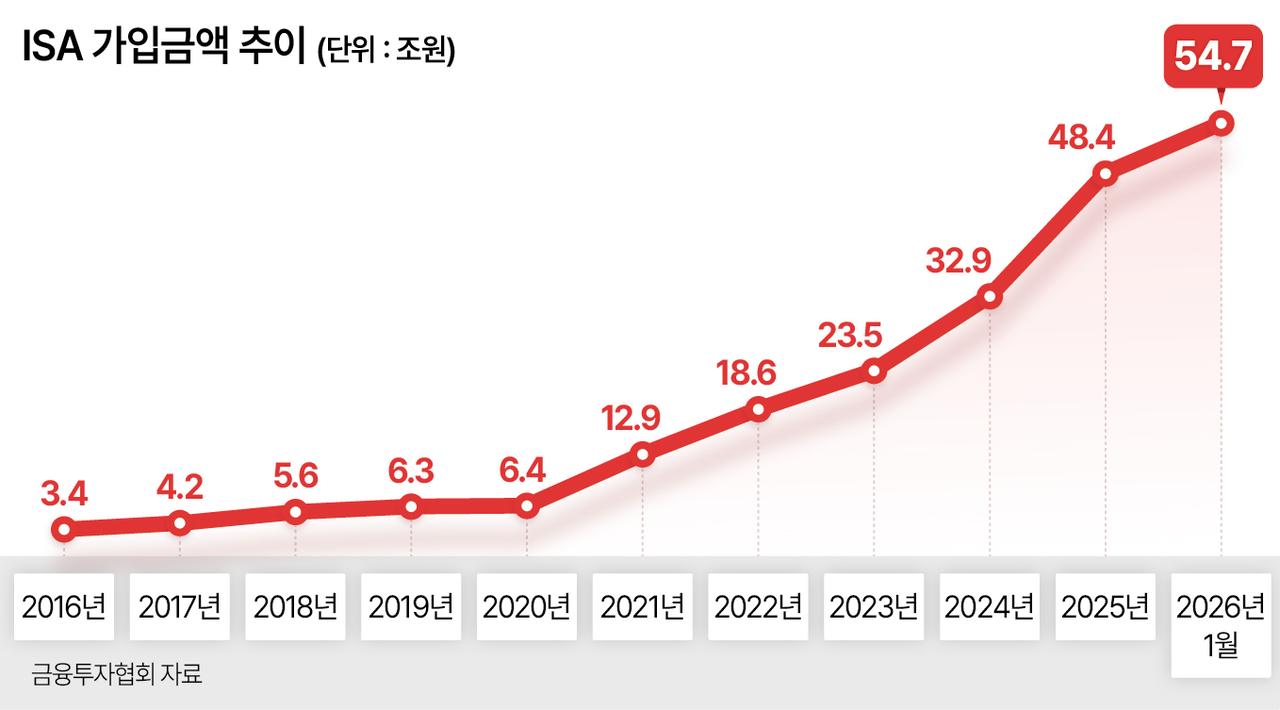
In practice, demand for overseas investment within ISAs has already grown substantially. With overseas ETFs now accounting for around 20 percent of ISA holdings, analysts say it is hard to assume investors will necessarily shift to domestic assets simply because the new productive finance ISA offers better terms. Some investors may instead choose to invest directly in overseas equities outside the ISA framework altogether.
As the controversy grew, President Lee Jae Myung ordered a review of the ISA reform plan Friday. At a situation-monitoring meeting attended by presidential office staff, Lee was reported to have questioned why the plan had been put forward without adequate preparation and directed a "full review." Democratic Party policy chief Han then officially signaled the possibility of revisions at a press briefing Sunday.
Discussions between the ruling party and the government are now expected to focus on how much of the existing ISA's operating conditions — including contract terms and the carryover of contribution limits — should be preserved. The likely direction is to protect existing account holders' options as much as possible while offering additional tax benefits through the new productive finance ISA to encourage domestic investment. The government's tax reform plan is set to be finalized through ruling party-government consultations later this month before being submitted to the National Assembly. The public comment period runs through Aug. 20, after which the plan will go to a vice ministerial meeting Aug. 27 and a Cabinet meeting Sept. 1, before being submitted to the regular legislative session by Sept. 3.

kacew@heraldcorp.com