
South Korea's auto industry is expected to shed a net 11,000 jobs over the next decade as the sector undergoes a structural shift toward electric and self-driving vehicles, according to a new government forecast.
The projected decline reflects a loss of 15,000 jobs in vehicle manufacturing, offset in part by a gain of 4,000 in auto parts production. The transition from internal combustion engines to electric vehicles is expected to eliminate a large share of existing components while driving demand for new parts suited to future mobility, reshaping the industry's employment structure in the process.
The Korea Employment Information Service's "Analysis and Outlook for Automotive Industry Workforce Demand," released Monday, projects total employment in the combined auto and trailer manufacturing sector — covering both vehicle assembly and parts production — will fall from 693,000 in 2024 to 682,000 in 2034, a net decrease of 11,000. The average annual rate of decline is 0.2 percent.
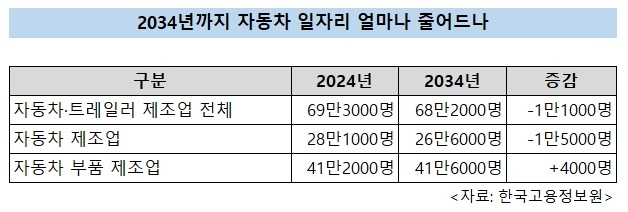
Breaking down the figures by subsector, employment in vehicle manufacturing is forecast to fall from 281,000 in 2024 to 266,000 in 2034, a drop of 15,000. The auto parts sector, by contrast, is expected to add 4,000 workers over the same period, rising from 412,000 to 416,000. Those modest gains will partially offset losses in vehicle assembly, producing the overall net decline of 11,000. Even so, the parts sector's cumulative growth rate over the decade is limited to around 1 percent — effectively stagnant.
The slight increase in parts employment is not at odds with the broader loss of components driven by the EV transition. Demand for engine and drivetrain parts used in combustion-engine vehicles will fall, but demand for batteries, electric motors and generators, and power conversion devices will rise. Many existing components — body panels, suspension systems and braking systems — will continue to be used in electric vehicles as well. The overall headcount in the parts industry will remain largely stable, but the products being made and the skills required will change significantly.
The shift to electric vehicle production is expected to eliminate about 11,100 of the roughly 30,000 parts currently used in conventional vehicles — a reduction of 37 percent. All 6,900 engine-related components would disappear, and only 2,100 of the 5,700 drivetrain and transmission parts would survive. Batteries, power transmission systems, electric motors and generators, and power conversion devices are expected to generate new demand.
The pace of the EV transition is also expected to accelerate. A survey of 326 automotive industry experts found that electric vehicles' share of domestic auto production is projected to rise from 15.6 percent in 2027 to 24.8 percent in 2032 and 37.8 percent by 2050. The share of internal combustion engine vehicles, meanwhile, is expected to fall from 52.6 percent in 2027 to 37.0 percent in 2032 and 20.5 percent by 2050.
The spread of electrification and autonomous driving technology is expected to produce diverging trends in workforce demand by occupation. The number of professionals and related workers is projected to fall from 119,000 in 2024 to 97,000 in 2034, a decline of 22,000. Workers in machine operation and assembly, however, are expected to increase by 23,000 — from 366,000 to 389,000 — and the number of elementary laborers is forecast to grow by 11,000, from 46,000 to 57,000. Total employment in the auto industry will shrink, but the direction of change will vary by occupation.
Labor mobility driven by industry restructuring is already evident. An analysis of employment insurance records shows that 46.1 percent of workers who left the auto industry in 2024 moved to other manufacturing sectors — meaning nearly one in two departing auto workers shifted to a different area of manufacturing.
Parts suppliers are also feeling the strain of the transition. In a survey of auto parts companies, 44.3 percent said the shift to future vehicle production would have a negative impact on their business. Only 22.5 percent expected a positive effect, while 33.3 percent said it would have little impact.
The pace of transition varies widely across companies. Among parts suppliers already producing components for future vehicles, the share of such parts in total output is expected to rise from an average of 22.6 percent in 2024 to 54.1 percent in 2034. Among suppliers not yet producing future-vehicle parts, only 16.5 percent said they had plans to make the transition.
fact0514@heraldcorp.com




