'Every child has the right to be protected and to grow up healthy'
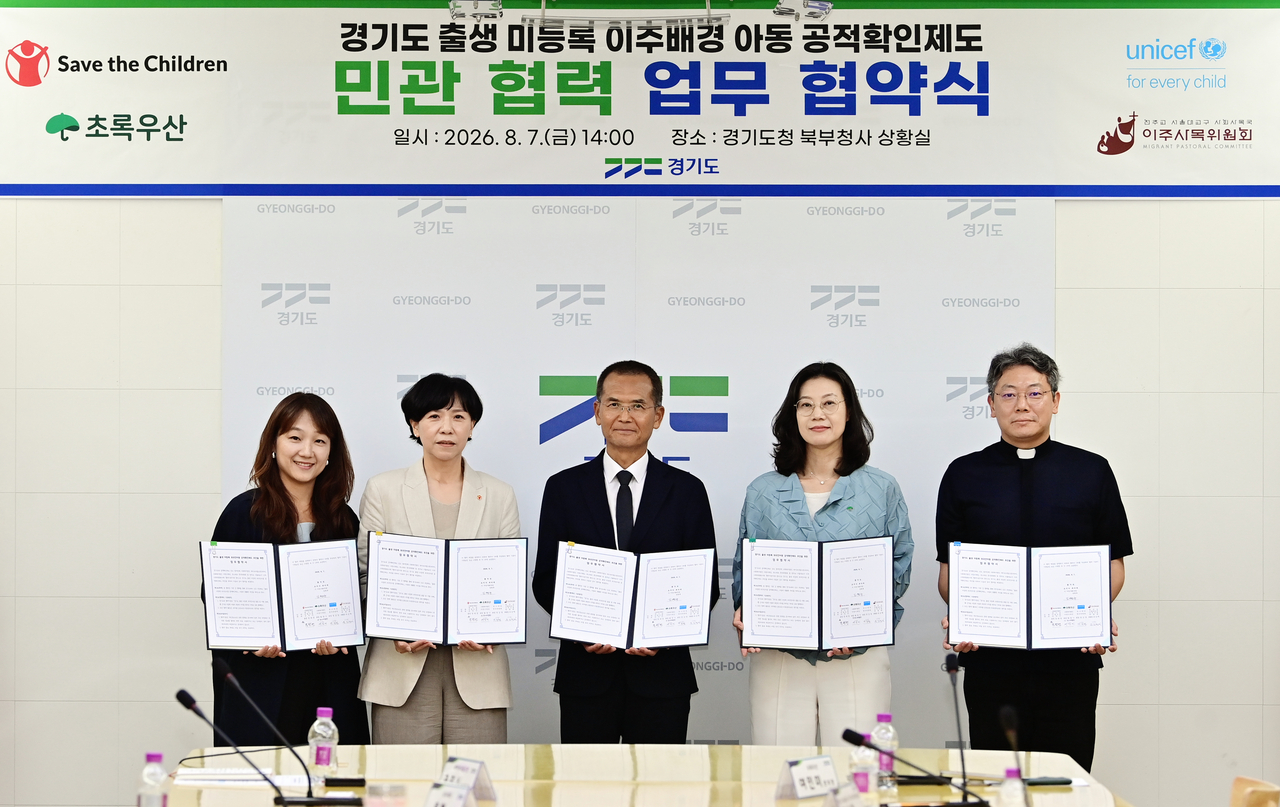
Gyeonggi Province signed a public-private MOU on Friday with Save the Children Korea, ChildFund Korea, UNICEF and the Catholic Archdiocese of Seoul's Migrant Pastoral Committee to strengthen protections for unregistered migrant-background children. The signing ceremony was held at the province's Northern District Office.
The agreement centers on the province's official verification system, launched this year, which allows public institutions to formally confirm the existence of migrant-background children who have not been registered at birth. The system does not substitute for birth registration or confer nationality or residency status, but it enables children to be connected to medical, childcare and welfare support services.
Gyeonggi Province and the four partner organizations agreed on the principle of the "best interests of the child" regardless of residency status, and on the need to strengthen the public sector's role beyond the current civil-society-led approach. Under the MOU, the parties will cooperate on identifying unregistered migrant-background children and linking them to support services; coordinating with existing health, medical, education, livelihood and welfare programs; publicizing and promoting the official verification system; and handling any other matters needed for the system's smooth operation and for supporting unregistered migrant-background children.
The MOU aims to reinforce a public-private cooperation framework spanning the full process — from identifying unregistered migrant-background children, through official verification, to connecting them with private welfare services and managing individual cases.
Jo Min-seon, head of the rights advocacy division at Save the Children Korea, who attended the signing, described a recent case in which an unregistered first-grade girl sustained a serious leg injury while playing and her organization covered the treatment costs. "Unregistered migrant-background children are in the unfortunate situation of not even being covered by safety mutual-aid insurance," she said. "Going forward, the public and private sectors must work together to actively identify and support these children."
The province currently operates the official verification system across 10 cities and counties — Goyang, Hwaseong, Seongnam, Bucheon, Ansan, Pyeongtaek, Siheung, Anseong, Dongducheon and Gwacheon — and had issued 144 child verification certificates as of the end of June, a roughly 144 percent increase from 59 certificates as of the end of March. For children identified as needing support, the province provides tailored welfare services through its partner organizations, including coverage of medical, pharmaceutical and residential costs.
Gyeonggi Province plans to step up outreach and promotion to ease the anxiety of undocumented parents, and to improve access to the system by drawing on field networks including civil society groups and honorary ambassadors of its immigration and social integration support centers. The province also intends to expand the system beyond the current 10 participating cities and counties to eventually cover the entire province.
Kim Won-gyu, director of the province's immigration and society bureau, said every child has the right to be protected and to grow up healthy, regardless of the country of birth or the residency status of their parents. "We plan to actively promote the official verification system through migrant community networks and the field networks of our partner organizations, and to bring non-participating cities and counties on board so that the child protection framework can be expanded across the entire province," he said.
pjh@heraldcorp.com