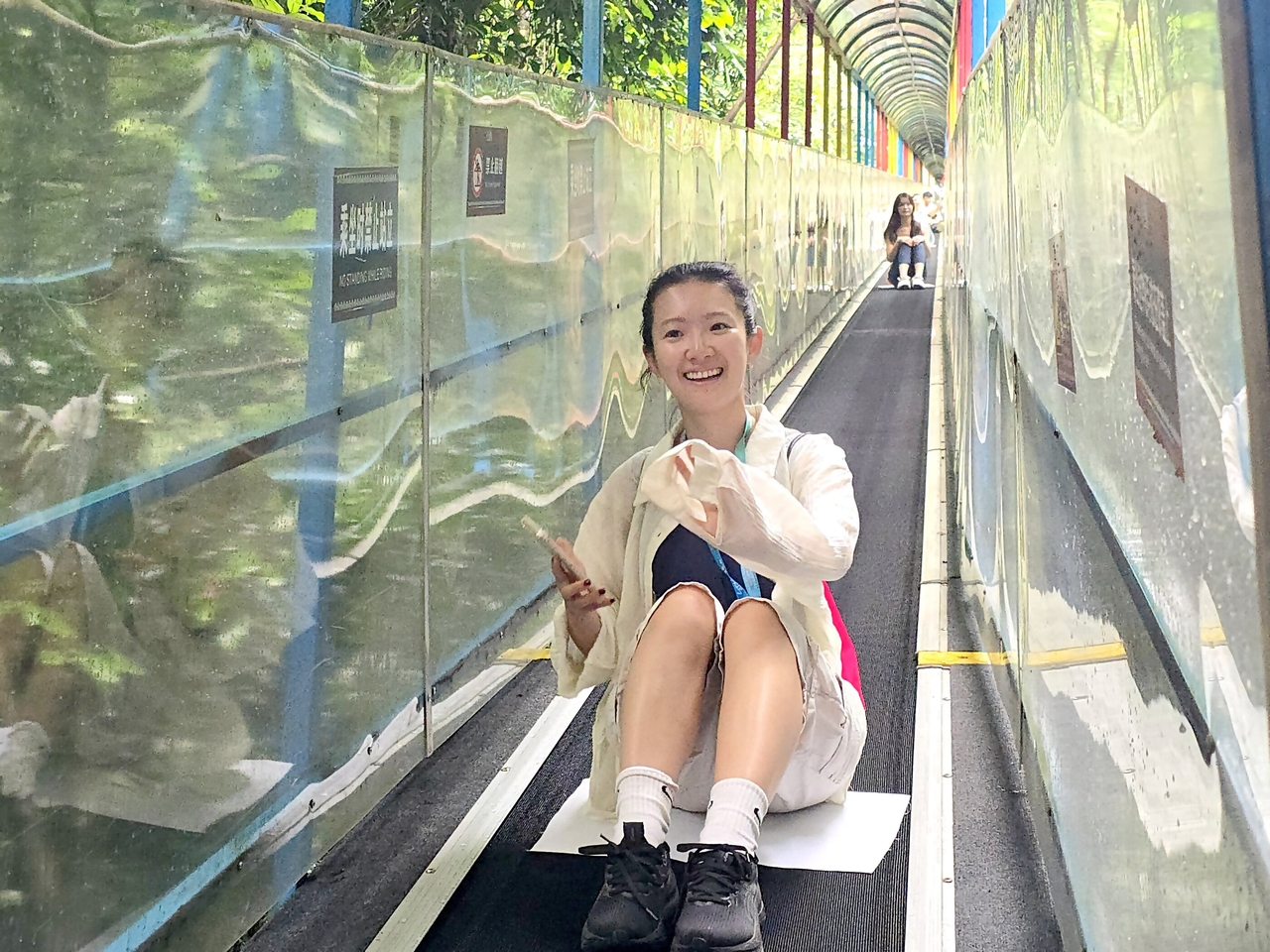
Hiking at Qixianling National Forest Park, tucked in the southern reaches of Hainan — China's southernmost island, often called the "Hawaii of the East" — does not require standing up.
The park sits about an hour and 40 minutes north of Sanya, a coastal city on Hainan's southern shore.
Hainan has long drawn Korean visitors with its golf courses, ocean leisure activities, distinctive culinary culture and warm hospitality. Qixianling adds yet another dimension to the island's appeal.
Just as mountains account for much of the charm of Hawaii and Jeju, Qixianling beckons as a destination for exploration and adventure deep inside a tropical rainforest.
At the park — known in Korean as Chilseonnyeong National Park — visitors begin with a gentle walk suitable for all ages before encountering one of the world's most unusual hiking experiences: ascending the mountain while seated.
The park inspires a sense of goodwill and the quiet hope that one's health will improve simply by being there.
Hainan shares its name with South Korea's own Haenam — the county at the tip of the Korean Peninsula — lending the island an immediate familiarity for Korean visitors. Adding to that warmth, the Miao and Li ethnic minority communities living near the park share historical ties with Korea. Research papers published in both China and South Korea trace how these groups migrated southward into Guizhou, Yunnan, Hunan, the Zhuang Autonomous Region, Hainan, and the northern reaches of Vietnam, Thailand and Myanmar after the fall of Goguryeo and Baekje to the Silla-Tang alliance.
The park's official Chinese name — Qixianling Hot Spring National Forest Park — includes the word "hot spring," a fitting signal that this is a place dedicated to health and well-being.
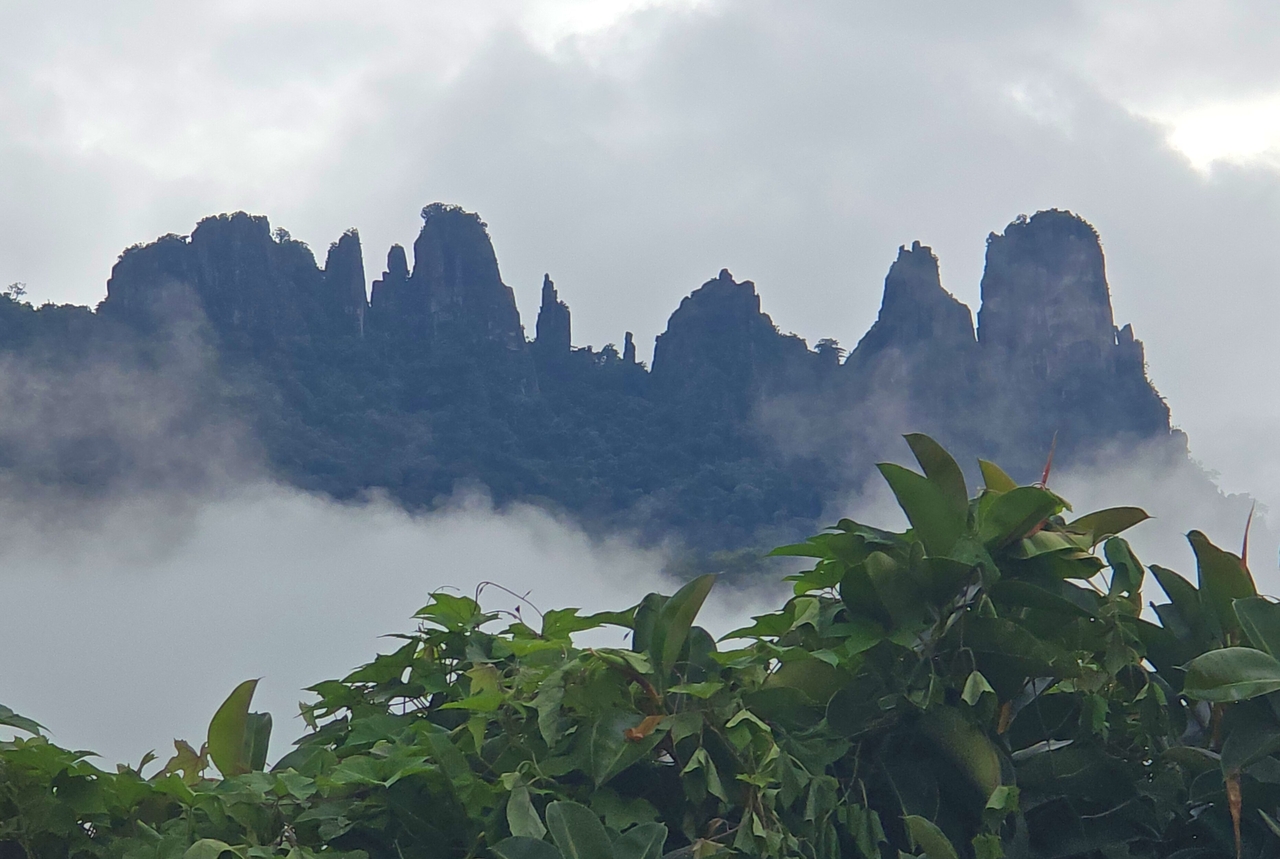
From the parking lot, visitors can already see the jagged rock formations at the summit, said to resemble seven fairies chattering among themselves. The shy celestial maidens occasionally drape themselves in cloud silhouettes or vanish behind white veils, only to reappear — playful and vivid — just when a visitor's patience runs out.
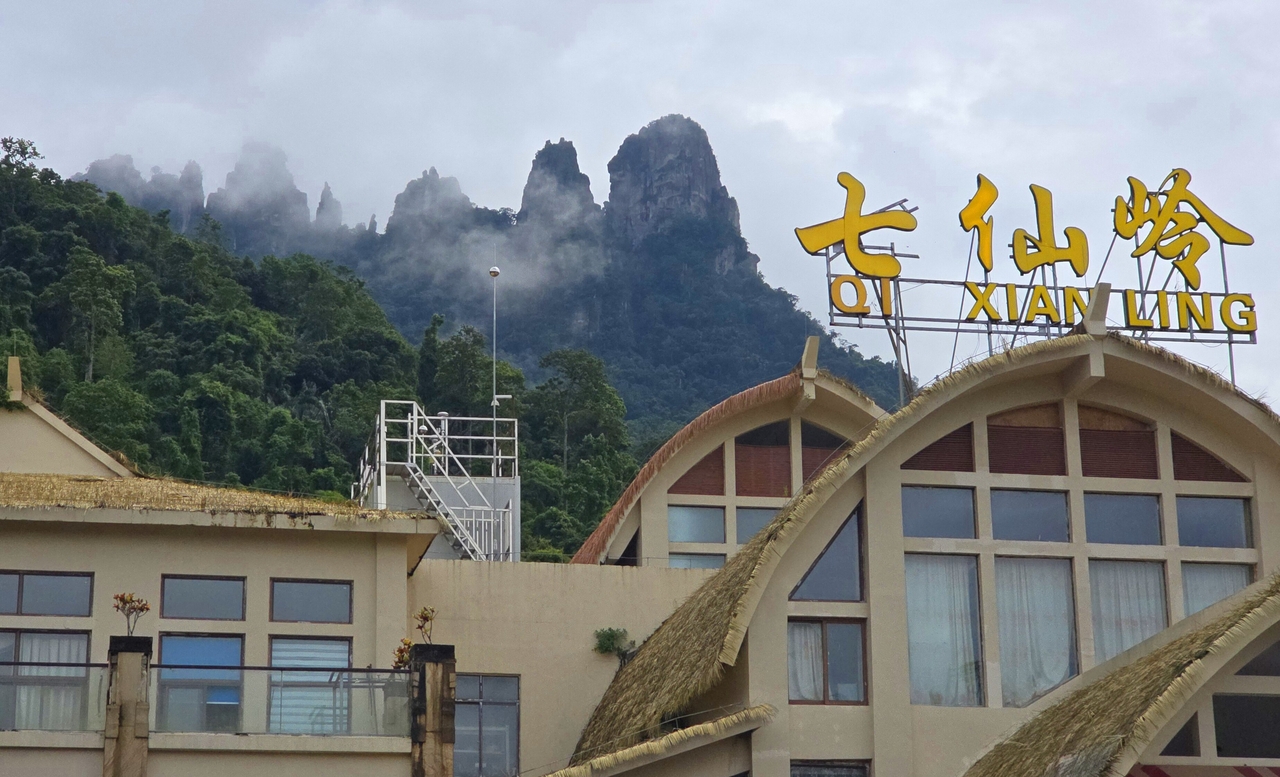
Past the grand boat-shaped entrance gate, the mountain disappears from view and the lush jungle takes over, its living inhabitants seemingly reaching out to greet every passerby.
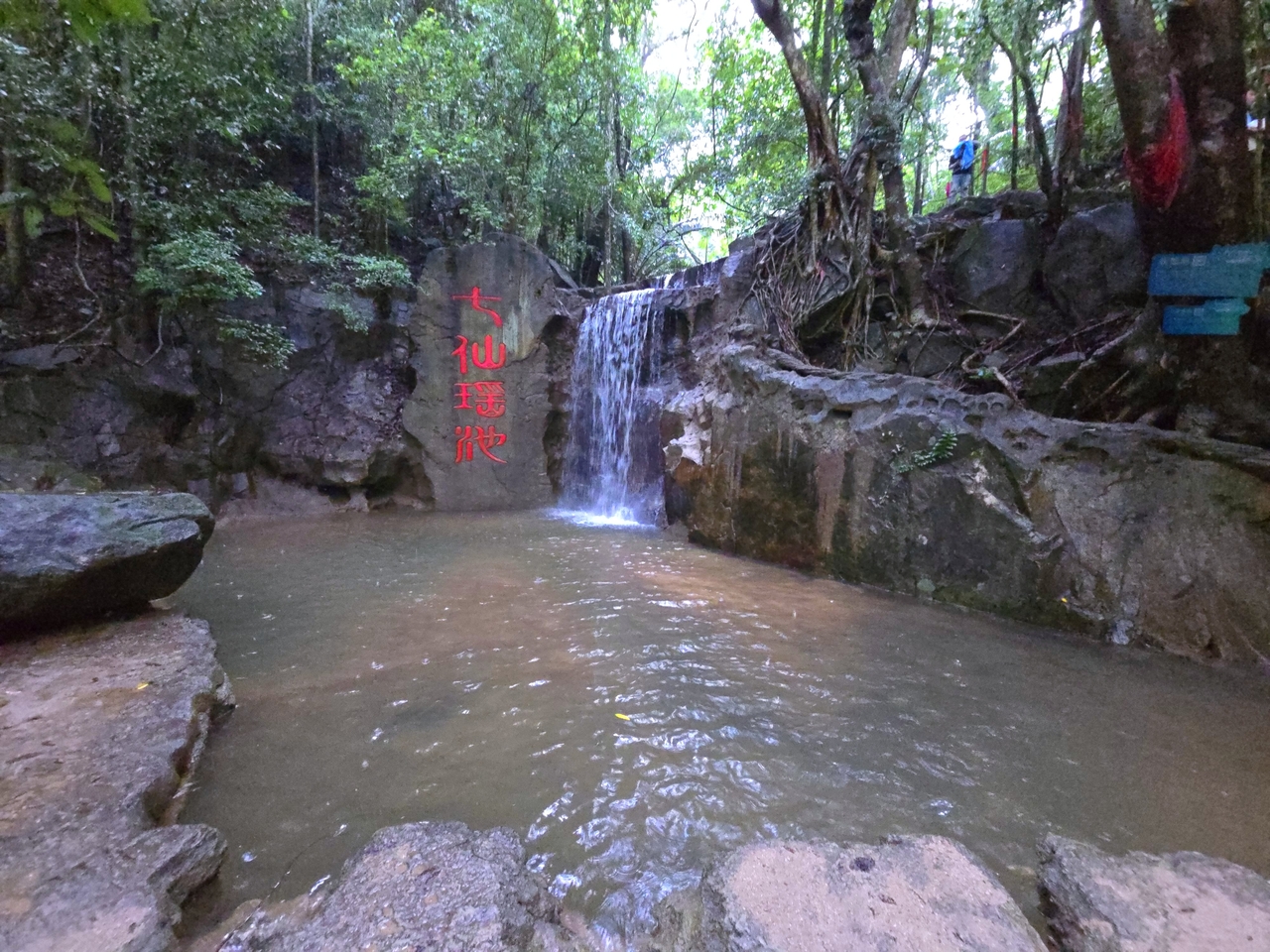
Enormous tropical plants — their leaves dwarfing even the giant Victoria water lily — line the path like imperial fans, while the Qixian Yaochi, a crystalline pool fed by a waterfall, refreshes the spirit of every hiker who passes.
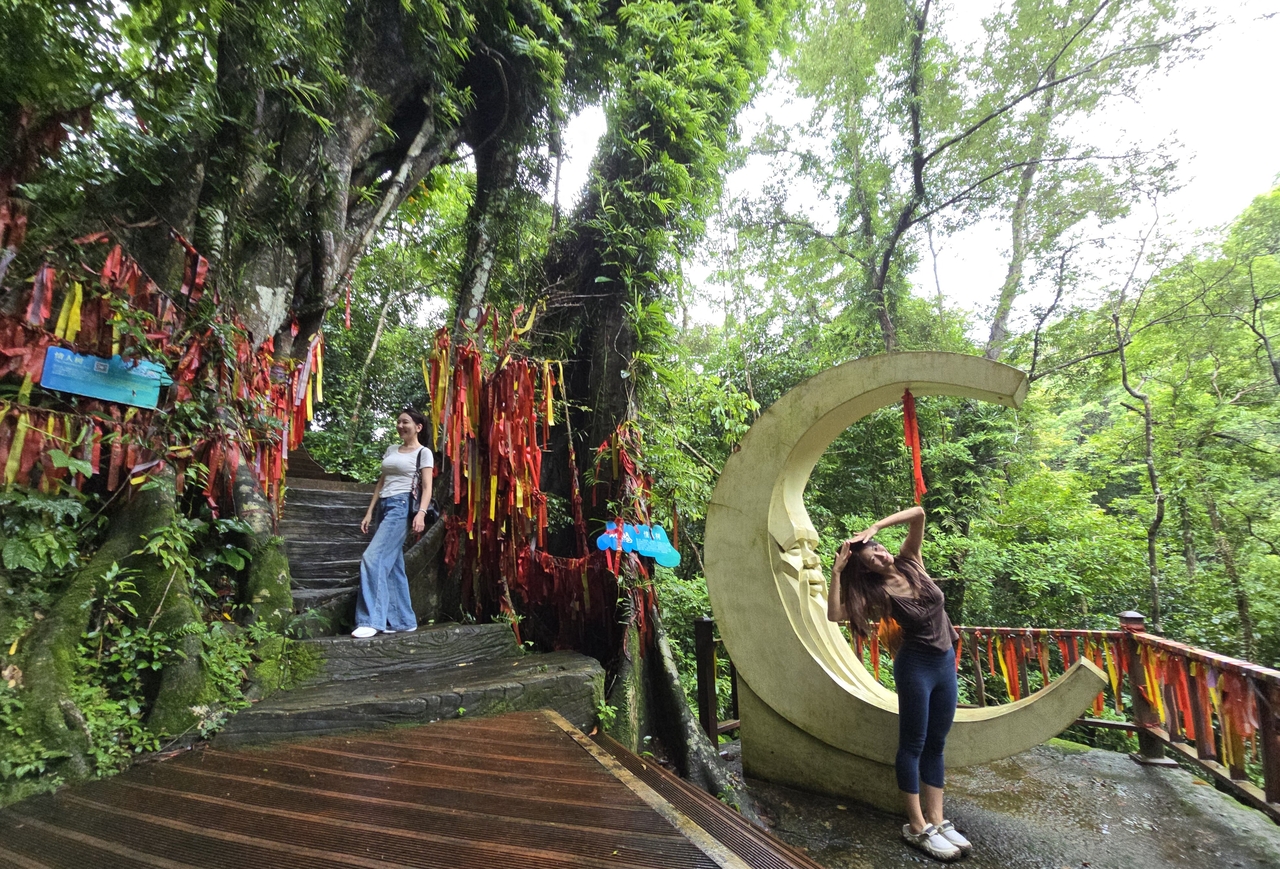
Two massive trees grown together into a single form, known as the Lover Tree, have a disarming effect: even the most stoic hiker tends to soften at the sight.
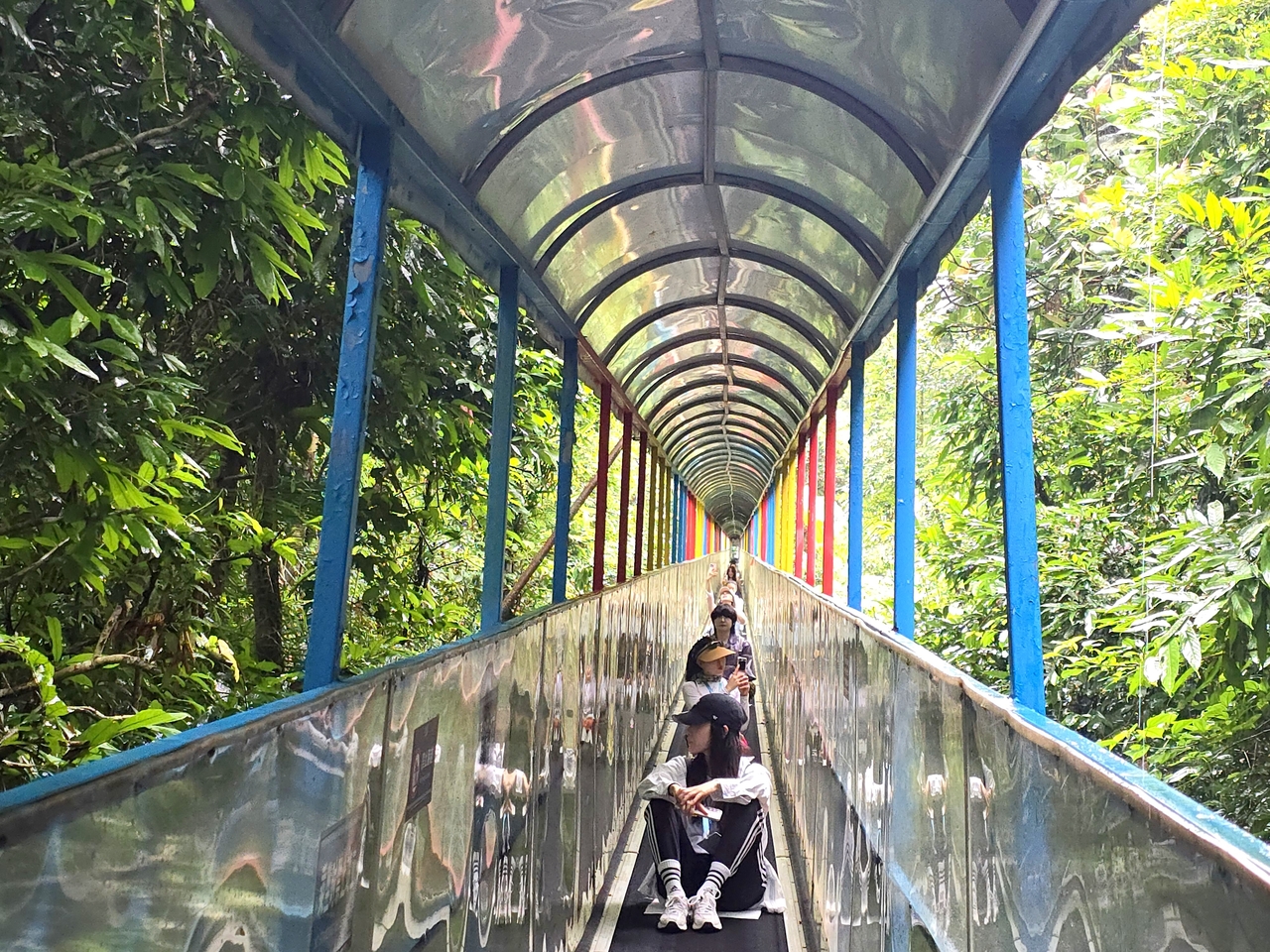
The routes to the summit platform at 1,126 meters above sea level are varied. Just when a visitor who loves the mountain but finds a long trek daunting is ready for a rest, the Qicai Yunji — whose name means "seven-colored cloud thrones" — comes into view, offering the park's signature seated ascent.
Under an arched frame roughly 2 meters tall and 1 meter wide, a moving-seat conveyor belt carries visitors safely up the mountain. Riders sit facing downhill — back toward the summit — with legs stretched out or tucked in, settling into a stable, comfortable position. The belt moves at roughly the same pace as a standard airport moving walkway.
The Qicai Yunji operates as a one-way uphill option and covers about 60 percent of the total trail. It is divided into four segments: the first ends at the 500-meter mark, the second at 850 meters, the third at 1,300 meters and the fourth at 1,800 meters. Visitors can ride only the first half — up to 850 meters — or take the full ride to the 1,800-meter terminus (measured along the trail, not by elevation).
Conventional hiking follows the trail upward in the natural direction of travel, but the Qixianling seated ascent runs in reverse — riders face downhill as they rise. Trees lean in through the arch frame on either side, forming a vast green tunnel that gives the sensation of being pulled into a mysterious emerald passage, much like Alice tumbling into Wonderland. The Qicai Yunji operates from 8:30 a.m. to 5:30 p.m.
After disembarking at the 1,800-meter terminus, visitors walk only about 260 meters before rejoining the main hiking trail.
The path continues through the atmospheric Guanyin Cave valley before reaching the summit area known as Yunshan Tianjie — "a cloud-draped mountain touching the boundary of the sky" — where clouds drift in and out in an ever-changing display.
At times the summit feels like a Swiss alpine peak such as Rigi, swathed in mist and seemingly lifted into a celestial realm. When the clouds clear, the view stretches over countless villages and valleys far below, filling the visitor with a quiet sense of triumph.
The descent passes back through Guanyin Cave, then continues past Xiannu Pavilion — said to be a resting spot for fairies and immortals — through Fulin Valley, where dense forest stands guard over a clear mountain stream, past the Lover Tree, and on to a field of massive boulders reminiscent of the rock formations along Korea's Donghae coast, before reaching a pavilion set against strikingly white soil near the entrance.
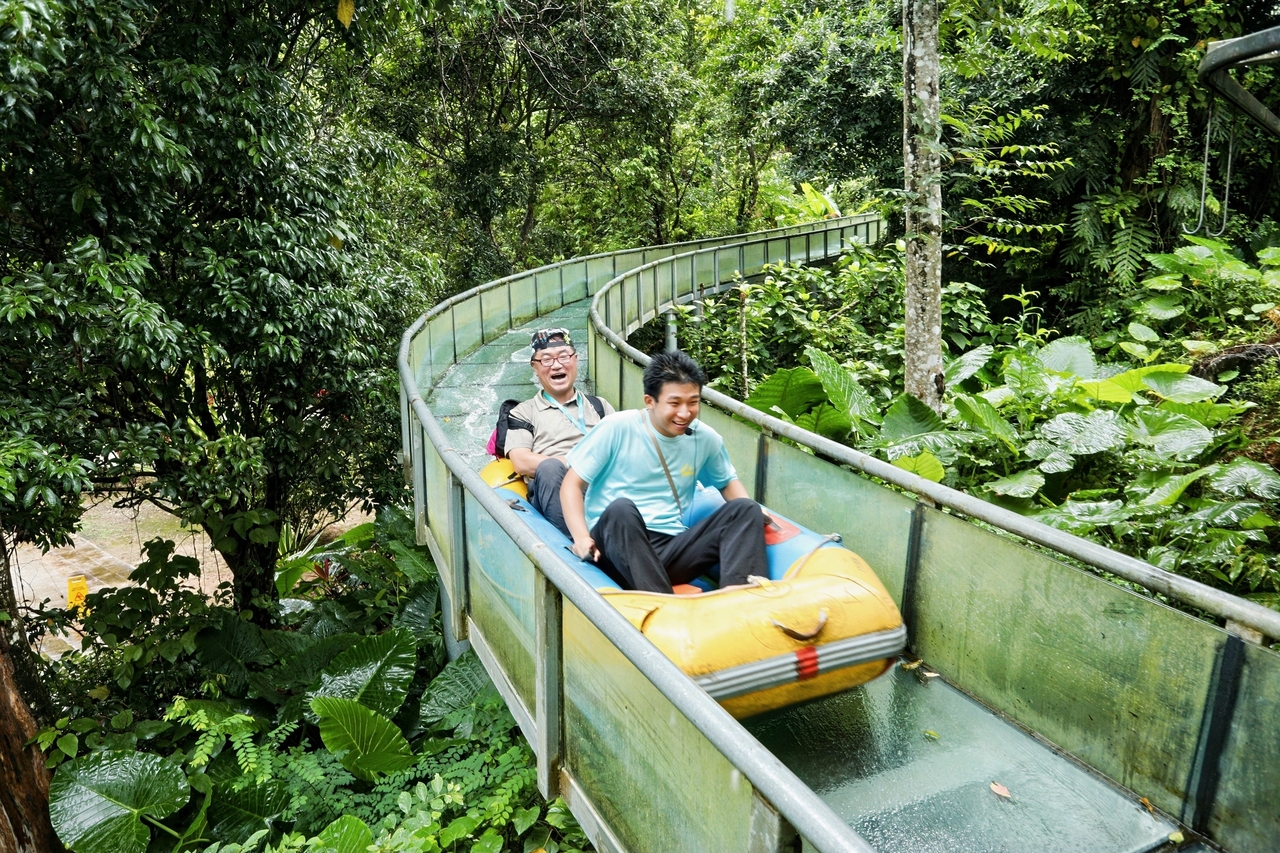
Shortly after passing the Lover Tree and the Qixian Yaochi waterfall on the way down, another thrilling seated activity awaits — one that sends visitors flying off the mountain in style.
There is no boatman in sight, yet boats have made their way up the mountain. Not far from the Qixian Yaochi, a stack of two-person vessels sits waiting.
The attraction — an aerial glass drift ride — channels water through a transparent U-shaped aerial waterway and sends two-person boats gliding down it all the way to the trailhead below.
The course winds in S- and O-shaped curves, delivering a rush of speed. The channel is engineered with enough precision that even the sharpest bends produce almost no splashing.
Attempting to take photos with a phone on board is strongly discouraged — a dropped device means losing every memory of the day. A better approach is to ask the group just ahead to snap a photo, then return the favor when they come down.
The park also offers a 1,200-meter jungle slide that sends riders hurtling through the forest at speed, as well as bare-handed rock climbing up sheer cliff faces near the summit.
Korean fairy-tale heroines tend to suffer — one famously became a woodcutter's wife after losing her heavenly robe, while another endured punishment for mischief before being exiled to shape Jeju Island as an earthly goddess. The fairies of Qixianling, by contrast, seem to have specialized in having a very good time.
Surveying the park's many activities and varied charms, one cannot help but conclude that Hainan's seven fairies must have been a remarkably cheerful bunch.
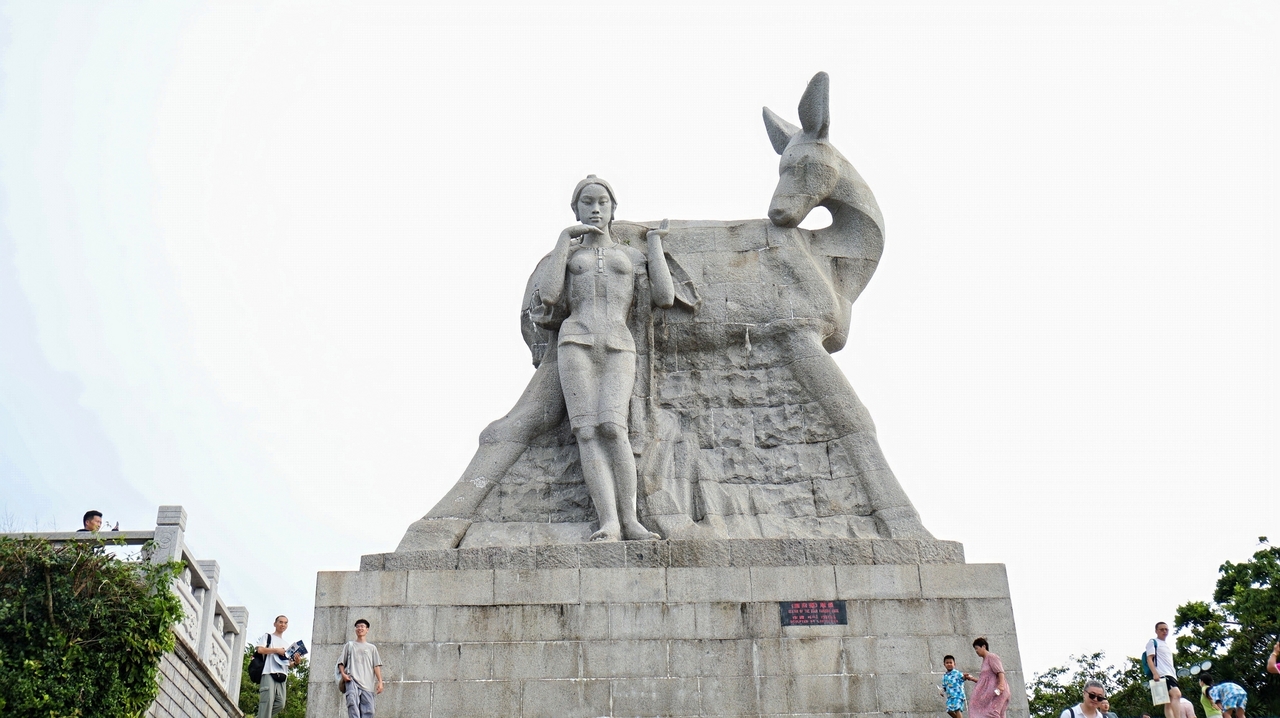
In Sanya, the southernmost city of Hainan Province, a different legend awaits: the story of a deer fairy who fell in love with a hunter and endured a turbulent fate. What sorrow does she carry — so unlike the spirited seven of Qixianling? The Hainan travel series continues.
abc@heraldcorp.com