![A Seoul production of "Tannhäuser" by the Korean National Opera, directed by world-renowned opera director Yona Kim [Korean National Opera]](https://wimg.heraldcorp.com/news/cms/2026/08/08/news-p.v1.20260808.93564ed348704dc89b1c0392013b3bf8_P1.jpg)
Scene one: Elisabeth, her white robes billowing — every fold a testament to purity and nobility. In the sacred world of Wartburg, she believes in love, atones for sin and ultimately gives her own life to redeem a man. Then there is another woman, far away in the Venusberg. That is the realm of Venus, the archetypal femme fatale — a world of flesh, desire and pleasure, a woman who satisfies a man's every craving and holds him captive. The man straddles both worlds, torn and tormented as he moves between them. (From "Tannhäuser")
Scene two: Brünnhilde, on horseback, leaping into a blazing funeral pyre. Is she a passive sacrificial victim offered up for a man's salvation — or the hero who ushers in a new age? She casts off the divine status of the Valkyrie, once merely a passive instrument of her father Wotan, and with her own hands burns down the world of contracts stained by the arrogance, greed and lust for power of the male gods. Her voice, soaring from the highest register, brings Valhalla crashing down and returns the ring — symbol of greed — to the primal nature of the Rhine. (From "Der Ring des Nibelungen")
Wagner, who has thrilled opera fans in Korea this summer, was in truth a deeply problematic human being. Music lovers, conductors and directors adore the richness and variety of his operas, yet when it comes to Wagner the man, they tend to look the other way — on account of his tangled private life.
From "Tannhäuser" to "Der Ring des Nibelungen," Wagner's view of women underwent a dramatic transformation. He had long and consistently portrayed the brutal madonna-whore dichotomy that the 19th century imposed on women — yet in "Götterdämmerung," the grand finale of his life's masterwork "Der Ring des Nibelungen," he shatters it entirely. Could any single artist's universe contain so dramatic an evolution in the portrayal of women?
His works are shot through with the desires, betrayals and brutal romantic history of Richard Wagner (1813–1883) — a man of genius and contradiction in equal measure. It is a story of musical revolution achieved by a selfish composer who exploited the wives who shared his life and the wives of his patrons as emotional and financial instruments.
Jaap van Zweden, music director of the Seoul Philharmonic Orchestra and a Wagner specialist who recorded the complete "Der Ring des Nibelungen" cycle with the Hong Kong Philharmonic, said Wagner was "a composer who draws you in and makes you experience his music as if you are part of it." "With Wagner's music," he added, "you either love it or you hate it — there is no middle ground."
Wagner the 'problem man' and his ruthless way with women
Few figures in history display so vast a gulf between artistic genius and personal moral failure as Wagner. On stage he sang passionately of the redemption of man and the world; offstage he was an extreme egotist. His extravagance knew no bounds, and he fed his art by destroying the lives of those around him — the women he passed through most of all.
In 1836, the 23-year-old Wagner married Minna Planer, an actor three years his senior. Their life together was anything but smooth. From the very beginning their relationship was a succession of discord and misfortune. During their Paris years, crushing poverty had creditors at their heels and the couple moving from one rented room to the next. Minna managed the household and endured Wagner's artistic obsessions. It was during this period that he produced "The Flying Dutchman," "Tannhäuser" and "Lohengrin."
Wagner and Minna looked in opposite directions: he dreamed of the heavens while she kept her feet on the ground. Her painful devotion was routinely ignored. Wagner embroiled himself in scandals with women from prominent families. Even so, when Wagner became a wanted man after the failed Dresden uprising and fled in the night to Zurich, Minna went with him.
The man who rescued the exiled Wagner in Zurich was Otto Wesendonck, a wealthy textile merchant. Wesendonck gave Wagner a comfortable cottage beside his own villa and provided generous financial support. Wagner repaid him with betrayal, entering into an affair with Wesendonck's beautiful and intellectually accomplished wife, Mathilde Wesendonck.
The liaison was intoxicating. Blinded by his forbidden love for Mathilde, Wagner exchanged secret letters with her at the cottage — until his wife Minna discovered them. The episode survives in history as the shameful "Zurich scandal." To Wagner, Mathilde was a source of inspiration he had to possess even at the cost of wrecking other people's lives. The affair became a central inspiration for the opera "Tristan und Isolde."
![A Seoul production of "Tannhäuser" by the Korean National Opera, directed by world-renowned opera director Yona Kim [Korean National Opera]](https://wimg.heraldcorp.com/news/cms/2026/08/08/news-p.v1.20260808.1586a88f29f74935a8986951bd663496_P1.jpg)
The most fatally destructive affair of Wagner's life was his relationship with Cosima von Bülow — daughter of Franz Liszt and wife of conductor Hans von Bülow. Of all Wagner's romantic entanglements, this one drew the most fierce moral condemnation.
Bülow was Wagner's loyal disciple and ally, the man who had devoted himself body and soul to the premieres of "Tristan und Isolde" and "Die Meistersinger von Nürnberg." Wagner showed no regard for that bond. Even as Bülow stood on the podium conducting his works, Wagner carried on an affair with Bülow's wife Cosima — living under Bülow's roof and fathering three children with her. Wagner ultimately took Cosima for himself and remarried, driving a wedge between himself and his mentor Liszt in the process.
Throughout his life, women were for Wagner nothing more than emotional consumables to replenish his artistic inspiration and financial refuges to shelter him. The inner world of this selfish and dissolute man was transmuted into the artistic motif of male redemption through female sacrifice. Wagner, who had ruined the lives of others to satisfy his own desires, bestowed upon the male protagonists of his operas the gift of sacrifice by pure and noble women. He was a man of contradiction — one who sought aesthetic absolution for the moral guilt of having destroyed lives in the name of art.
When Wagner changed women, a masterpiece was born
For Wagner, love and marriage were the catalysts for a harmonic revolution that transformed the course of Western music. Each new romance, marriage or affair produced works of enduring greatness.
The years with his first wife, Minna Planer, represent Wagner's early period. "The Flying Dutchman," "Tannhäuser" and "Lohengrin" all emerged during this time, built on a foundation of traditional diatonic harmony and solid formal order. In these works Wagner pressed hard on the classic binary opposition — saint versus seductress, faithful wife versus femme fatale, chaste woman versus desiring woman. They are works deeply saturated with the patriarchal outlook of the 19th century.
![The Korean National Opera's production of "Tristan und Isolde" [Korean National Opera]](https://wimg.heraldcorp.com/news/cms/2026/08/08/news-p.v1.20260808.d1c10996676d4f7890834f949cd56af3_P1.jpg)
This is why the novelist Thomas Mann wrote in his 1933 essay "Sufferings and Greatness of Richard Wagner" that "two extreme faces coexist in Wagner's view of women — sensual eroticism and ascetic redemption" and that "within his aesthetic, it is always the great feminine archetype that redeems man and the world."
Senta in "The Flying Dutchman" is a heroine who feels a fated love for the cursed captain she sees in a portrait. She throws herself into the sea to save him — a woman who appears passive yet chooses a transcendent destiny entirely of her own will.
The dichotomy in "Tannhäuser" between Elisabeth and Venus is even more extreme. Venus, embodying carnal pleasure, and Elisabeth, embodying spiritual purity, stand in absolute opposition. Tannhäuser's sin of yielding to the seductress is redeemed only through Elisabeth's death.
In "Lohengrin," Elsa and Ortrud pose the forbidden question: "What is your name, and where do you come from?" Unlike Elsa, who brings tragedy upon herself, Ortrud — armed with pagan sorcery and political ambition — defies the patriarchal order, making her one of the most powerful villains in Wagner's work and one of his most autonomous female types.
Within his operas, Wagner conceived of women as agents who choose for themselves, and he used those characters as musical seeds. In "The Flying Dutchman," Senta's ballad condenses the motifs of the sea, the curse and redemption. That musical material spreads through the entire opera, binding the work into an organic whole. Yet the conclusion — that a woman's death redeems a man — does not change.
The affair with Mathilde Wesendonck during the Zurich exile marks Wagner's middle period. In the grip of forbidden love, he unleashed the greatest harmonic revolution in the history of opera.
His female characters changed too, shaped profoundly by the precariousness of that love. The women in his operas no longer confine themselves to the role of saintly absolver of male sin. Freed from the binary framework, they desire, rage, command and choose. They boldly cast aside social convention and define the meaning of love on their own terms.
![A Seoul production of "Tannhäuser" by the Korean National Opera, directed by world-renowned opera director Yona Kim [Korean National Opera]](https://wimg.heraldcorp.com/news/cms/2026/08/08/news-p.v1.20260808.0a4efd452a704859a4643d7e958e7bad_P1.jpg)
Sieglinde in "Die Walküre" begins as a tragic figure violated by patriarchal violence, but the moment she carries Siegfried in her womb she gives rise to the most radiant love-redemption motif in all of Wagner's operas.
While deep in that dangerous love, Wagner set five poems by Mathilde to music, composing the "Wesendonck Lieder" for soprano. Two of the songs — "Im Treibhaus" (In the Greenhouse) and "Träume" (Dreams) — read almost as preliminary sketches that rehearse the core musical motifs of "Tristan und Isolde." The opera grew directly from them.
The opening bar of the Act I prelude — the famous Tristan chord (F–B–D♯–G♯) — was a revolution that shook the foundations of functional harmony as Western music had practiced it for centuries.
The Tristan chord resists clear explanation within traditional harmonic theory. Dissonance refuses to resolve into consonance; instead it chains endlessly into further dissonance through a succession of modulations. It is a musical embodiment of desire perpetually deferred, never consummated. The Tristan chord, carrying within it the dissolution of tonality, announced both the end of 19th-century Romantic music and the beginning of 20th-century modernism. Debussy's "Prélude à l'après-midi d'un faune," Mahler's "Resurrection" and "Das Lied von der Erde," the kiss scene in Strauss's "Salome" — and the music of Scriabin and Schoenberg — all bear the imprint of the Tristan chord.
The unresolved harmonies drift in uneasy suspension until, in the Act III finale, Isolde's "Liebestod" reaches its final bar and resolves everything — all the anxiety, conflict, crisis and fate — into a perfect tonic chord in B major. At the moment Isolde's desire is fulfilled, the harmonic longing of centuries is quenched alongside it. Yet even here, the female character still moves toward death.
![The Korean National Opera's production of "Tristan und Isolde" [Korean National Opera]](https://wimg.heraldcorp.com/news/cms/2026/08/08/news-p.v1.20260808.0d7a11035c234109b941d4c33fb05202_P1.jpg)
Soprano Nina Stemme said in a 2012 Gramophone magazine interview that interpreting Isolde's "Liebestod" as mere passive sacrifice for a man's sake "is a grave misreading." "It is the most autonomous and powerful musical declaration in opera history," she said, "in which Isolde merges her entire self with the universe through timbre and harmony."
Wagner's most prolific late period coincided with his most scandalous affair. Once he settled with Cosima von Bülow and their son Siegfried was born, the raw and violent musical language of his earlier work took on warmer, more intimate colors.
On Christmas morning 1870, to mark Cosima's 33rd birthday, Wagner secretly assembled 13 chamber musicians on the staircase of their villa at Tribschen in Switzerland and had them perform the "Siegfried Idyll." The piece distilled into chamber music the love duet theme between Brünnhilde and Siegfried from Act III of the opera "Siegfried." It was the most purely tender and intimate musical confession Wagner — a composer who had always pursued the explosive sound of a full orchestra — ever offered to a wife and family.
The female archetypes in his operas became agents who upend myth and history. Eva in "Die Meistersinger von Nürnberg" is nominally the prize in a singing contest, yet within the drama she carves out her own destiny. Kundry in "Parsifal" is the most complex and fractured character Wagner ever created — a subject torn between redemption and temptation.
Mezzo-soprano Waltraud Meier said in a 2003 interview with the American music journal Opera News that "Kundry is the most complete and multilayered woman in opera history." "Wagner gave her a divided self — seductress, servant, redeemed soul," Meier said, "but when a singer performs the music, she becomes the most powerful subject on stage, bearing alone the internal contradictions of the entire drama and shaking the souls of the audience."
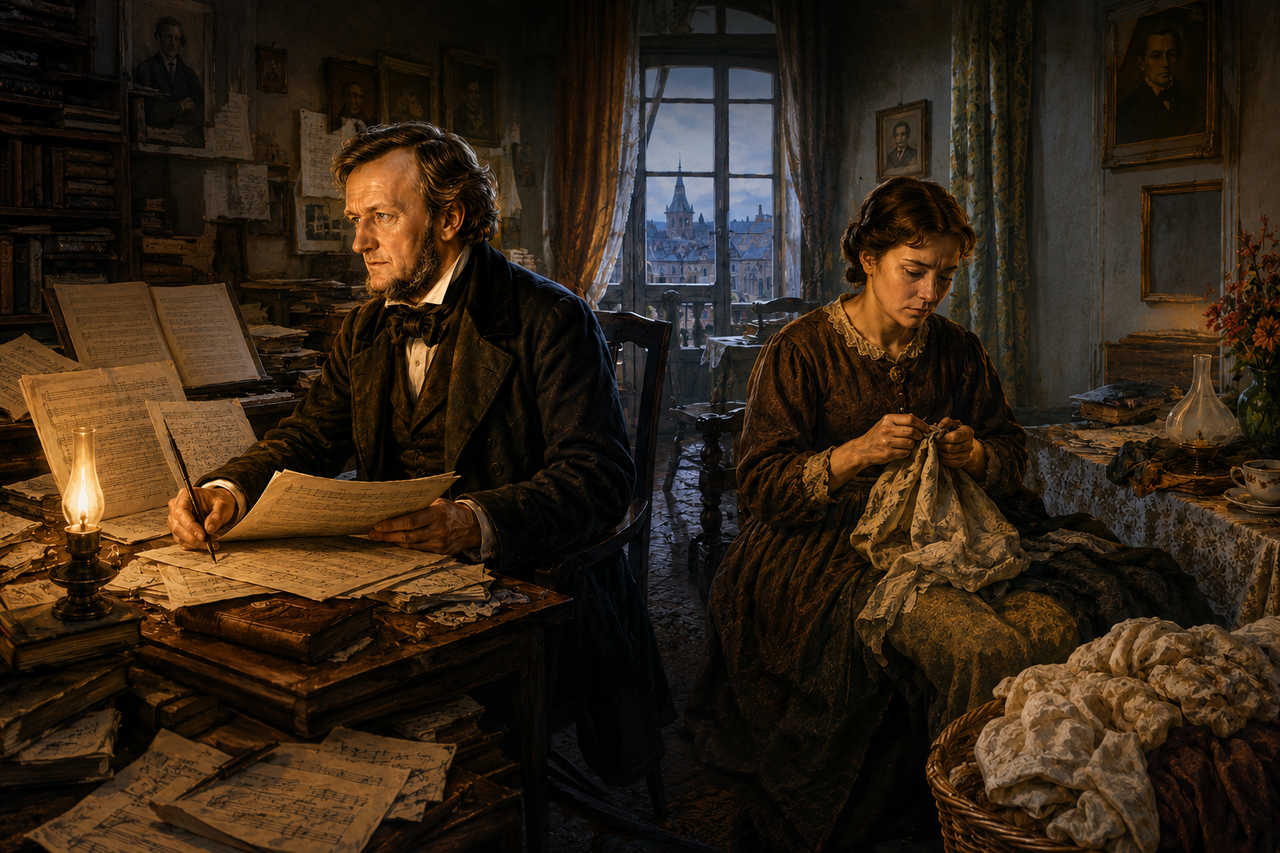
![Wagner and Cosima von Bülow's dangerous love [ChatGPT]](https://wimg.heraldcorp.com/news/cms/2026/08/08/news-p.v1.20260808.af8cd70e412c409996430678d54e61b3_P1.png)
Four women who shattered absolute power in 'Der Ring des Nibelungen'
The women in Wagner's masterwork "Der Ring des Nibelungen" are more complex still. Marking its 150th anniversary this year, "Der Ring des Nibelungen" is on the surface a drama of men's struggle for absolute power — yet the four women at its core are the true driving force of that vast structure.
Wagner worked on the four-part epic from 1848 to 1874, a span of 26 years. He wrote the libretto in reverse order, beginning with "Götterdämmerung" and working back toward "Das Rheingold," while composing the music in forward order from "Das Rheingold" through to "Götterdämmerung." The cycle comprises the prologue "Das Rheingold," followed by Day One "Die Walküre," Day Two "Siegfried" and Day Three "Götterdämmerung." Pure performance time runs to about 15 hours; attending the full cycle takes upward of 17 hours.
The stage is set beneath the Rhine, in an age before the gods' palace, before heroes, before war. In the depths of the river, the Rhinemaidens guard their gold. Whoever forges a ring from that gold will seize absolute power — on one condition: the renunciation of love. From that premise — "abandon love and you may have power" — the 14-hour epic unfolds.
The women who appear along the way are compelling. The Rhinemaidens embody a primal natural state before civilization. The earth goddess Erda devastatingly exposes the limits of Wotan's patriarchal power. In Act II of "Die Walküre," Fricka takes her place as a legal subject who breaks the arrogance of the patriarchal tyrant. Sieglinde is trapped within male violence yet chooses love by breaking through patriarchal oppression.
![Key scenes from "Der Ring des Nibelungen" [ChatGPT]](https://wimg.heraldcorp.com/news/cms/2026/08/08/news-p.v1.20260808.3269fd0d77ee4601bb3a788159a0bc3d_P1.png)
Brünnhilde — the true protagonist of "Der Ring des Nibelungen" — spends her existence obeying her father Wotan's commands until she witnesses genuine human love and confronts an ethical awakening. She slips the ring forged from men's greed onto her finger, rides into the funeral pyre, extinguishes the world of the gods and purifies the earth, becoming the hero who opens a new age.
Soprano Birgit Nilsson once said that what a singer needs most to perform Brünnhilde is "comfortable shoes and a voice of steel." But more important than vocal technique, she emphasized, is understanding that Brünnhilde is "the true hero of 'Der Ring des Nibelungen' — the one who ends, with her own hands, the world of greed and arrogance that the male gods created."
'Vocal authority' that overpowers the patriarchal text — are women merely sacrificial victims?
The female characters in Wagner's operas have provoked fierce debate across generations. Catherine Clément, in her book "Opera, or the Undoing of Women," described opera as "a patriarchal machine that destroys women."
Wagner's operas are no exception, in this reading. Senta, Elisabeth, Isolde, Brünnhilde and the women who follow them are seen as sacrificial victims who must die either for violating patriarchal norms or for washing away a man's sins. Wagner's glorious music, the argument runs, emotionally anaesthetizes the audience into mistaking these women's unjust deaths for beautiful art. Eva Rieger similarly argued that "Wagner imprisoned his female characters within stereotypes to serve his own self-centered vision of redemption."
![Elisabeth in the Korean National Opera's production of "Tannhäuser" [Korean National Opera]](https://wimg.heraldcorp.com/news/cms/2026/08/08/news-p.v1.20260808.1233b02e869947f6a1afdbb804e0f4f0_P1.jpg)
Second-wave feminist musicologists, however, rebuffed readings that stop at the surface narrative. Nila Parly, in her book "Vocal Victories," argues that the heart of Wagner's music lies in "the singing voice of the performer on stage." The most innovative and avant-garde musical language in Wagner's operas — the Tristan harmony, the endless melody, the love-redemption motif — emerges without exception from the mouths of female characters, which means those characters are not merely peripheral figures or sacrificial victims.
Even when the libretto appears to sacrifice a woman, the argument goes, the powerful voice of the female singer — cutting through the full stage and an orchestra of more than 100 — commands the entire space and exercises a "vocal authority" that overpowers the patriarchal text. Parly concludes that "women are not victims; through music they are the true subjects who govern the entire drama."
Harvard musicology professor Carolyn Abbate advanced the same concept of "vocal authority" in her book "Unsung Voices," writing that "even when the text of the libretto speaks of a woman's destruction, the soprano's vocal authority on stage dominates the sonic space of the vast orchestra and overwhelms the patriarchal narrative."
The view of women projected onto Wagner's operas is a complex product of the historical limitations of 19th-century patriarchal society, the composer's inner world and his artistic intuition. From Senta's ballad in "The Flying Dutchman" to Isolde's Tristan harmony in "Tristan und Isolde" to Brünnhilde's musical journey in "Der Ring des Nibelungen," the arc runs parallel to the process by which Western music broke free of the constraints of harmonic theory and entered modernity.
Conductor Daniel Barenboim said in his 2002 book "A Life in Music" that "Wagner's music transcends the 19th-century social text written in the libretto." "The female characters on stage are not appendages of men," Barenboim said. "The deepest harmonies of the Wagner orchestra translate the psychology of the female characters and elevate them into philosophical subjects who drive the tragedy and redemption of the world."
shee@heraldcorp.com