Unification Minister Jung Dong-young said Friday that referring to North Korea by its official name — the Democratic People's Republic of Korea, or Joseon — is "not something the Ministry of Unification should drive on its own" and that public debate must come first. The remarks came two days after President Lee Jae Myung urged caution on the policy, signaling a deliberate slowdown.
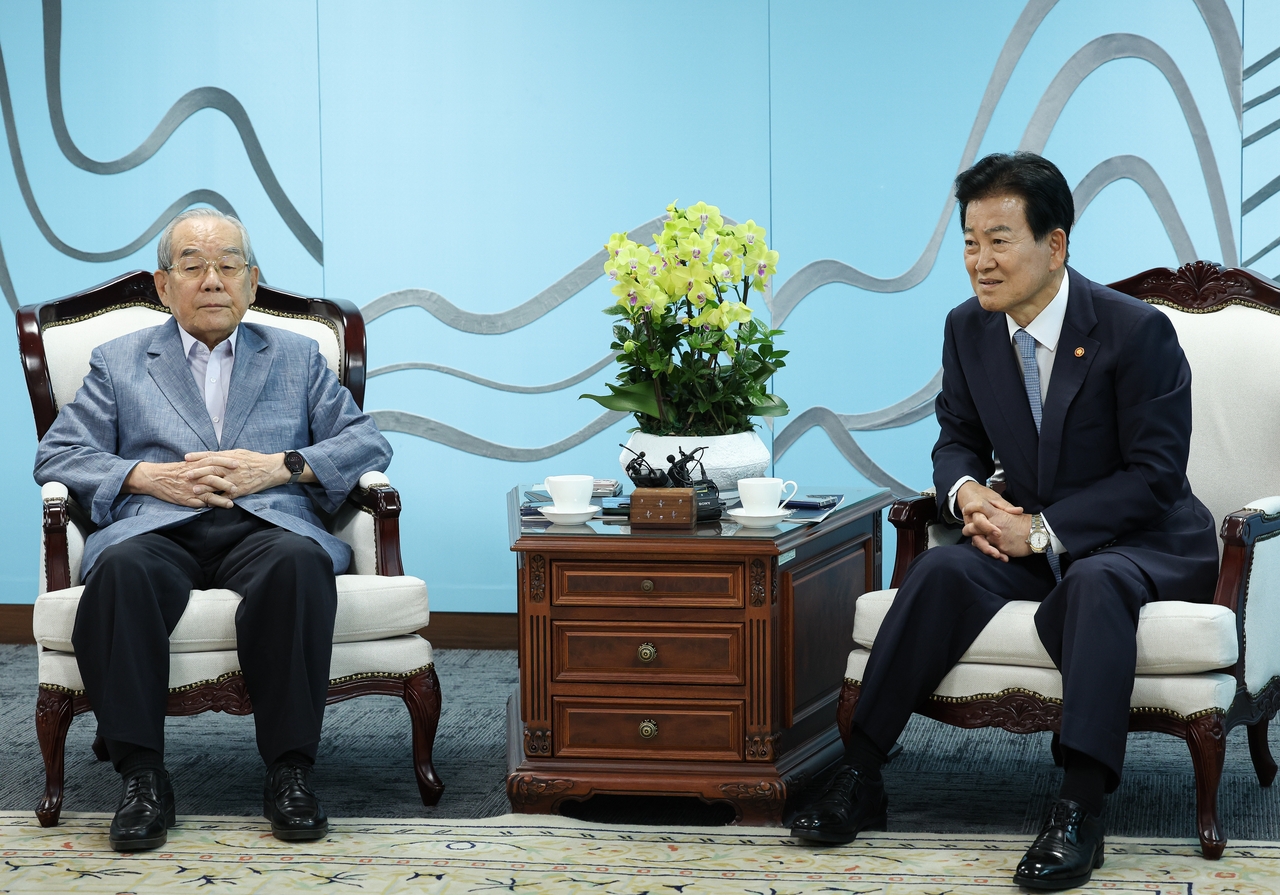
Speaking at a tea gathering with senior advisers from the Peace and Unification Advisory Council at Government Complex Seoul, Jung said a key phrase had been left out of earlier coverage of his ministry briefing. "The part where I said we would proceed only after public deliberation was omitted, making it look as though the ministry had already set its course," he said. "I explained that public debate and the maturation of public opinion would come first, and I would like that to be corrected."
The Ministry of Unification had presented the use of North Korea's official name as the "first step" of its Korean Peninsula peace-coexistence initiative during a presidential briefing on Wednesday, framing it as a practical measure to promote mutual respect and reciprocal cooperation between the two Koreas. President Lee responded with a warning. "If the wording gives opponents a handle to drag this into political conflict, the outcome could actually be worse than doing nothing," he said. "This needs careful thought."
The ministry has since emphasized that the government does not intend to lead the adoption of the name itself, but rather to support a public deliberation process driven by senior figures and civic groups.
Friday's gathering was attended by Paik Nak-chung, professor emeritus at Seoul National University; former Unification ministers Lee Jae-jeong, Lim Dong-won and Jeong Se-hyun; Im Heon-yeong, director of the National Museum of Korean Literature; and Ham Se-ung, chairman of the An Jung-geun Memorial Foundation. The senior figures broadly expressed support for switching to the name "Joseon" when referring to North Korea.
Lim Dong-won, who served as unification minister under President Kim Dae-jung, noted that inter-Korean agreements adopted since the 1991 Basic Agreement on Inter-Korean Relations have consistently used both "Republic of Korea" and "Democratic People's Republic of Korea" in their text. "Using the word Joseon may feel like something new, but it is not at all," he said. "We need to change how the public thinks about this."
Jeong Se-hyun, who held the unification portfolio under both Kim Dae-jung and Roh Moo-hyun, said more than 100 inter-Korean agreements signed since 1991 already use the official name. "We have been writing it that way in documents all along, and now we are simply saying let's also say it out loud — why is there so much fear about that?" he said.
Paik Nak-chung cited the precedent of former President Roh Tae-woo, who referred to North Korea as the "Democratic People's Republic of Korea" in a UN General Assembly address during his tenure. "This is a longstanding tradition," Paik said. "We are not talking about using a nickname — refusing to do even this is nothing short of saying we want to fight."
Jung acknowledged the difficulty of the broader situation. "We have been trying for the past year, but the North remains as unyielding as ever," he said. "We are working hard to open an era of peaceful coexistence where both sides can win, but even the narrowest opening remains blocked — it is deeply frustrating."
psj@heraldcorp.com