Falling births expose limits of core education business, forcing diversification
Woongjin targets AI platforms, Kyowon expands into funeral services, Daekyo eyes senior care and care food
Firms race to build new revenue streams in lifelong learning, corporate training and healthcare
"If the number of children falls, education companies must change too."
As the school-age population shrinks in earnest, South Korea's education companies are scrambling to find new revenue beyond their core workbook and textbook businesses. From AI education platforms to funeral services, senior care and specialized food for the elderly, these firms are racing to reinvent themselves — transforming from "education companies" into "lifestyle service companies."
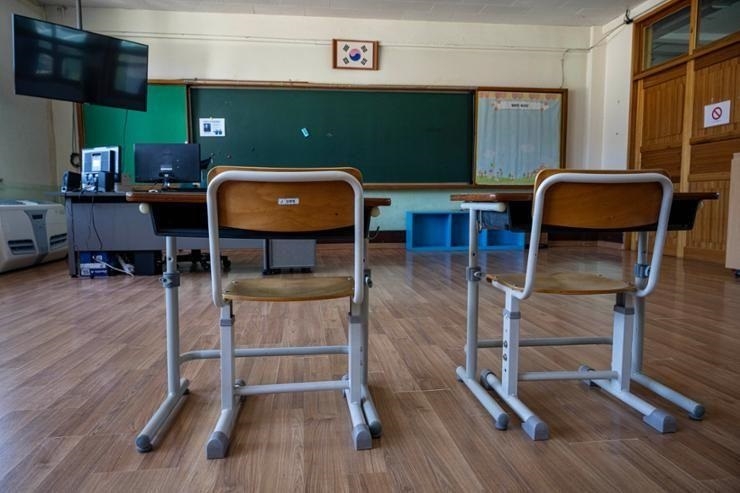
According to the Ministry of Statistics (formerly Statistics Korea), the number of births stood at about 250,000 in 2025, less than half the 640,000 recorded in 2000 — a drop of more than half in roughly two decades. In effect, only about four children are born today for every 10 born in 2000. With the student population in long-term decline, a growing consensus has taken hold across the education industry: relying solely on workbooks and study guides is no longer a viable path to growth.
Woongjin has moved most aggressively. The company has been pushing into the business-to-business market through its corporate AI education platform Woongjin SkillOne, which offers training for the AI Certification for Everyone (AICE) qualification and customized AI education content for corporate clients. It is also building a structure that allows third-party content providers to list their offerings on the platform and generate revenue. The shift marks a clear pivot from student-focused workbooks toward corporate education platform services.
Kyowon is widely cited as a leading example of successful diversification. Despite its strong image as an education company, it has built funeral services into a core pillar through its subsidiary Kyowon Life. By bundling funeral services with cruise travel, wedding packages and related offerings, the company has secured a stable revenue stream largely insulated from the education market. Industry observers regard it as a successful acquisition, noting that Kyowon has staked out an early position in the senior market — a segment far less exposed to the effects of the low birth rate.
Daekyo is also expanding beyond education into the senior industry. The company has been broadening its home-visit care and day-care services while entering the care food business — a strategic response to rising food demand driven by an aging population. It is developing senior services as a new growth engine alongside its existing education business under the Noonhapgi brand.
Visang Education is focused on transforming itself into an AI-driven edtech company. Leading with an AI learning platform, a digital learning management system and an AI tutor solution, it is pushing into overseas markets as well as the domestic market. Growing demand for digital textbooks and AI-based education content is seen as a key new growth driver.
Dong-A Publishing is also accelerating the development of AI-integrated education content. By strengthening AI-powered question generation, learning analytics and teacher-support features, the company is shifting its business model from a print-textbook publisher to an AI education content provider. Analysts say these moves across the industry amount to more than a push into new businesses — they represent a strategy for survival.
"With the student population in continuous decline, it has become difficult to grow by looking only at the education market," an industry official said. "Competition to stake out early positions in new markets that can be linked to education — AI, corporate training, the senior industry and healthcare — will only intensify going forward."
hong@heraldcorp.com