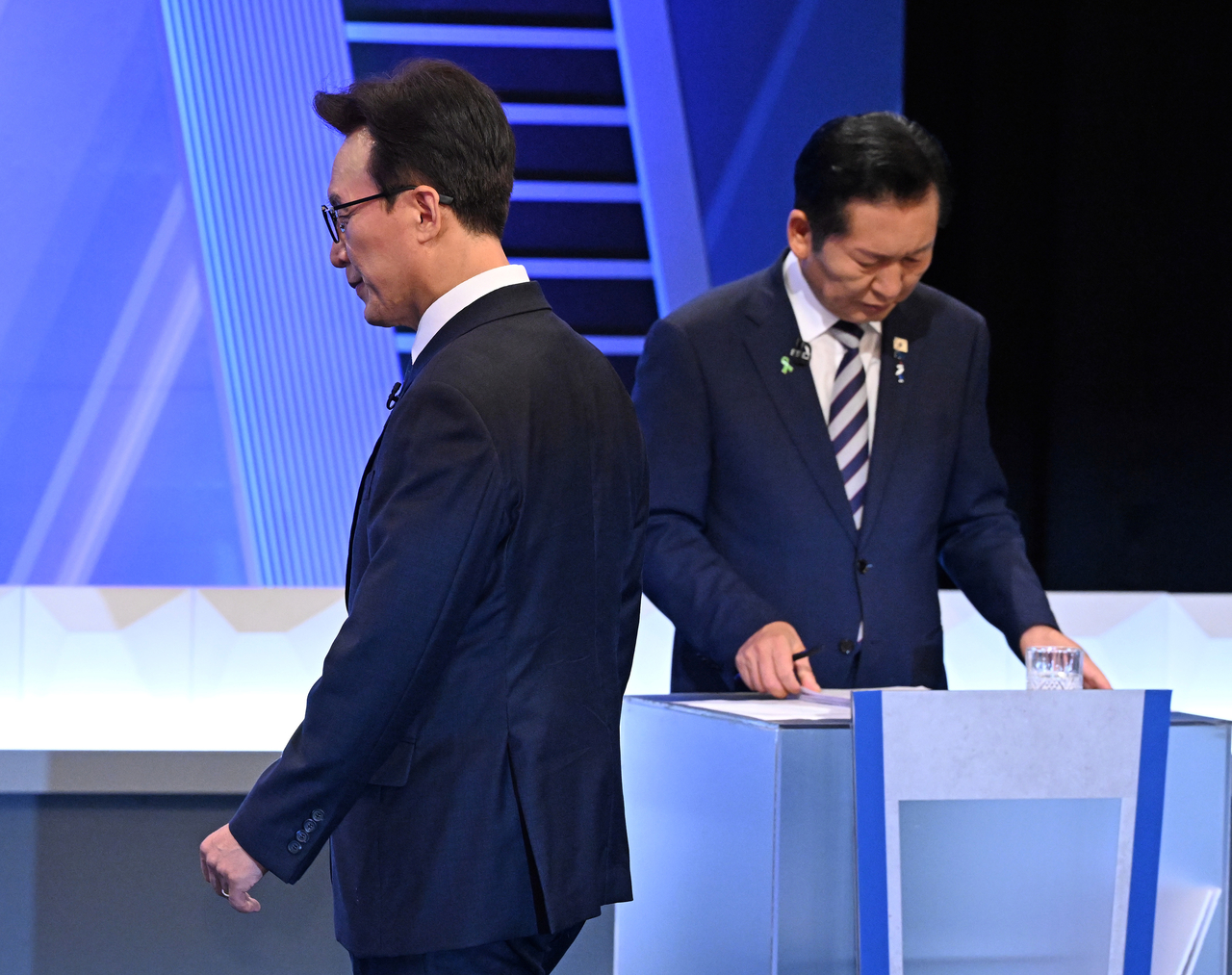
The Democratic Party of Korea's Aug. 17 national convention has drawn even the current government's policies into the fray, with a dispute over single-stock leveraged exchange-traded funds escalating into a war of attrition between two former top officials competing for the party leadership. The increasingly bitter exchanges have prompted concern within the party about whether divisions can be healed once the convention ends.
The fallout from leadership candidate Jung Chung-rae's challenge to rival Kim Min-seok over responsibility for single-stock leveraged ETFs continued through Friday. Jung wrote on Facebook that day: "Don't distort things by claiming I was targeting Cheong Wa Dae — that's nonsense. I'm asking for an apology from those spreading malicious rumors. On single-stock leveraged ETFs, I'm saying former Prime Minister Kim should apologize on moral and political grounds."
Jung had written Thursday that Kim, as a former prime minister, "should apologize to the citizens who have shed tears over single-stock leveraged ETFs." Kim's camp rebuffed the attack, saying the prime minister had neither led nor set policy on the ETF introduction, and that attacking him simply for being part of the government "is ultimately an anti-Lee Jae Myung act — an attack on the Lee Jae Myung administration and the president himself."
Lawmakers aligned with Kim went on the offensive. Democratic Party Rep. Chae Hyeon-il said the ETF was "a policy of the Lee Jae Myung government, pushed by financial authorities and enacted through a Cabinet meeting," and said Jung's attempt to shift blame onto a former prime minister "amounts to admitting his own failure to communicate between the party and the government when he was party leader at the time."
Kim Yong, a candidate in the supreme council member race, also sharply criticized Jung, saying he appeared to be "unable to say it directly to the president, so instead trying to pin all the blame on rival candidate and former Prime Minister Kim." He added: "If a government policy causes side effects in the market, isn't it the duty of the ruling party leader to share responsibility as one team, work out countermeasures at the party level, and pool wisdom together?"
As the convention race grows more heated, voices within the Democratic Party are calling for self-correction. Rep. Park Ji-won said on KBS Gwangju Radio on Friday that while candidates were trading "unspeakable insults and attacks," politics has a way of unifying once a winner is chosen. "Those running for party leadership should be debating real-life issues — real estate, the stock market — not trading insults," he said. "I'm worried."
A lawmaker from the greater Seoul area said the damage could run deep, with not just the candidates but their supporters fracturing along factional lines. "The most important task after the convention is unity," the lawmaker said. "It's time for members who haven't taken sides to step up."
The Democratic Party's central election management committee issued a statement Thursday saying the Aug. 17 convention primary was showing "serious signs of overheating" and vowing to "firmly respond to illegal and disruptive acts that undermine electoral order and damage the party's reputation." The committee added that interference with the election and illegal campaigning "constitute clear grounds for disciplinary action," and that any violations uncovered would be subject to "strict accountability, including member sanctions, without exception — even after the convention concludes."
addressh@heraldcorp.com