![Heat shimmer rises over Yeouidae-ro in Yeongdeungpo-gu, Seoul, on Tuesday, when a severe heat wave alert was in effect. [Yonhap]](https://wimg.heraldcorp.com/news/cms/2026/08/07/rcv.YNA.20260804.PYH2026080412060001300_P1.jpg)
As a record-breaking heat wave continues to grip the country, attention is turning to the standards governing heat protection for workers. The current regime draws a sharp distinction — rest breaks are mandatory, work stoppages are merely advisory — leaving workers and employers confused about what is actually required and raising doubts about the system's effectiveness.
According to the Ministry of Employment and Labor on Friday, the current regime divides heat-wave response into three tiers: employers' mandatory health and safety obligations, the ministry's work-stoppage guidelines, and individual workers' right to halt work.
The most enforceable tier is the employer's mandatory health and safety obligation. Under the Occupational Safety and Health Standards Rules, when work is carried out for two or more hours in a workplace where the heat index reaches 31 degrees Celsius or above, employers must take at least one of the following measures: install and operate cooling or ventilation equipment, adjust working hours, or guarantee rest breaks. When the heat index reaches 33 C or above, employers must provide a rest break of at least 20 minutes every two hours. This is a legal obligation, not a recommendation.
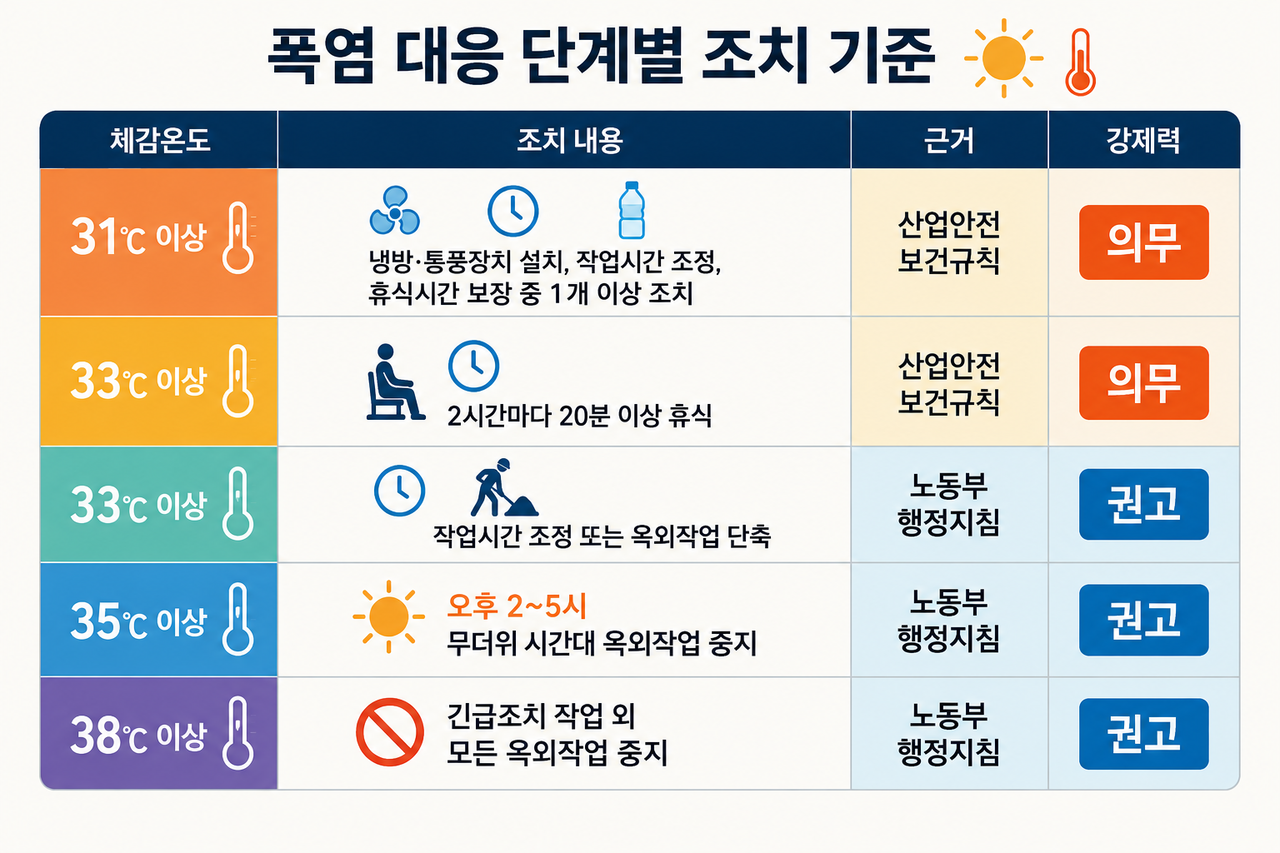
Work stoppages during a heat wave, by contrast, are governed not by law but by Ministry of Employment and Labor administrative guidelines.
When the Korea Meteorological Administration issues a severe heat wave alert, the ministry recommends that construction sites and other workplaces halt work and draw up action plans. When a severe heat wave alert was issued across Seoul on Tuesday, the ministry activated a work-stoppage reporting system at construction sites nationwide through its regional offices and required them to submit compliance plans.
However, this falls under the ministry's administrative guidelines, not a legal obligation under the Occupational Safety and Health Act. Because it is advisory rather than legally binding, it carries no enforcement power.
Labor groups argue that work stoppages during extreme heat should be made mandatory. Yang Gyeong-su, chairman of the Korean Confederation of Trade Unions (KCTU), said in a recent appearance on MBC Radio that work stoppages during heat waves "amount to nothing more than a recommendation, leaving employers to decide on their own whether to comply," and called for legislation requiring certain types of work to stop above a set temperature, as is the case in Europe.
![On Tuesday, when the severe heat wave alert was issued, regional employment and labor offices sent official cooperation notices to construction sites with project values of 5 billion won or more, outlining the "heat-wave work-stoppage reporting system upon issuance of a severe heat wave alert." [Provided by the Seoul Regional Employment and Labor Office East Branch]](https://wimg.heraldcorp.com/news/cms/2026/08/07/news-p.v1.20260806.244246f4edd549fa9339349af6ec8900_P1.png)
The ministry maintains that advisory status does not mean the guidelines lack teeth.
Labor Minister Kim Young-hoon acknowledged that "the argument that it lacks effectiveness is not entirely wrong," but said that "if a serious accident occurs at a site that did not follow the ministry's work-stoppage advisory, there is a strong likelihood that the employer will be found to have neglected preventive measures." In other words, employers who ignore the advisory could bear full legal responsibility for any resulting accident. Kim added that because employer directives carry strong weight on the ground — often more so than the law itself — the advisory cannot be dismissed as a mere recommendation.
Labor authorities also emphasize that workers have an individual right to stop work under the Occupational Safety and Health Act. Critics note that fear of lost wages or retaliation makes it difficult for workers to exercise this right in practice, but Article 52 of the act allows workers to halt work and evacuate when there is an imminent risk of an industrial accident.
Employers are also prohibited from dismissing or otherwise disadvantaging a worker solely because that worker stopped work for a reasonable cause. However, whether extreme heat constitutes an "imminent risk" may depend on the specific conditions of each workplace.
Meanwhile, the Korea Meteorological Administration forecast that the heat will persist into next week, with Seoul's daytime highs expected to reach 36 C on Monday, 35 C from Tuesday through Friday, and 34 C on Saturday and Sunday. Because heat index readings at outdoor work sites are likely to be even higher, workers are advised to familiarize themselves with their rights and their employers' obligations — including the mandatory health measures that kick in at a heat index of 31 C, the required rest breaks at 33 C, and the ministry's tiered work-stoppage guidelines that apply when a severe heat wave alert is issued.
![Workers wearing protective gear carry out weeding work at Government Complex Sejong amid the ongoing heat wave on Tuesday. [Yonhap]](https://wimg.heraldcorp.com/news/cms/2026/08/07/rcv.YNA.20260804.PYH2026080405780001300_P1.jpg)
fact0514@heraldcorp.com