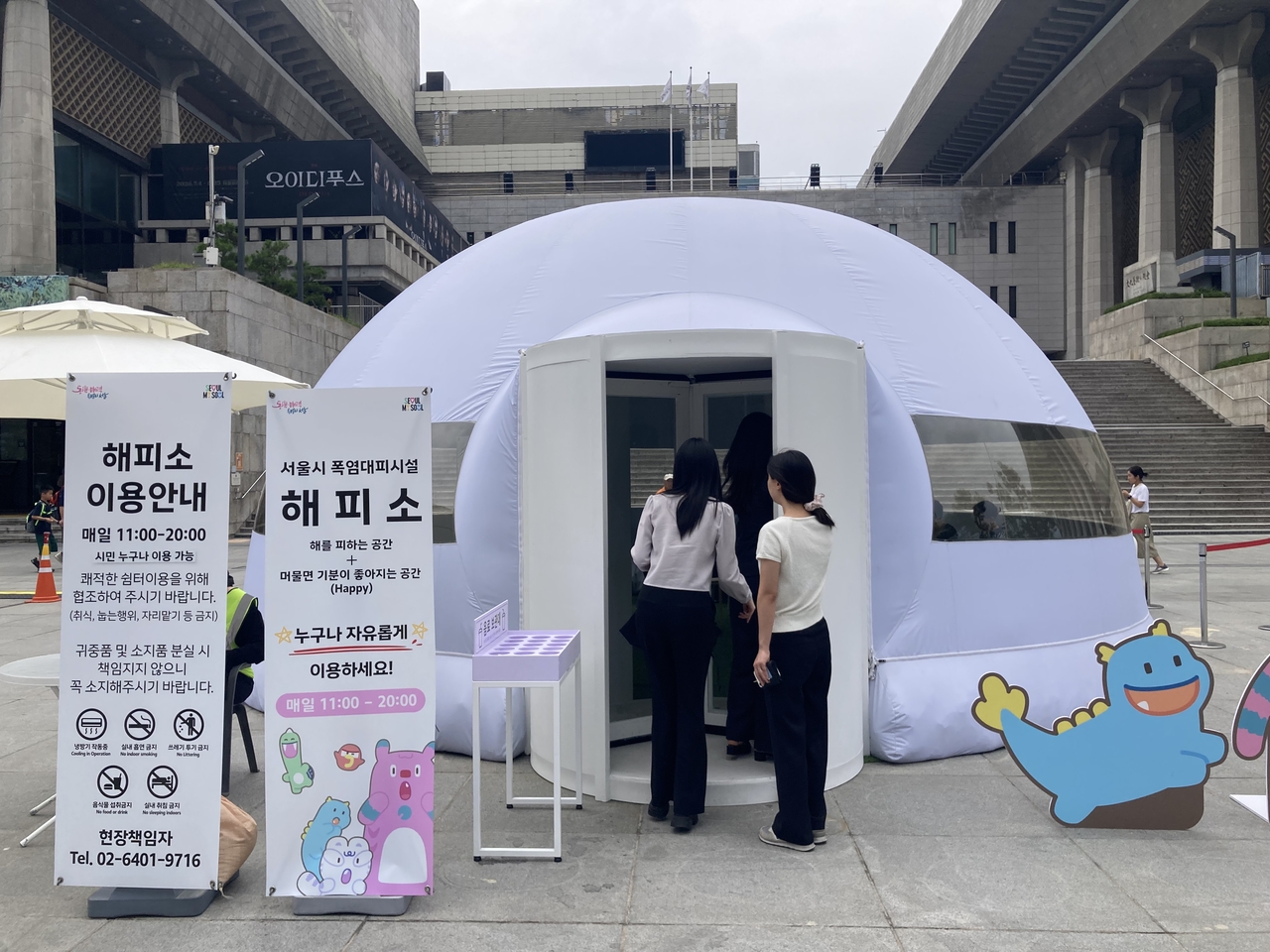
A mobile outdoor heat shelter called "Happiso," introduced by the Seoul Metropolitan Government at Gwanghwamun Square in June, has become a popular urban refuge as the city endures a prolonged heat wave.
The city said Thursday that 30,405 people visited the Gwanghwamun Square Happiso over the 51 days from June 10 through July 31, averaging about 596 visitors per day.
User satisfaction was also high. A survey of 800 visitors gave the facility an overall satisfaction score of 95.7 out of 100. The highest-rated category — satisfaction with the purpose of providing a heat shelter — scored 97.3 points.
Kim, a 75-year-old who visited the shelter last month, said he used to hunt for shade whenever he came to the area. "I no longer have to go looking for shade," he said. "I plan to use it every time I come."
Happiso is a Seoul-style mobile heat shelter that uses materials such as air domes and polycarbonate panels to provide cooling, shade and rest in a single space. The name combines the Korean phrase for "a place to escape the sun" with the English word "happy," conveying the idea of a place that lifts one's mood.
The Gwanghwamun Square location opened June 10 in front of the Hangul Fountain and currently operates daily from 11 a.m. to 8 p.m. Visitor numbers surged after mid-July as the heat wave intensified. On July 17, the shelter recorded its single-day peak of 1,426 visitors, and on July 31 another 1,004 people stopped in to cool off.
The Gwanghwamun Square Happiso had been scheduled to run through Tuesday, but the city is reviewing plans to extend operations through the end of the month given the continuing heat and sustained public demand.
Building on the strong demand and satisfaction scores seen at Gwanghwamun Square, the city is installing Happiso shelters at 15 locations across Seoul — plazas and parks with heavy foot traffic but limited shade and rest space. As of Wednesday, 13 of the 15 sites had been completed, with the remaining facilities set to open by mid-August.
The 15 locations are: Gwanghwamun Square (Jongno-gu), Cheonggye Square (Jung-gu), the Gwangyang-dong sports site (Gwangjin-gu), Gandemae Park and the Knowledge Flower Garden (Dongdaemun-gu), near Junghwa Station (Jungnang-gu), Banghak Four Seasons Square (Dobong-gu), Buramsan Azalea Garden and Gyeongchun Line Forest Trail Square (Nowon-gu), the Hongje-dong Sinhihan Playground (Seodaemun-gu), Exit 7 of Hongik University Station (Mapo-gu), West Seoul Lake Park (Yangcheon-gu), Nodeul Naru Park (Dongjak-gu), Nakseongdae Park (Gwanak-gu) and Iljasan Neighborhood Park (Gangdong-gu).
Each shelter will be tailored to its site and expected demand, taking the form of a horizontal or vertical structure or a dome ranging from 5 to 16 meters in diameter. Operating hours and duration will also be set flexibly based on local conditions and management capacity.
Choi Jin-seok, head of the Seoul Metropolitan Government's Disaster and Safety Management Office, said the city would maintain rigorous operations and safety management. "Nearly 600 residents are using the shelter every day on average, and satisfaction stands at a high 95.7 points," he said.
ikson@heraldcorp.com