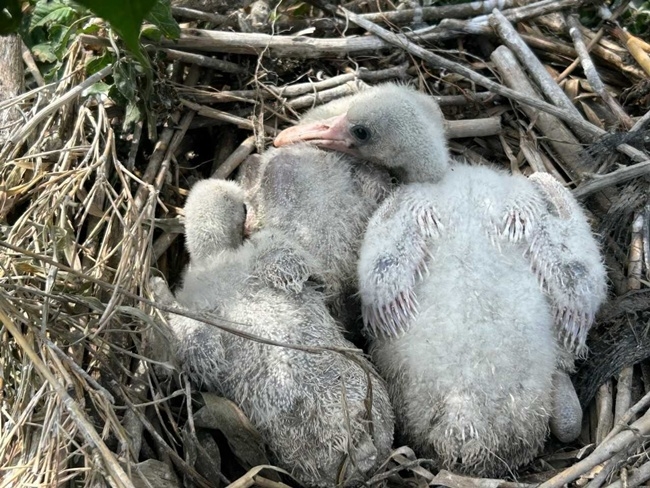
Nest and eggs observed on Janggu Island in Suncheon Bay
![An endangered black-faced spoonbill forages in Suncheon Bay. [Provided by Suncheon City]](https://wimg.heraldcorp.com/news/cms/2026/08/06/news-p.v1.20260806.ad86aaae9d8c43129084e0c459f6d3fe_P1.jpg)
Black-faced spoonbills — an endangered species and Natural Monument No. 205 — have been confirmed breeding on Janggu Island in Suncheon Bay, marking the first known breeding site for the birds on South Korea's southern coast.
More than 90 percent of the global black-faced spoonbill population has historically bred on uninhabited islands along South Korea's west coast, but the birds' breeding range has been gradually expanding southward to areas such as Suncheon in recent years.
Suncheon City said 15 spoonbill nests were observed on Janggu Island in Byeollyang-myeon, and the birds were seen incubating eggs and raising chicks.
More than 50 black-faced spoonbills were also recently spotted in the restored wetlands of Suncheon Bay's "reverse reclamation" project, indicating that the bay's tidal flats and surrounding areas serve as both a breeding ground and a stable habitat for the species.
City officials attributed the development to the Suncheon Bay tidal flats' organic connection with nearby inland wetlands, which together provide a stable environment for the spoonbills' breeding, foraging and resting needs.
Classified as critically endangered both domestically and internationally, the black-faced spoonbill numbered only 300 to 500 individuals worldwide in the early 1990s. Conservation efforts by international environmental organizations have since helped the population recover to roughly 7,700 birds.
"We plan to work with relevant agencies, including the National Institute of Ecology, to continuously monitor the breeding status of black-faced spoonbills on Janggu Island, assess potential threats near the breeding site, and strengthen protection and management measures to ensure the new breeding ground remains stable," a city official said.
parkds@heraldcorp.com