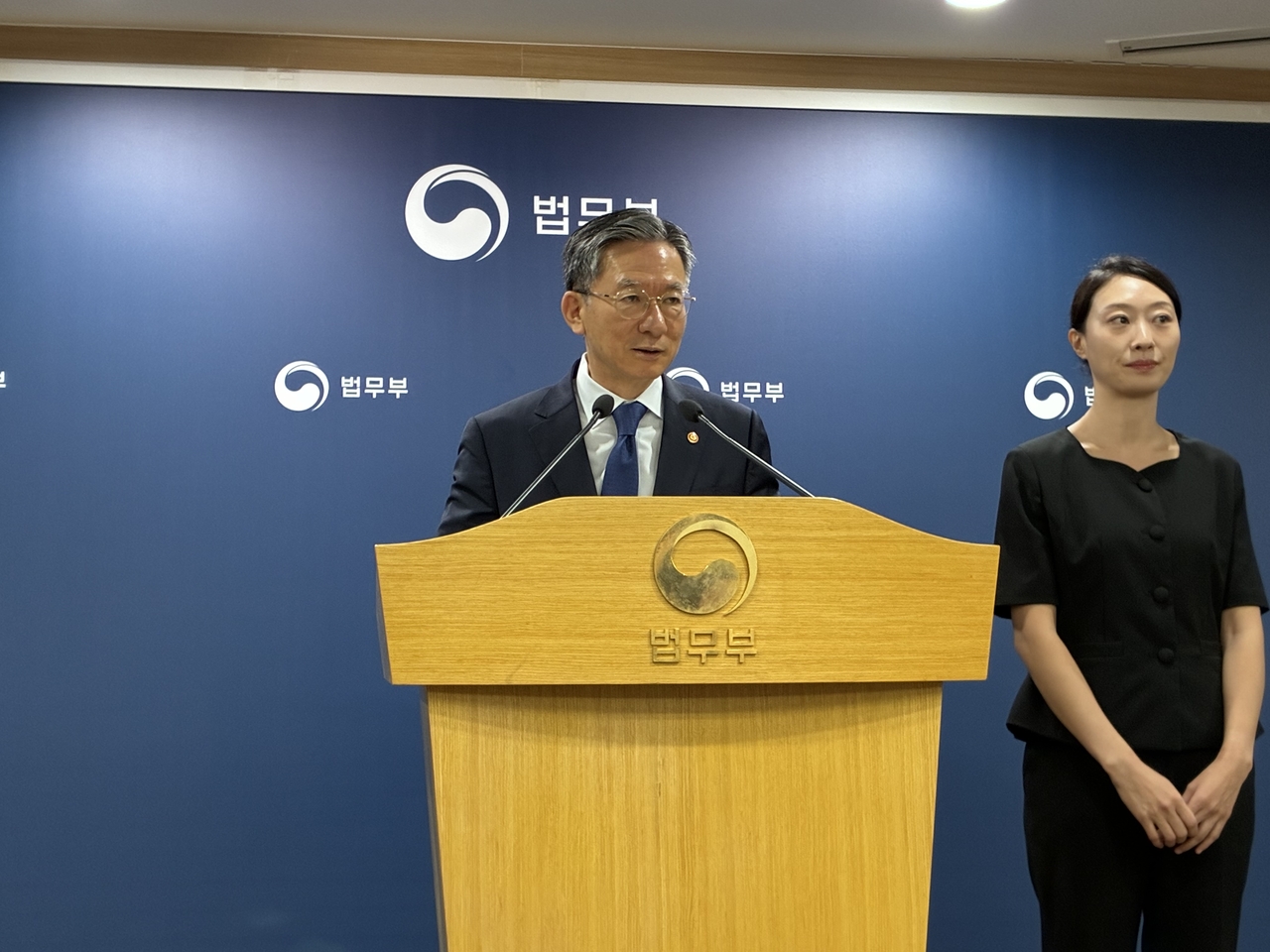
With prosecutors set to lose their investigative powers in October — triggering the transformation of the Prosecution Service into a Public Prosecution Service and the creation of a new Serious Crime Investigation Agency — Justice Minister Jeong Seong-ho said the role of trial prosecutors and others will remain critical even after the revised Criminal Procedure Act takes effect. The Public Prosecution Service will have to bring and sustain charges based solely on case files transferred from primary investigative agencies.
Jeong made the remarks Wednesday morning at a pre-briefing for the ministry's second-half work plan, held in Gwacheon, Gyeonggi Province. Responding to a reporter's question about how preparations for the Public Prosecution Service were progressing now that a rough design for the Serious Crime Investigation Agency had emerged, he said, "We need personnel to analyze transferred cases, indict and sustain prosecutions."
The National Assembly passed a revised Criminal Procedure Act on Friday, with the abolition of prosecutors' supplementary investigative powers as its centerpiece. A Cabinet meeting chaired by President Lee Jae Myung reviewed and approved the bill on Tuesday. Once promulgated, the revised act will take effect Oct. 2, coinciding with the launch of the Serious Crime Investigation Agency and the Public Prosecution Service.
'Drastically downsizing the Public Prosecution Service? That's not the case'
"The Serious Crime Investigation Agency is a newly created organization, while the Public Prosecution Service is essentially the existing Prosecution Service changing its nameplate — so there won't be much difference," Jeong said. "However, some are asking whether it should be drastically downsized since the Public Prosecution Service will no longer conduct investigations, including supplementary ones. That is not the case."
He added that since the Lee Jae Myung administration took office, self-initiated investigations had already been limited largely to financial and securities crimes and price-fixing cases, meaning their share was not high to begin with. "We need personnel to analyze transferred cases, indict and sustain prosecutions," he said. "Since trial prosecutors will have to bring and sustain charges based solely on records transferred from primary investigative agencies, I believe the number of trial prosecutors will need to increase."
Minister urges Assembly to establish legal basis for joint prosecutor-police investigations
Jeong said Wednesday that he had stressed to the National Assembly the need to establish a legal basis allowing prosecutors and police to conduct joint investigations.
"We are currently running nine joint investigation units covering narcotics, finance and securities, and other areas," he said. "We are discussing how to maintain them. I think we need to be thorough in drafting investigation rules and related enforcement decrees — including how prosecutors will provide legal counsel. Even if they are not conducting direct investigations, I believe we should create a framework that allows them to provide support."
Jeong particularly noted the severity of drug crime, saying the legal basis for joint investigation unit operations should be established as soon as possible and that consideration should be given to creating a dedicated agency such as a drug enforcement bureau. "The joint drug investigation units have produced the greatest results in cutting off drug manufacturing, distribution, sales and use," he said. "The police officers seconded to them also say the collaborative framework works well."
In legal circles, concern has been raised over the approaching statute of limitations for Public Official Election Act violations that occurred during the local elections held in June, with the deadline set to expire at year's end — all amid the abolition of prosecutors' supplementary investigative powers. The worry is that if police transfer a case but it needs supplementary investigation and is sent back, the statute of limitations could expire in the meantime.
"Prosecutors are currently making bone-grinding efforts — they are working so hard that I have to tell them not to run themselves to death on cases," Jeong said. He added, "There are more election law cases from this round of local elections than usual, and I am deeply concerned. Whether we can properly wrap up investigations going forward — it seems we will have to work very hard."
Ministry to fast-track breach-of-trust reform and replacement legislation
At the pre-briefing Wednesday, the Ministry of Justice said it had responded firmly to crimes affecting people's livelihoods — including voice phishing and narcotics — in the first half of this year, and had strengthened protection for crime victims through measures such as developing a mobile application that allows real-time location tracking of perpetrators. The ministry also highlighted the detection of large-scale price-fixing in daily necessities and victories in international litigation and arbitration cases brought against the state.
For the second half of this year, the ministry said it would demonstrate change across four priority areas: a country safe for citizens, practical legal administration to revive the economy, a society that respects human rights, and legal administration innovation oriented toward the future.
The ministry said it would fulfill its role in supporting economic recovery. It plans to reform the breach-of-trust offense — whose vague elements have burdened corporate management — and swiftly advance replacement legislation to prevent any gap in criminal liability.
Article 355, Paragraph 2 of the Criminal Act stipulates that a person managing another's affairs who, in breach of their duties, acquires a financial benefit or causes a third party to do so, thereby inflicting loss on the principal, shall be punished by up to five years in prison or a fine of up to 15 million won ($10,500). Article 356 of the same act provides that a violation committed in breach of occupational duties carries a penalty of up to 10 years in prison or a fine of up to 30 million won.
The business community has long called for a sweeping overhaul of the breach-of-trust offense, arguing that the vague definition of who can be punished and what constitutes the crime exposes normal business activities to the risk of criminal prosecution. In January, eight major business groups including the Korea Enterprises Federation submitted a proposal to the National Assembly and the Ministry of Justice calling for improvements to the offense.
In addition, the ministry said it would introduce AI across its legal administration operations — including expanding the detection of abnormal behavior and tailored treatment for high-risk patients under treatment and custody through an AI behavioral analysis system at the National Forensic Psychiatric Hospital — and would pursue an expansion of the class action system, currently limited to the securities sector, to help small-scale and numerous victims seek redress more easily.
Meanwhile, speculation about Jeong's resignation surfaced after the Democratic Party of Korea adopted the abolition of prosecutors' supplementary investigative powers as its official party line. He was also reported to have indicated at a recent ceremony for newly appointed prosecutors that he had considered stepping down for health reasons. On Wednesday, Jeong offered only a brief comment: "President Lee Jae Myung, at a closed Cabinet meeting on Tuesday, expressed deep concern for the hardships faced by correctional officers and asked us to stand by those officers in difficult circumstances."
bell@heraldcorp.com