
As the so-called "operating-profit N% bonus" — a scheme tying performance pay to a fixed share of operating profit — emerges as a new flashpoint in labor-management relations, experts are pushing back against treating such bonuses as wages subject to collective bargaining.
Voices at the forum held Tuesday also argued that decisions on how to deploy operating profit are purely a matter of management judgment, and that any regulatory reform must weigh companies' capacity to invest alongside shareholder rights.
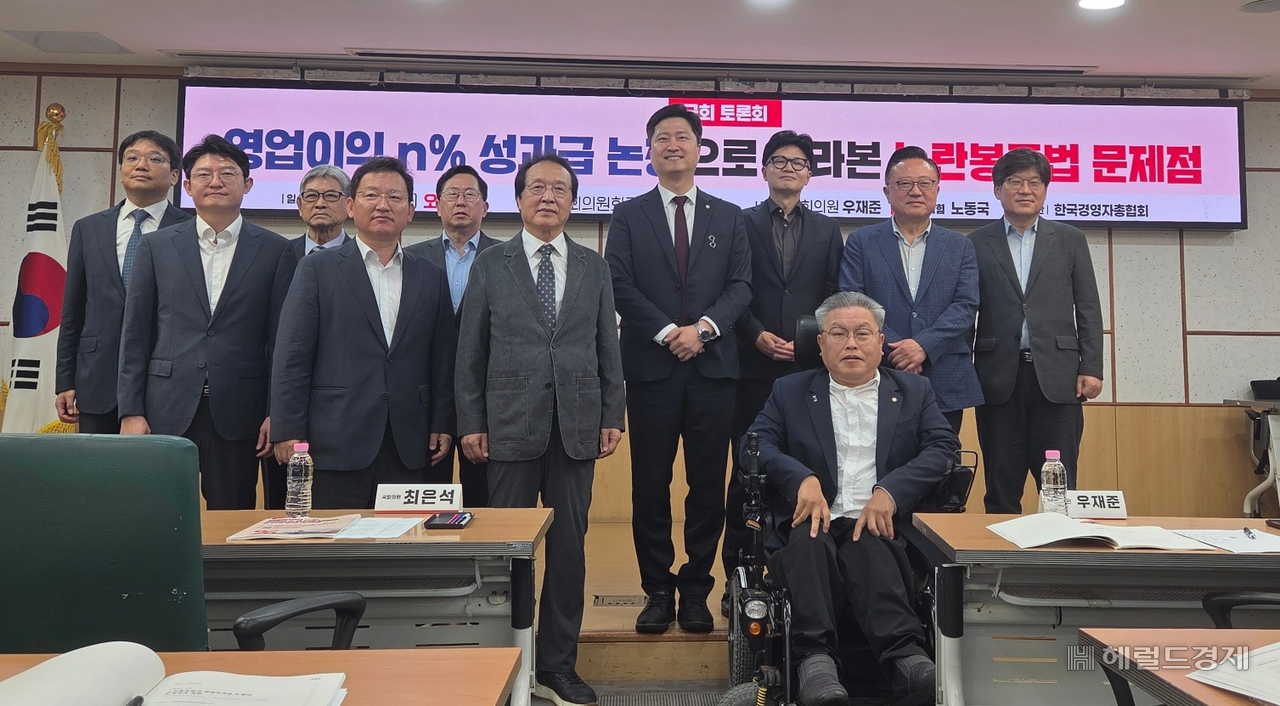
People Power Party lawmaker Woo Jae-jun and the PPP's labor bureau hosted the forum Tuesday at the National Assembly Members' Office Building under the title "Problems with the Yellow Envelope Act as seen through the operating-profit bonus debate."
The forum, organized by the Korea Enterprises Federation, featured Park Ji-soon, a professor at Korea University School of Law; Hong Ki-yong, an emeritus professor of business administration at Incheon National University; Kim Dong-hee, head of the Korea Enterprises Federation's labor standards policy team; and Koo Ja-hyung, an attorney at law firm Yulchon.
Park argued in his presentation that performance bonuses linked to operating profit should be understood as "post-hoc distributions of business results" rather than compensation for labor. Because such bonuses are paid only when a company turns a profit, fluctuate significantly in size, and are influenced by factors individual workers cannot control, they are difficult to classify as wages under labor law, he said.
Park said the Yellow Envelope Act had broadened the scope of labor disputes to cover "management decisions affecting working conditions," fueling the spread of operating-profit bonus demands. Under that expanded definition, a wide range of management decisions — including restructuring, outsourcing, the introduction of AI and robots, and investment and production plans, as well as performance bonuses — could become subjects of bargaining and industrial action, he said.
As remedies, Park proposed three measures: codifying the authority, responsibility, directness and specific scope used to determine who qualifies as an employer beyond a direct contractual relationship; drawing a clear distinction between workplace operational norms and contractual terms covering wages and bonuses; and establishing a "safe harbor" for employer determinations related to safety management activities.
Attorney Koo said the Ministry of Employment and Labor had announced it would issue guidelines on whether the "N% bonus" constitutes a mandatory bargaining subject, but noted the approach has clear limits because such guidelines cannot bind courts or labor relations commissions. "If amending the Yellow Envelope Act proves difficult, please consider using subordinate legislation — such as enforcement decrees — to exclude the operating-profit N% bonus from mandatory bargaining subjects," he said.
Hong said using operating profit as the sole benchmark for calculating performance bonuses raises accounting and financial concerns. "Operating profit does not reflect interest expenses, foreign-exchange losses, corporate taxes or non-recurring losses," he said. "If a company records a net loss for the period yet pays out large bonuses based on operating profit alone, its financial structure can deteriorate sharply."
Hong also said the operating-profit N% approach creates an asymmetry between shareholders and workers and could run counter to the intent of the revised Commercial Act. For those reasons, he said, it would be more rational to treat performance bonuses as post-hoc profit distributions and base them on net profit for the period or economic value added (EVA).
While acknowledging the motivational value of performance bonuses, Hong warned that if operating-profit-based bonuses become entrenched practice at large conglomerates, similar demands could spread to small and medium-sized enterprises, public enterprises and the self-employed. "It distorts the cost structure across industries and weakens companies' capacity to invest," he said. "We need to move beyond short-term labor-management compromises and set the standard for a Korean-style profit-sharing model through shareholder meetings, boards of directors, rational performance metrics and clear legal procedures."
PPP lawmakers said they had no objection to fair compensation for workers, but expressed concern that tying bonuses to operating profit could undermine sustainability and corporate vitality.
Woo said the provision now at the center of the controversy — covering "management decisions affecting working conditions" — was hastily added to the list of bargainable subjects on the day the bill passed, without adequate deliberation. "The strikes and labor-management conflicts stemming from the law's implementation are only just beginning. We must find a rational solution now," he said.
Independent lawmaker Han Dong-hoon said the current administration appeared to be both malicious and incompetent. "Whether or not the government knew the Yellow Envelope Act would cause this confusion, it should reflect on its own conduct, submit an amendment as a government bill and apologize to the public," he said.
Kim Seong-won, chair of the National Assembly's Industry, Trade, Resources, SMEs and Startups Committee, said operating profit is not immediately distributable cash or surplus funds. "Performance bonuses must be designed by comprehensively weighing cash flow, investment plans, productivity, individual and organizational contributions, and medium- to long-term business performance," he said.
Kim Hyeong-dong, the PPP's floor leader on the National Assembly's Climate, Energy, Environment and Labor Committee, and Koo Ja-geun, the PPP's floor leader on the industry and SMEs committee, both said that "defining performance bonuses by a uniform yardstick can only increase industrial rigidity," and called for a longer-term discussion.
The view that how a company uses its operating profit is an inherent management prerogative also drew support. Kim Dong-hee of the Korea Enterprises Federation said operating-profit-linked bonuses do not fall within the scope of bargaining under labor law, and that decisions on how to deploy operating profit are an inherent management matter. "Regardless of what formula is used, setting the basis and scale of profit distribution through collective bargaining is itself an encroachment on the domain of management judgment," he said.
Kim added that labor-management councils may discuss the direction of profit sharing before management makes its final decision. He also said the government and the National Assembly should create conditions that allow companies to deploy operating profit fully toward research and development and capital investment.
go@heraldcorp.com




