![India's liquefied petroleum gas carrier Shivalik arrives at Mundra Port in Gujarat state after transiting the Strait of Hormuz, in March. [Reuters]](https://wimg.heraldcorp.com/news/cms/2026/08/04/news-p.v1.20260730.c0297aadad7349f7b56ee135ee1517fa_P1.jpg)
International oil prices tumbled around 5 percent after US President Donald Trump abruptly canceled plans for a large-scale strike on Iran and raised the possibility of renewed dialogue. Iran quickly denied any plans for talks with Washington, however, leaving analysts to warn that geopolitical tensions in the Middle East remain.
Brent crude for October delivery closed down 4.7 percent at $83.77 a barrel on the ICE Futures Exchange on Monday, while West Texas Intermediate for September delivery fell 5.1 percent to $80.34 a barrel on the New York Mercantile Exchange. The WTI settlement was the lowest since July 16.
The immediate trigger for the selloff was a shift in Trump's position.
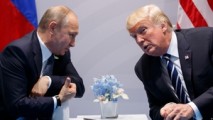
Trump had signaled a major strike against Iran at a Cabinet meeting at Camp David on Friday, raising the prospect of large-scale US-Israeli military action. On Saturday night, however, he posted on social media that he was calling off the attack at the request of Middle Eastern nations. On Sunday he said a deal had been reached regarding the Strait of Hormuz and suggested the move could lead to denuclearization negotiations with Iran. Then on Monday he said talks between the US and Iran would begin.
Iran immediately denied this.
Iranian Foreign Ministry spokesperson Esmail Baghaei said at a briefing Monday that the only negotiations underway were consultations between Iran and Oman over safe passage through the Strait of Hormuz, and drew a clear line against any suggestion of scheduled talks with the United States. He said the Strait of Hormuz issue was "a matter between Iran and Oman" and said the US had no role in it.
Markets responded by selling off crude futures heavily, on the view that a reduced likelihood of US military action would ease concerns about supply disruptions.
Analysts cautioned, however, that oil price volatility is unlikely to fade quickly. Since the ceasefire MOU the US and Iran signed in June was in effect rendered void, the two sides have repeatedly floated and then denied the possibility of negotiations.
Oil market consultancy Ritterbusch and Associates said in a note that "the latest crude futures plunge appears to be yet another overreaction to statements by President Trump," adding that markets are responding with excessive sensitivity to political remarks.
A supply increase outlook also weighed on prices. OPEC and its allies, known as OPEC+, held a video conference Monday and agreed to raise output by 188,000 barrels per day starting in September. The additional supply is set to reach the market that month.
Market participants broadly expect the future direction of oil prices to hinge on whether the US and Iran actually resume negotiations and on the level of tension surrounding the Strait of Hormuz.
sjy@heraldcorp.com