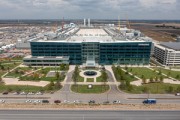
![The dealing room at Hana Bank's headquarters in Seoul on Friday, when the Kospi closed at 6,595.45, up 1,001.89 points (17.91%), setting records for both the largest single-day point gain and the largest percentage rise in the index's history. [Yonhap]](https://wimg.heraldcorp.com/news/cms/2026/08/01/rcv.YNA.20260731.PYH2026073113540001300_P1.jpg)
"Crash. Then surge."
That is July in Korea's stock market in a single line. The Kospi fell 28.9% over the month, its steepest monthly decline since 1990. From its June 19 peak, the index shed 33.5%, wiping out more than 2,456 trillion won ($1.7 trillion) in market capitalization. Yet on Friday the Kospi closed at 6,595.45 — up 1,001.89 points, or 17.91% — marking the largest single-day gain in the index's history.
In a market that has lost all sense of direction, what diagnosis are private bankers — the professionals who manage the money of high-net-worth clients — offering?
Five PBs at major domestic banks — KB Kookmin Bank, Shinhan, Hana Bank, Woori and NH NongHyup Bank — were asked for an emergency assessment. Their diagnosis converged on one point: corporate earnings have not been impaired; what collapsed was supply and demand. Where they diverged was on what to buy.
"Earnings are unchanged — it's the supply-demand that broke down"
Park Tae-hyung, branch manager at Woori TCE Signature Center, pointed to single-stock leveraged products listed on May 27 as the trigger for the wild swings. "There was absolutely no change in corporate earnings — in fact, long-term earnings forecasts were revised even higher," he said. "Retail investors piled into leverage, margin calls were triggered, and selling begat more selling all the way through Thursday."
Cho Han-jo, a market analysis specialist at NH NongHyup Bank's WM business division, agreed that the listing of single-stock leveraged products had maximized the market-cap impact of the underlying stocks, and concluded that it was volatility — not fundamentals — that drove the capital outflows.
Min Se-jin, team leader at Shinhan Premier Seoul Finance Center, cited concentrated selling by institutions and foreign investors, along with debate over whether AI semiconductor stocks had peaked. "SK hynix posted record earnings, but the results came in below elevated expectations, raising profit-taking concerns," she said. "Leveraged ETFs, margin trading, anxiety over rate hikes and the Iran situation all tangled together, and even though fundamental damage was limited, fear was amplified to the extreme."
Park Eun-kyung, deputy head at Hana Bank's Club1 Hannam PB Center, traced the root cause to concentration itself. "In the first half of the year, Samsung Electronics, SK hynix and SK Square together accounted for 55% of the Kospi's market capitalization," she said. "While the Kospi fell about 30% over the month, semiconductors dropped 40%."
US-side catalysts compounded the pressure. "Alphabet's second-quarter results on July 22 showed the first negative free cash flow since its listing, and concerns grew that hyperscaler capital expenditure expansion was eroding cash flow," Park said. "News that China had begun mass-producing DUV equipment — a core tool in chip manufacturing — also weighed on the sector."
Some PBs saw Friday's regulatory change as a turning point. The Financial Services Commission moved up to Friday — from the originally scheduled Wednesday — a measure raising the minimum deposit for single-stock leveraged ETFs and ETNs from 10 million won to 30 million won in cash.
Park Tae-hyung said he expected volatility to ease from August onward as stocks converge toward their intrinsic value. Park Eun-kyung added that forced selling on Friday had nearly run its course: "Most of what needed to be shaken out has been cleared."
Some PBs, however, cautioned against trying to call the market's direction at all. Jung Sung-jin, deputy head at KB Kookmin Bank's Gangnam Star PB Center, said: "People who bought at the top are a problem, but those who sold at the bottom out of fear of further declines are an even bigger problem. You tell someone it looks like it will keep falling and they should get out — then it rallies like today. You tell someone to get in now — and there's a very real chance it falls further next week."
The biggest variable: US rates — 'A September hike looks unlikely'
The Federal Reserve held its benchmark interest rate steady at 3.50–3.75% on Wednesday (local time), its fifth consecutive pause, but three of the 12 voting members backed a 0.25 percentage point increase. Interest-rate futures markets are pricing in roughly a mid-50% probability of a September hike.
Park Tae-hyung flagged rising US long-term rates as a key burden. "When long-term rates rise, the discount rate used to calculate the present value of future earnings for growth companies goes up," he said. "Even if earnings forecasts are unchanged, valuations fall — and that puts pressure on Korean semiconductor share prices."
The yield on the 10-year US Treasury note climbed as high as 4.71% during trading on July 23, its highest level in 18 months, while the 30-year yield surpassed 5.2%, a 19-year high.
On the timing of a rate hike, the prevailing view was that December was the most likely window. "There are midterm elections on Nov. 3, so a September hike is off the table," Jung said. "And even without a rate increase, Treasury yields have already priced in quite a lot — there's no strong reason to move."
Min also leaned toward December at the earliest. "Consumer spending growth is slowing, wage growth has fallen below inflation, and the GDP advance estimate came in below forecasts," she said. "If they move at all, it will be around December."
Park Eun-kyung was the one voice leaving the door open to September. "It depends on how the Middle East situation develops," she said. "If oil prices and inflation stay higher than expected for longer, a September hike is possible."
Park Tae-hyung also named the Middle East as the second major variable. "If the US-Iran standoff leads to a prolonged blockade of the Strait of Hormuz, oil prices would spike, push US inflation back up, and translate into renewed pressure for rate hikes," he said.
For retail investors looking for a reliable indicator, the PBs pointed to government bond yields. "The 10-year Treasury yield has the biggest influence on equities," Park Eun-kyung said. "It's not a perfect correlation, but watching how the index moves relative to Treasury yields when rates rise gives you a reasonable read on direction." Min added that investors should also watch whether the leading economic index — which tends to lead semiconductor-driven exports — shows signs of slowing.
The won-dollar rate has fallen back to the low 1,400s — is it time to buy dollars?
The won's July strength emerged as another variable in wealth management. The won-dollar rate fell from a week-end closing rate of 1,549.4 won at the end of June to 1,424.0 won on Friday — the sharpest appreciation among all G20 currencies for the month.
The won's rise was attributed to dollar conversion demand from the $26.5 billion SK hynix raised through its US American depositary receipt listing, as well as a narrowing of the Korea-US interest rate gap. The Bank of Korea raised its benchmark interest rate from 2.50% to 2.75% on July 16, its first increase in three and a half years.
Park Eun-kyung said the bulk of the dollar supply from that conversion would be absorbed by August, after which the exchange rate would be driven by foreign investors' buying and selling of domestic equities.
Views on how to respond diverged. Park Tae-hyung said he was not advising wealthy clients to sell their dollars. "If your dollar position is below your target allocation, a falling exchange rate is actually an opportunity to add," he said.
Min agreed. "People who held off converting because the rate was too high will actually want to buy more dollars as the won strengthens," she said. "There is a very large pool of pent-up demand to convert once the rate drops below 1,400 won."
Jung, by contrast, viewed even the 1,400-won level as still elevated. "Historically the exchange rate ranged between 1,150 and 1,200 won — we are well above that now," he said. "Compared with 1,550 won it looks cheap, but 1,420 to 1,430 won is still on the expensive side. I would not say people need to convert right now just to hold dollars for currency diversification."
Park Eun-kyung advised tailoring the strategy to how much dollar exposure a client already holds. "For those with no dollar exposure at all, it makes sense to start building a small position," she said. "The best approach is to accumulate gradually on a regular basis, while also taking a lump-sum entry on a portion when the rate dips."
On fixed-rate products, she noted that one-year time deposit special rates are around 3.5%, while dollar-denominated insurance products offer around 4% for three-year terms and around 5% for five-year terms. "Rates that jumped suddenly because of the war situation could come back down once things settle, so locking in high-rate products now is also worth considering," she said.
'Don't put it all in one basket': 55% growth stocks, 30% value stocks, 10–20% cash
The point all five PBs agreed on most strongly in terms of investment strategy was diversification — though they differed on what to diversify into.
Park Tae-hyung cautioned against concentrating in a single sector or stock. "Just because a particular sector or name looks great is no reason to go all-in," he said. "There are plenty of companies with growing, reliable earnings whose share prices have been cut in half — shipbuilding, defense, securities, power infrastructure. The earnings are solid but the stocks are down 50%."
Cho also said broadening a portfolio into financials and healthcare — both sensitive to interest rates — would be positive for returns.
Financial stocks drew particular attention as a sector that can weather volatility. "Financials were almost the only thing that survived this crash," Min said. "Their correlation with the semiconductor sector is very low, earnings stability is solid, and dividends are relatively high. Personally, I think holding 20 to 30% in financials makes sense."
Park Eun-kyung went further and offered specific weightings. "Hold 55 to 60% in growth stocks, about 30% in value stocks such as bank shares and dividend payers, and make sure to keep 10 to 20% in cash or cash equivalents," she said. "You need that cash so you can deploy it when a correction comes." She singled out cosmetics as a sector with low correlation to the semiconductor cycle.
Jung placed greater weight on time diversification than on stock selection. "Diversification means spreading across stocks, but now it also has to mean spreading across time," he said. "If a one-year time deposit is yielding around 3.5%, set your target return at roughly three times that — around 10% — and go in with that goal. Don't just wait indefinitely: once you hit your target, take profits and re-enter in tranches."
'Raising domestic exposure? Not so sure' — some PBs say look to the US
Views on the domestic market also diverged. Jung was blunt: "I am not recommending domestic stocks to my clients yet." He explained that SK hynix and Samsung Electronics account for 50 to 55% of the Kospi, and while semiconductor fundamentals are sound, domestic factors such as leverage are creating excessive volatility. "US stocks benefit from strong shareholder-friendly policies — companies buy back and cancel shares to support prices," he said. He recommended currency-hedged ETFs or index funds to reduce foreign-exchange risk.
Park Eun-kyung took a middle position. "Semiconductors are at the core of the AI industry, so holding zero semiconductor exposure is itself a portfolio risk," she said. "There is no need to exit domestic index-based semiconductor investments entirely."
She did, however, recommend directing new money toward the US. "Keep the semiconductor holdings you already have, but for fresh money going in — the kind you would invest regularly like a savings plan — consider shifting the direction toward the US," she said. "I don't think we'll get back to the previous all-time high, but by September or October the market will likely be higher than it is now."
The PBs were united in their view that July's crash stemmed more from supply-demand dynamics and sentiment than from any deterioration in corporate earnings. Their strategies differed, but on one piece of advice there was no dissent: the greater the volatility, the more important it is not to concentrate everything in a single stock, a single sector, a single currency or a single market.
Interview participants:
Jung Sung-jin, deputy head, KB Kookmin Bank Gangnam Star PB Center
Min Se-jin, team leader, Shinhan Premier Seoul Finance Center
Park Eun-kyung, deputy head, Hana Bank Club1 Hannam PB Center
Park Tae-hyung, branch manager, Woori TCE Signature Center
Cho Han-jo, market analysis specialist, NH NongHyup Bank WM Business Division
won@heraldcorp.com