
![An exterior view of Sagajeong Central I'Park apartment complex in Myeongmok-dong, Jungnang-gu, Seoul. [Naver Maps Street View]](https://wimg.heraldcorp.com/news/cms/2026/07/31/news-p.v1.20260619.f214796fc6f740c6bcda6b01639e3ce2_P1.png)
Outer Seoul neighborhoods dominated by lower-priced apartments are heating up as commercial banks pile additional lending restrictions on top of the government's already tight mortgage regulations. Buyers stretching their finances to the limit are converging on peripheral districts where prices remain relatively accessible and borrowing capacity is still maximized. In Jungnang-gu, a transaction has crossed the 1.5 billion won mark for the first time.
According to the Ministry of Land, Infrastructure and Transport's actual transaction price disclosure system, an 84-square-meter unit at Sagajeong Central I'Park in Myeongmok-dong, Jungnang-gu, Seoul changed hands on Friday for 1.53 billion won ($1.04 million), setting an all-time high for the complex. It is the first time a standard 84-square-meter unit in Jungnang-gu has exceeded 1.5 billion won, excluding pre-sale rights transactions. A 59-square-meter unit in the same complex also set a new record, selling for 1.35 billion won on July 6.
The head of a licensed real estate agency in Myeongmok-dong said the recently reported transaction was actually concluded about a month earlier due to land transaction permit procedures. "Deals above 1.5 billion won have continued since then," the agent said, adding that many prospective buyers have been calling in a panic, worried that once the complex's market price firmly clears 1.5 billion won, the mortgage ceiling will drop to 400 million won.
According to the Korea Real Estate Board's weekly apartment price trend report for the fourth week of July 2026 (as of Monday), apartment prices in Jungnang-gu rose 0.53 percent over the week — the highest gain among all cities, counties and districts nationwide.
The surge is not confined to Jungnang-gu. Nowon-gu's weekly gain widened from 0.43 percent to 0.46 percent, Dobong-gu's from 0.22 percent to 0.23 percent, and Gangbuk-gu's from 0.27 percent to 0.33 percent. Geumcheon-gu also expanded its rise, from 0.32 percent to 0.35 percent.
Record-high transactions are also emerging in older outer-district complexes that had long struggled to recover their 2021 peak prices. An 84-square-meter unit at Cheonggu 3-cha in Junggye-dong, Nowon-gu sold for 1.43 billion won on July 11, surpassing the previous record of 1.42 billion won set in February 2021 — a new high after five years and five months. An 84-square-meter unit at Sindorim Daelim 1·2-cha in Sindorim-dong, Guro-gu also set a record, changing hands for 1.495 billion won on July 20.
A man in his 30s who recently bought his first home in Nowon-gu ahead of his upcoming marriage said he had weighed whether to keep renting on a jeonse contract, save more and buy in a better neighborhood later, or purchase now. "Lending conditions don't look like they'll improve for now, and I figured home prices could rise further in the meantime, so I decided to buy," he said.
Since the government's Oct. 15 measures last year, mortgage limits have been tiered by home value: up to 600 million won for homes priced at 1.5 billion won or below, up to 400 million won for homes between 1.5 billion and 2.5 billion won, and up to 200 million won for homes above 2.5 billion won. With demand concentrating on sub-1.5 billion won homes — where borrowing capacity is greatest — prices in those complexes are being pushed higher.
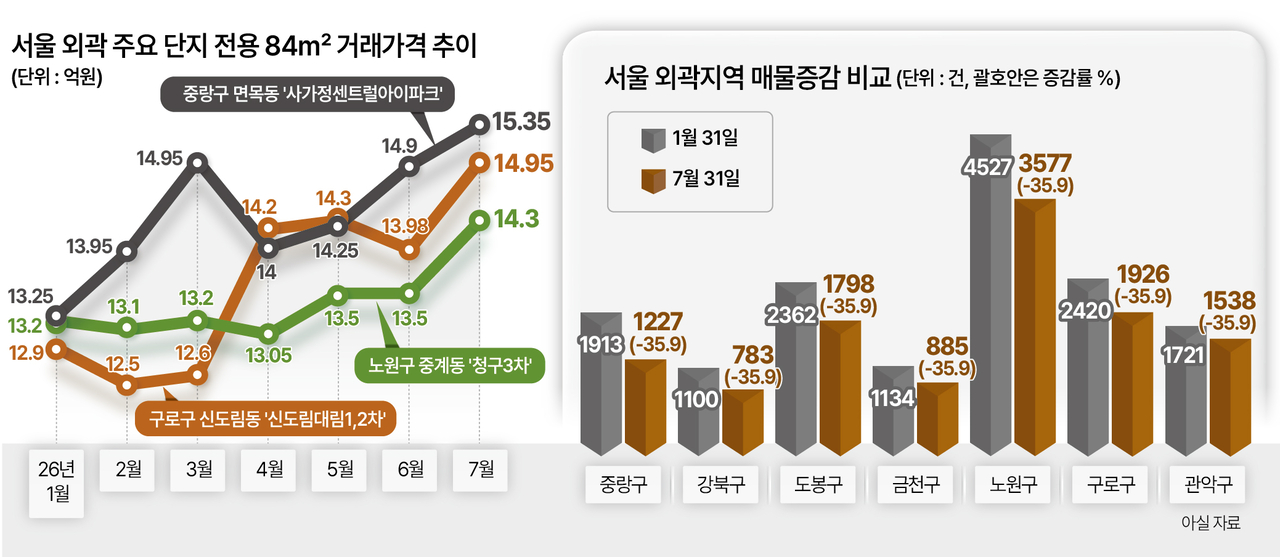
Available listings are also shrinking rapidly, particularly in outer Seoul districts. According to real estate big data firm Asil, Jungnang-gu recorded the steepest drop in apartment listings among Seoul's 25 autonomous districts over the past six months as of Friday.
The number of apartments listed for sale in Jungnang-gu fell 35.9 percent, from 1,913 units on Jan. 31 to 1,227 units on Friday. Gangbuk-gu followed with a 28.9 percent decline, from 1,110 to 783 units, and Dobong-gu dropped 23.9 percent, from 2,362 to 1,798 units.
Geumcheon-gu fell 22.0 percent from 1,134 to 885 units, Nowon-gu dropped 21.0 percent from 4,527 to 3,577, Guro-gu declined 20.5 percent from 2,420 to 1,926, and Gwanak-gu slipped 10.7 percent from 1,721 to 1,538. All seven districts with the steepest listing declines are in Seoul's outer ring — the areas commonly grouped as Nowon-Dobong-Gangbuk and Geumcheon-Guro-Gwanak.
Ham Young-jin, head of the real estate research lab at Woori Bank, said a proposed property tax hike in the government's tax reform plan could temporarily push more listings onto the market, but supply was unlikely to rise enough to meet demand.
Ham added that last year banks had effectively halted new lending as they managed total loan volumes, even waiving early repayment fees for a month to encourage borrowers to pay down their balances. "This year the situation is not much different, and there is room for other commercial banks to impose additional lending restrictions," he said.
quq@heraldcorp.com




