![An aerial view of the Gangnam area, including apartment complexes slated for reconstruction [Yonhap]](https://wimg.heraldcorp.com/news/cms/2026/07/30/rcv.YNA.20260713.PYH2026071309100001300_P1.jpg)
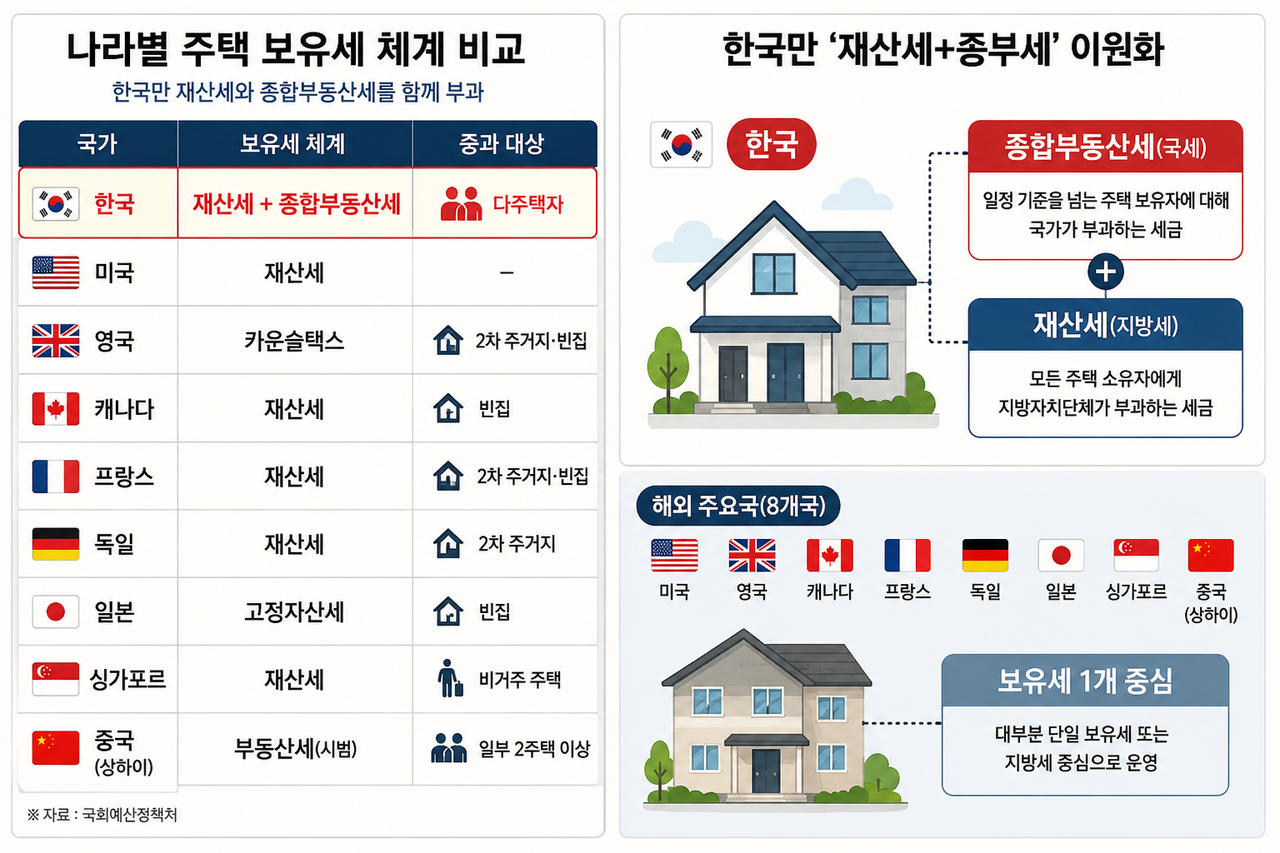
South Korea is the only country among major economies that splits its housing property tax into two separate levies — a local property tax and a national comprehensive real estate tax, known as the jongbusae — according to a new report.
Most other countries operate a single property-holding tax centered on local government, the report found, though each tailors its own approach to assessed values, tax rates, exemptions and surcharges on multiple-home owners or vacant properties.
The National Assembly Budget Office on Thursday released a report comparing housing property tax regimes across nine countries and 10 cities — South Korea, the United States (New York and Los Angeles), Canada (Toronto), the United Kingdom (London), France (Paris), Germany (Berlin), Japan (Tokyo), Singapore and China (Shanghai) — examining four areas: assessed value, tax base and rates, exemptions and deductions, and surcharges on multiple-home owners and vacant properties.
South Korea runs a dual system combining the local property tax and the national comprehensive real estate tax, while the United States, Canada, the United Kingdom, France and Germany generally rely on a single system in which local governments levy property taxes. Japan imposes both a fixed-asset tax and an urban planning tax, but both are local levies. Singapore operates a national-level property tax. China in principle does not tax owner-occupied residential housing, with a pilot property tax program running only in Shanghai and Chongqing.
The basis for calculating assessed values also differed by country. South Korea, the United States and Canada use capital value — primarily market price — while France and Singapore base assessments on annual rental value. South Korea, New York and Singapore reassess values every year, whereas Los Angeles and Shanghai use the acquisition price as the base. The United Kingdom and France retain valuations from 1991 and 1970, respectively, adjusted for inflation. Germany reassesses every seven years and Japan every three.
Tax rate structures also varied. South Korea applies progressive rates of 0.05 to 0.4 percent for the local property tax and 0.5 to 5.0 percent for the comprehensive real estate tax. Singapore likewise uses progressive rates — 4 to 32 percent for owner-occupied homes and 12 to 36 percent for non-owner-occupied properties. New York applies an assessment ratio and then a variable rate set annually by local government, while Los Angeles has an effective rate of roughly 1.04 to 1.35 percent. Toronto's rate ranges from 0.767 to 1.209 percent, Berlin's combined basic and local rate stands at 0.146 percent, and Japan levies a fixed-asset tax of 1.4 percent plus an urban planning tax of 0.3 percent. The report cautioned, however, that differences in how tax bases and assessed values are calculated make it difficult to compare nominal rates across countries as a straightforward measure of tax burden.
Exemption and deduction regimes were largely focused on protecting vulnerable groups and owner-occupiers. South Korea offers comprehensive real estate tax deductions for elderly single-home owners and long-term holders, along with a cap on annual tax increases. The United States provides tax credits for owner-occupiers, the elderly and people with disabilities. Canada targets the elderly and low-income households; the United Kingdom, students and single-person households; France, the elderly and newly built homes; Germany, social housing and cultural heritage properties; Japan, a special residential land provision; and Singapore, preferential rates for owner-occupied homes. China exempts single-home owners from property tax altogether.
The policy goals pursued through property-holding taxes also differed sharply. South Korea applies differentiated fair-market-value ratios and tax rates to owners of multiple homes, while Singapore imposes higher rates on non-owner-occupied properties. The United Kingdom, France and Germany levy additional taxes on secondary residences that are not the owner's primary home, and Canada, the United Kingdom and France each impose a separate vacant-property tax. Japan removes the special residential land provision for vacant homes, raising the tax burden on them, while Shanghai taxes residential properties held by owners of two or more homes under its pilot program.
South Korea's real estate holding tax as a share of GDP stood at 0.9 percent last year, matching the OECD average but falling short of the G7 average of 1.9 percent, the report found. As a share of total tax revenue, South Korea's figure of 4.9 percent exceeded the OECD average of 3.8 percent but remained below the G7 average of 8.1 percent.
"Housing property tax regimes in major countries vary widely in their assessment methods, rate structures, exemption systems and surcharge approaches," the National Assembly Budget Office said. "Comparing the policy goals and operational methods of each country's system is meaningful as it provides a foundation for future discussions on reforming South Korea's property-holding tax."
fact0514@heraldcorp.com