
![A customer service counter at a KB Kookmin Bank branch in Seoul [Herald DB]](https://wimg.heraldcorp.com/news/cms/2026/07/30/news-p.v1.20260709.a68fc980450b4d06a90dd8d35f7948d4_P1.jpg)
With would-be buyers rushing to get on the property ladder before tighter lending rules take full effect, Shin, a worker in his 40s, recently visited a bank branch after months of anxiety about being left behind. He had his eye on an apartment near Seoul, but when he inquired about his borrowing limit, he came up 100 million won ($69,000) short of what he needed.
Just as Shin was about to abandon his home purchase plans, a bank employee told him he could expand his mortgage limit through a "repayment-conditional" arrangement — agreeing to pay off an existing personal loan as a condition of the new mortgage. By repaying a 50 million won personal loan he held at the same bank, he would free up enough room in his debt service ratio to increase his mortgage limit by about 150 million won. Since he had no spare cash on hand, Shin signed up for the arrangement on the spot and secured the funds he needed.
Banking industry sources said Thursday that repayment-conditional mortgage products have been drawing growing attention among borrowers as stricter government lending regulations push last-minute homebuying demand into banks. The approach involves paying off an existing personal loan or revolving credit line to lower the borrower's debt service ratio, then using the freed-up capacity to take on a larger mortgage. In some cases, borrowers can significantly increase their loan limit without putting up any additional cash.
A repayment-conditional arrangement is a type of special clause that expands the mortgage limit for home purchases on the condition that the borrower repays an existing loan. It typically involves paying off a personal loan or revolving credit line in exchange for a higher mortgage ceiling.
When a borrower with a personal loan at Bank A applies for a repayment-conditional mortgage at Bank B, Bank B proceeds with the loan review and contract process on the premise that the borrower will submit proof of repayment of the Bank A loan on the day the mortgage is disbursed. Once the borrower provides that proof, the mortgage is executed simultaneously with the registration of the collateral lien.
The process is even simpler when the borrower takes out the repayment-conditional mortgage at the same bank that holds the personal loan. The bank immediately applies the increased mortgage limit to repay the personal loan, then disburses only the remaining balance to the borrower — allowing the borrower to raise their loan limit without needing any extra cash.
The arrangement can substantially increase a borrower's mortgage ceiling. Take a salaried worker earning 100 million won a year who holds a 50 million won personal loan at an annual rate of 6 percent. If that person takes out a 30-year variable-rate mortgage at 4.5 percent with equal principal-and-interest payments, the maximum mortgage limit comes to 321 million won. But by repaying the 50 million won personal loan first, the ceiling rises to 476 million won — an increase of 155 million won, more than three times the amount repaid.
The gains are even larger with a fixed-rate mortgage, which is less affected by stress debt service ratio regulations. A borrower in the same situation who takes out a fixed-rate mortgage at 5.5 percent would have a maximum limit of 348 million won while holding the personal loan, rising to 516 million won after repayment — an additional 168 million won in borrowing capacity.
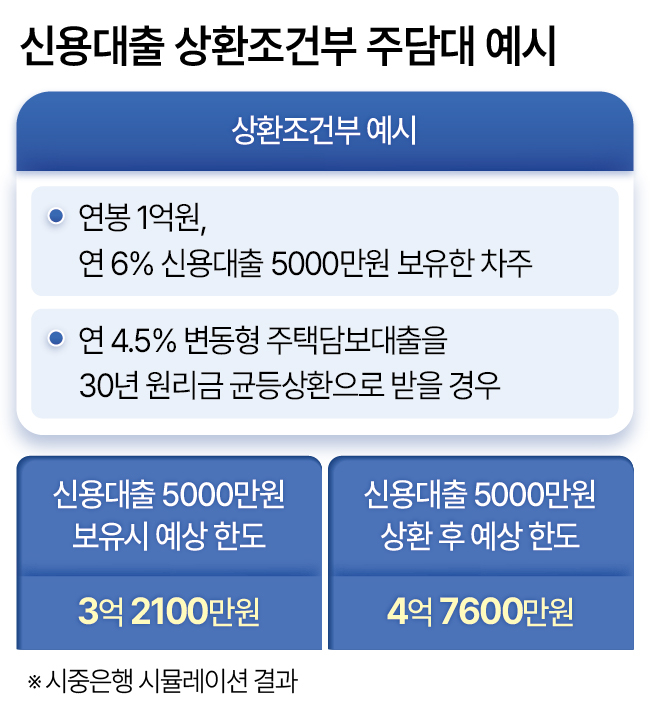
The mechanism is what industry insiders call "DSR magic." The debt service ratio divides a borrower's annual principal and interest payments by annual income. Banks generally cap additional lending once the ratio exceeds 40 percent. Because personal loans have shorter maturities than mortgages, they carry a heavier annual repayment burden and consume a disproportionately large share of the ratio. Repaying a personal loan frees up that capacity, allowing the borrower to take on a significantly larger mortgage.
As the government has continued tightening household lending rules, bank branches have seen a surge in borrowers seeking repayment-conditional arrangements. Inquiries have been especially common among those trying to secure balance-payment loans — a type of mortgage used to cover the final installment on a home purchase — which have recently become a flashpoint in the lending debate.
"As regulations limiting borrowers' loan ceilings — including the debt service ratio — have tightened, more people are coming into branches looking for any way to increase their limits," a bank official said. "A lot of them want to close revolving credit lines they aren't using and then take out a mortgage." Another official said repayment-conditional arrangements had long been a popular strategy for borrowers seeking to raise their limits, but added that related inquiries had picked up noticeably as last-minute homebuying demand increased.
Borrowers do not necessarily have to repay the full balance of a personal loan under a repayment-conditional arrangement. Experts advise consulting with a bank first to determine how much needs to be repaid before making any decision. "For example, if repaying just 10 million won is enough to unlock the limit you need, there's no reason to pay off the entire personal loan," said Kim Eun-jin, head of Leo Loan Research Institute. "Since some banks don't offer repayment-conditional products at all, I recommend visiting a branch before making any repayments."
With banks' overall lending capacity running thin under tighter government caps on total household loan growth, there is speculation that banks may soon begin imposing their own restrictions on repayment-conditional products. The combined household loan balance — excluding policy loans — at the five major banks (KB, Shinhan, Hana, Woori and NH) stood at 649.54 trillion won as of Thursday, July 23, exceeding the government's annual growth target by about 230 billion won.

hyuk@heraldcorp.com




