
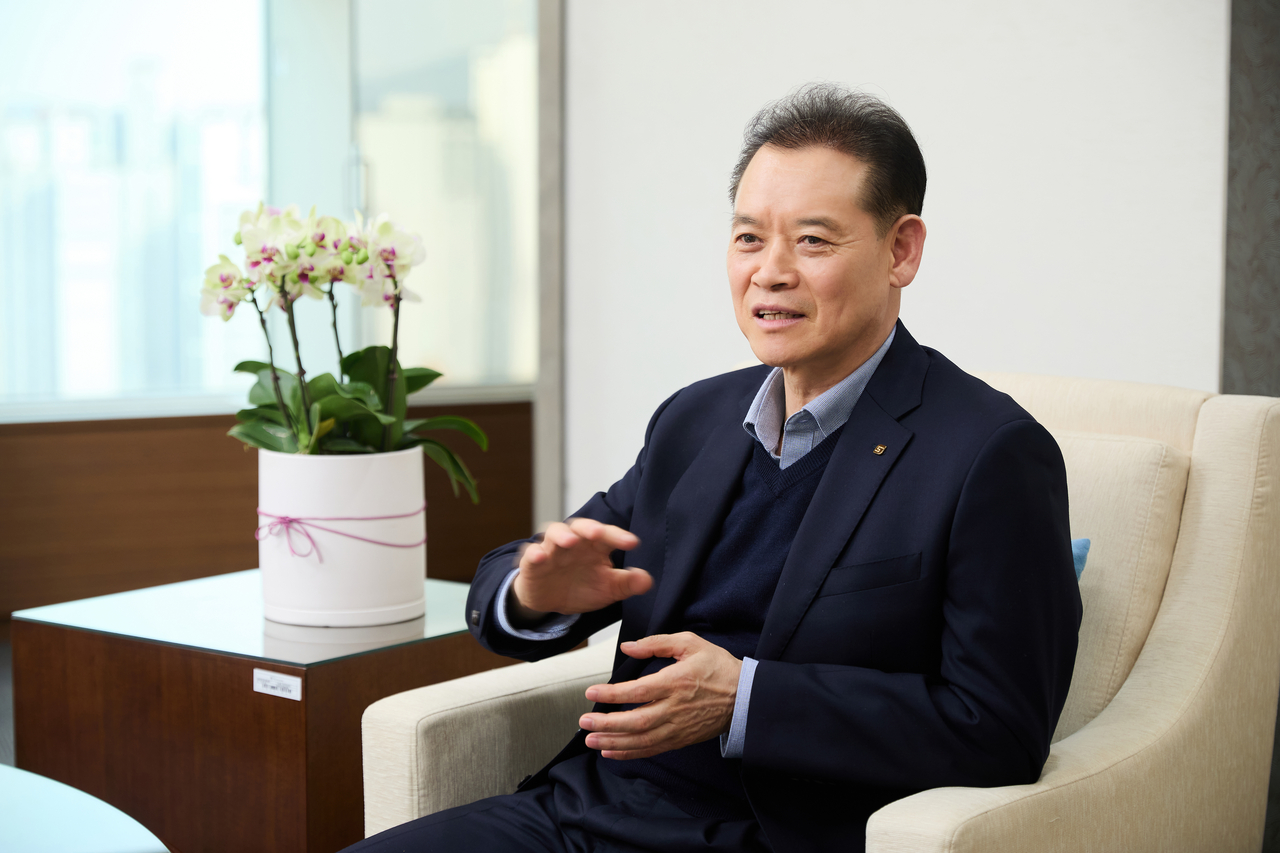
Amid a prolonged slump in Seoul's neighborhood commercial districts, the Seoul Credit Guarantee Foundation has joined forces with local district offices and financial institutions to step up support for small businesses and self-employed merchants.
The foundation, led by President Choi Hang-do, plans to expand its special credit guarantee programs in Yangcheon-gu and Mapo-gu while using its big data resources to identify commercial revitalization policies tailored to each district's characteristics.
The special credit guarantee system allows small business owners and small and medium-sized enterprises that struggle to secure financing due to insufficient collateral or low credit ratings to obtain bank loans backed by the foundation's guarantees.
On Monday, the foundation signed a special credit guarantee contribution MOU with Yangcheon-gu District Mayor Lee Gi-jae and representatives of commercial banks. The parties also signed a separate big data utilization MOU to strengthen cooperation on financial support and data-driven policy.
The special contribution fund totals 2.4 billion won, with Yangcheon-gu contributing 100 million won ($68,200), Woori Bank 1 billion won, KB Kookmin Bank 500 million won, Saemaul Geumgo 400 million won, Kakao Bank 200 million won, and Shinhan Bank and Hana Bank 100 million won each.
The fund will be used to provide 30 billion won in special credit guarantees to small businesses and self-employed merchants in Yangcheon-gu.
Eligible applicants are small business owners and small and medium-sized enterprises with a registered place of business in Yangcheon-gu. Each business may receive up to 200 million won in support.
Applications can be submitted online through the Seoul Credit Guarantee Foundation's mobile app, or in person at the foundation's Yangcheon General Support Center after booking a consultation by phone.
The big data MOU was designed to analyze the financial and commercial conditions of Yangcheon-gu using the foundation's data holdings and to develop effective support policies for small businesses that reflect the district's economic characteristics.
Yangcheon-gu plans to systematically analyze commercial district trends by area and industry, as well as financial usage patterns, to craft data-driven, customized support policies for local small businesses.
Mapo-gu, led by District Mayor Yoo Dong-gyun, is also expanding its special credit guarantee program to 41.5 billion won and building a big data-based, tailored support framework for its commercial districts.
On Friday, the foundation signed a special contribution MOU for local economic support with Mapo-gu, Saemaul Geumgo, Hana Bank and Kakao Bank. Mapo-gu and the foundation also concluded a separate big data-based local commercial district support cooperation MOU.
The signing ceremony, held at a conference room in the Mapo-gu district office, was attended by District Mayor Yoo, foundation President Choi, Bae Jun-seong of the Saemaul Geumgo Central Association's Seoul regional headquarters, Lee Chang-hwan, chairman of the Mapo-gu Saemaul Geumgo board of directors association, Yoo Chung-seon of Hana Bank's western business division, and Kim Seong-su of Kakao Bank's credit division.
Mapo-gu had already provided 31.25 billion won in special credit guarantees in the first half of this year in partnership with Woori Bank and Hana Bank. The latest MOU adds 10.25 billion won, bringing the total available low-interest financial support to 41.5 billion won.
Saemaul Geumgo, a community-rooted financial institution, and Kakao Bank, known for its mobile banking strengths, joined as new partner institutions. Hana Bank also committed additional contributions, moves expected to broaden small business owners' access to financing and widen their options.
Loan interest rates under Mapo-gu's special credit guarantee program range from 2.61 to 3.11 percent per year, with a maximum loan limit of 100 million won per business.
Mapo-gu will also pursue commercial district analysis and policy development using big data alongside the financial support measures.
The Seoul Credit Guarantee Foundation will supply commercial data — including foot traffic, industry-by-industry conditions, store counts and rental prices — and propose policies based on the analysis. Mapo-gu will use this information to examine shifts in local commercial activity and consumer spending patterns, and to identify support programs suited to the district's characteristics.
The foundation plans to sign a similar MOU with Songpa-gu and expand cooperation with other district offices as it works to revive struggling neighborhood commercial districts across the city.
seouldream01@heraldcorp.com




