![Yongsan Prugio Summit, an officetel complex in Hangang-ro 2-ga, Yongsan-gu, Seoul. [Naver Real Estate]](https://wimg.heraldcorp.com/news/cms/2026/07/29/news-p.v1.20260729.0782e848125d44119022ce490a6906b0_P1.jpg)
As the government pushes to convert vacant commercial and office spaces into studio units and officetel to boost housing supply, concerns are growing that the plan may miss the mark — officetel market demand is increasingly concentrated in mid-size and larger units. Average prices for large-category officetel in Seoul have climbed to around 1.4 billion won ($955,000), reflecting a surge in buyers seeking officetel as an alternative to apartments.
According to related ministries, the government is working to convert vacant shops, offices and knowledge industry centers in urban areas into studio units or officetel, with a target of 15,000 units over the next two years and more than 33,000 units by 2030. But critics note that converting existing commercial buildings into residential use may face structural constraints in securing adequate floor area, separate bedrooms, and sufficient natural light and ventilation.
Officetel sale prices are already showing a clear divergence by unit size. According to KB Kookmin Bank's July monthly officetel statistics, Seoul's officetel sale price index fell 0.02 percent from the previous month. By floor area, the micro category (exclusive use area of 30 square meters or less) dropped 0.20 percent, while the small category (over 30 to 40 square meters) fell 0.04 percent. By contrast, the upper-mid category (over 60 to 85 square meters) rose 0.10 percent and the large category (over 85 square meters) gained 0.23 percent. The mid-size category was flat.
Average sale prices followed the same pattern. The average price of micro-category officetel in Seoul slipped from 188.35 million won in June to 187.83 million won in July, a drop of about 520,000 won, while the small category edged down from 247.31 million won to 247.21 million won, a decline of about 100,000 won.
Mid-size units inched up from 441.178 million won to 441.18 million won, while the upper-mid category rose 710,000 won to 683.3 million won. Large units posted the biggest gain, climbing 3.24 million won in a single month from 1.3816 billion won to 1.3848 billion won.
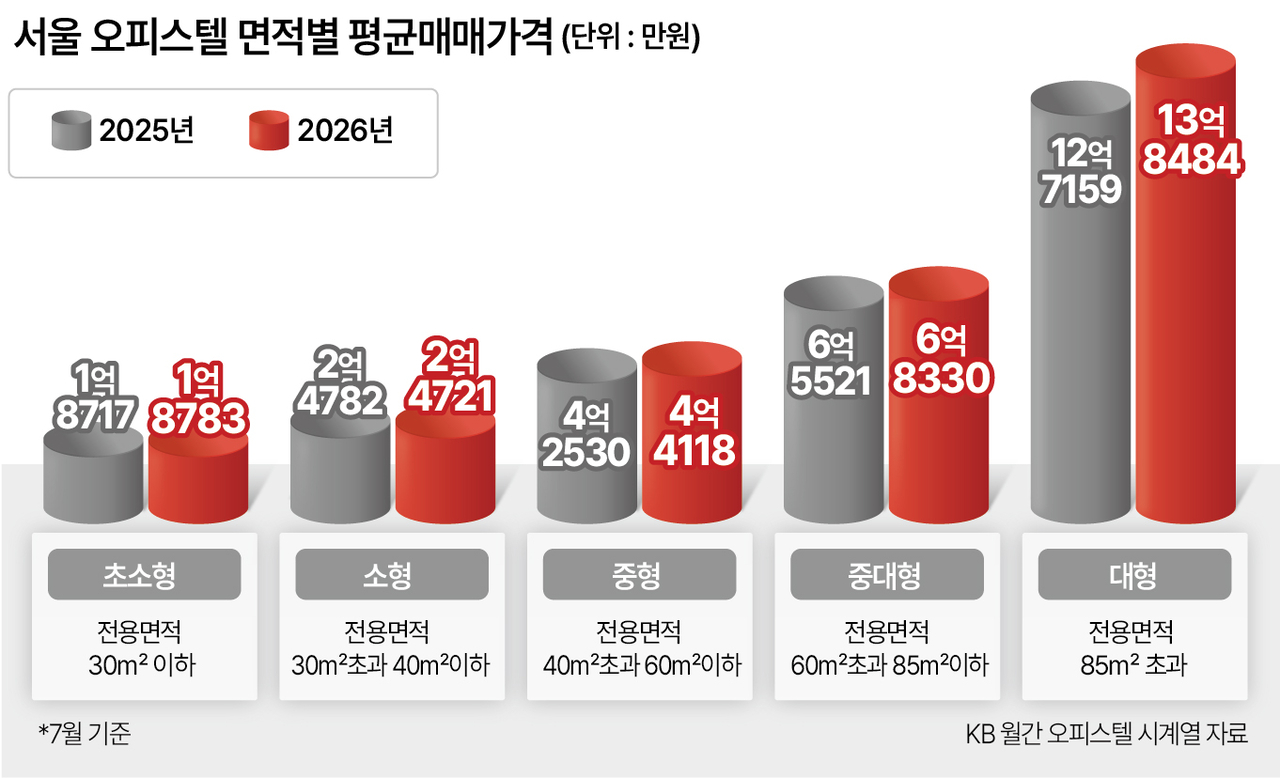
The gap is equally pronounced over a longer horizon. Seoul's large-officetel sale price index rose 8.97 percent from a year earlier, while the upper-mid category gained 3.75 percent over the same period. Micro units fell 1.00 percent and small units dropped 0.17 percent. Mid-size and larger officetel have emerged as an alternative housing option for two- and three-person households priced out of apartments or burdened by rising jeonse and monthly rent costs, while demand for studio-type units has remained weak due to concerns about resale liquidity.
"Even within the same officetel complex, demand for larger units outpaces demand for smaller ones," said the head of a licensed real estate agency in Hangang-ro 2-ga, Yongsan-gu. "The core buyers for transit-oriented officetel near business districts are people in their 20s and 30s, and they clearly prefer larger floor plans — not just for the location, but for living comfort and how well the space can be used."
Experts say supply targets focused purely on unit counts will struggle to deliver meaningful housing relief. Song Seung-hyeon, head of Urban and Economy, said a minimum level of residential floor area must be secured for supply to have real effect. "If you simply hit a target number of units, you can claim a quantitative achievement, but there are clear limits on the qualitative side," he said.
Song added that even addressing youth housing needs requires more than studio units designed for a single occupant. "If two people are going to live together, you need at least a two-bedroom unit," he said.
Experts also say structural policy reforms — including officetel acquisition tax rules and how units are counted toward a buyer's total housing holdings — must come first for supply measures to take effect. Officetel are currently classified as commercial facilities at the time of purchase regardless of intended use, making them subject to an acquisition tax rate of around 4.6 percent, which includes a 4 percent base rate plus local education tax. Once used as a residence after purchase, however, they can be treated as housing for capital gains tax and housing-count purposes — meaning a buyer is treated as a non-homeowner when buying but as a homeowner when holding.
Ham Young-jin, head of the real estate research lab at Woori Bank, said the acquisition tax on officetel needs to be eased first. "It is inconsistent for the government to pursue lease market stability through non-apartment supply while applying a 4 percent acquisition tax indiscriminately to both residential and commercial officetel," he said.

quq@heraldcorp.com