
Mokpo National University·Suncheon National University merger talks loom as medical school·hospital blueprint sparks fierce backlash
Suncheon's civic and political community is pushing back hard against a recently unveiled "super-regional integrated medical belt" plan by the Jeonnam-Gwangju Integrated Special City, saying the proposal is designed to benefit Mokpo at the expense of the eastern South Jeolla Province region — even as Mokpo National University and Suncheon National University are locked in a fierce, no-compromise competition over where to site a planned national medical school and university hospital ahead of a potential merger.
The backlash intensified after a blueprint showing the medical school and university hospital placed in Mokpo was made public before the two universities had even begun formal merger negotiations, prompting protest statements from Suncheon's political circles and civic groups. Critics say the move has only deepened the rift between the eastern region — encompassing Suncheon, Yeosu, Gwangyang, Goheung, Boseong, Gurye and Gokseong — and the western region, which includes Mokpo, Muan, Sinan, Yeongam, Haenam, Jindo, Wando and Gangjin. Mokpo and Suncheon are roughly 100 kilometers apart as the crow flies.
Suncheon Mayor Son Hun-mo wrote on his Facebook page Tuesday that while the integrated special city's "super-regional integrated medical belt" plan — announced alongside the formation of a "Public Healthcare Innovation Task Force" — appeared intended to build a unified super-regional healthcare system drawing on the strengths of both the eastern and western regions, a closer look told a different story. "The eastern region's plan focuses on restructuring and repurposing existing medical institutions such as Suncheon Medical Center into a locally self-sufficient healthcare system, while the western region is offered a new medical school, a university hospital and a medical research hub — with no mention whatsoever of a university main campus," he said.
Son added that the plan failed to reflect the longstanding demand of more than 800,000 residents in the eastern region, including Suncheon, for a medical school and hospital at Suncheon National University, as well as the region's inadequate healthcare conditions. He said the blueprint was released before the universities had even begun their own autonomous discussions on a merger and medical school, and that it would likely have had a significant impact on derailing the university merger negotiations.
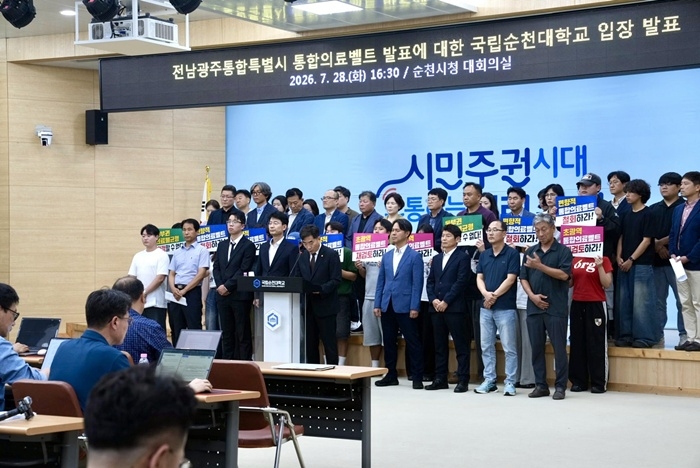
Faculty and alumni of Suncheon National University held a press conference Tuesday afternoon, saying the eastern region centered on Yeosu, Suncheon and Gwangyang is home to large-scale petrochemical national industrial complexes, a Posco steel mill and Gwangyang Port, making it the most populous and economically vital coastal zone in South Jeolla Province. "It is precisely because this region is most in need of advanced medical infrastructure to handle serious industrial accidents, critical illnesses and emergency cases that eastern-region residents are calling for a medical school," they said.
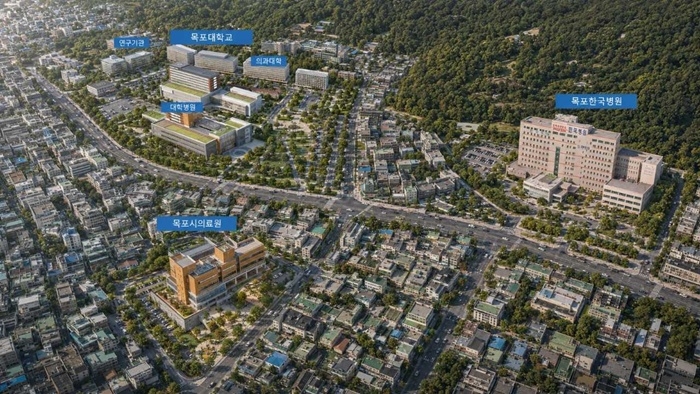
They also said the western region's planned "Medical Town" in Mokpo would concentrate all key functions there — a medical school, university hospital, medical research hub, a circulation system for training and retaining medical personnel, a medical R&D base, and a technology commercialization and startup ecosystem. By contrast, the eastern region's "Medical Innovation Town" consisted only of existing institutions: Suncheon Medical Center, a regional mother-and-child medical center, St. Carollo Hospital and the Korea Workers' Compensation and Welfare Service's Suncheon Hospital. "It amounts to nothing more than a reshuffling of existing medical facilities," they said.
Suncheon National University also took aim at a proposal document dated July 2, which stated that if the merger fell through and each university pursued the medical school application independently, the integrated special city would withhold administrative and fiscal support. "Announcing in advance that support will be withdrawn if things do not go as planned — on a matter that universities should decide for themselves — is not a request for agreement but a demand for submission," the university said, calling on Special City Mayor Min Hyeong-bae to immediately stop stoking regional division.
Nine assembly members representing Suncheon on the integrated city council also held a press conference Tuesday at the special city's eastern district office, condemning the administration for unilaterally announcing a policy plan that included the placement of a medical school and university hospital "without any prior consultation, just as Suncheon National University and Mokpo National University were about to begin their own autonomous discussions on the merger."
The Rebuilding Korea Party's Suncheon chapter joined the chorus of criticism, issuing a statement that the super-regional integrated medical belt plan announced Monday offered the western region "extraordinary benefits" — a new medical school, university hospital and medical research hub — while giving the eastern region only "a superficial alternative in the form of repurposing existing medical facilities, completely ignoring the realities of the eastern region."
The party also urged Mayor Min to immediately stop backroom administration and present a fair and transparent balanced development plan that reflects the will of residents.
A Jeonnam-Gwangju Special City official responded, saying that if the two universities reached a merger through their own autonomous discussions and a national medical school was established as a result, the city would work to build a locally self-sufficient healthcare system in connection with it.
parkds@heraldcorp.com



