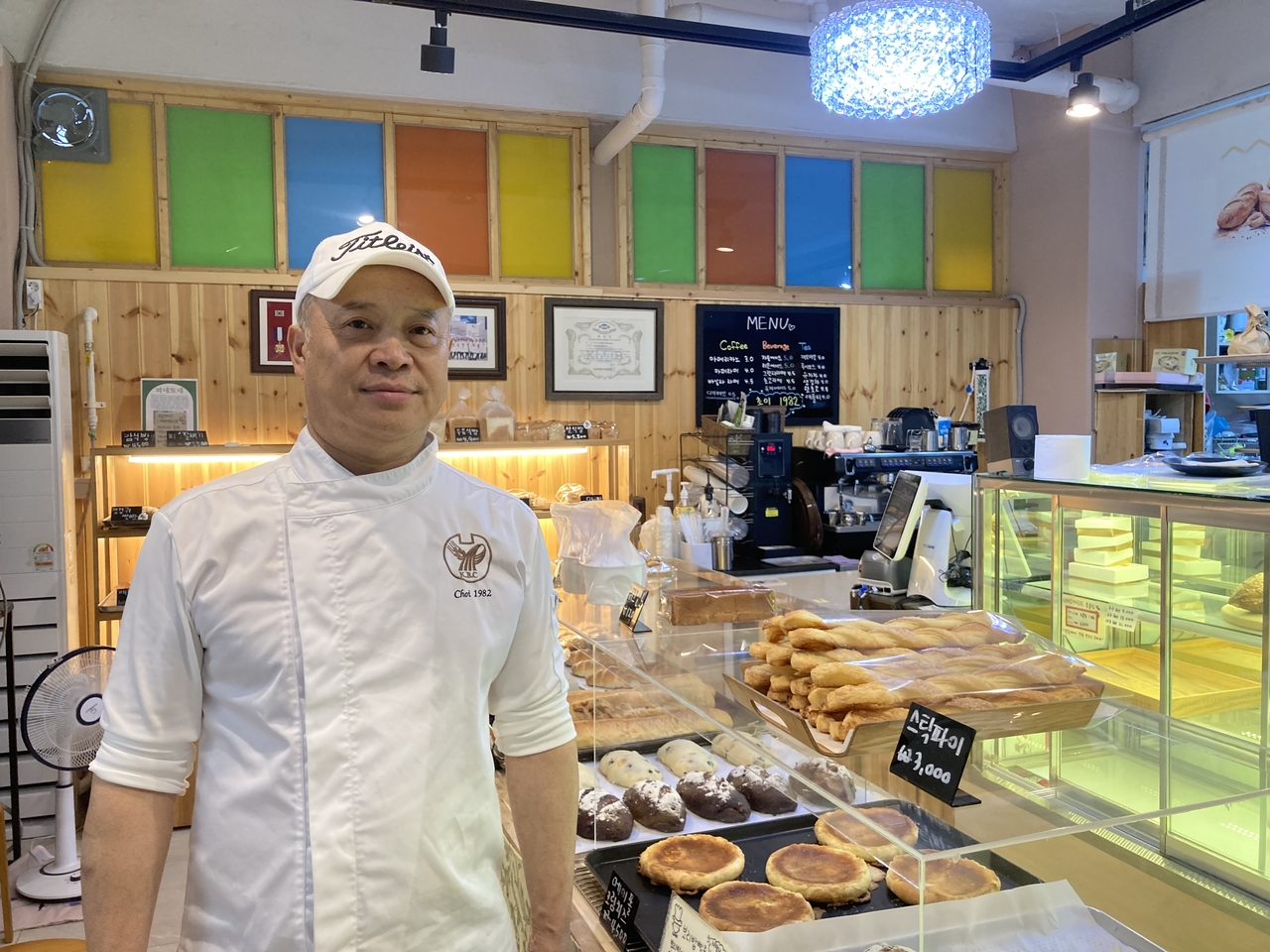
Tucked inside a worn-down commercial building in front of an apartment complex in Ichon-dong, Yongsan-gu, Seoul, is a small bakery called Choi1982. The shop is modest — barely 33 square meters with room for only about three tables — but it has become a neighborhood favorite. Its barley-rice bread and thistle-rice campagne are menu items found nowhere else. On a relatively quiet afternoon, Choi Yong-hyun, 64, dressed in a white chef's coat like any other bakery owner, moved briskly between the oven and the prep counter, checking on his loaves. He looked every bit the ordinary neighborhood baker — but behind that familiar image lies a story he has kept largely to himself.
Choi was born in Gimje, North Jeolla Province, in 1962, a young man full of dreams who had wanted to pursue music. Circumstances made that impossible. In 1981, at the age of 20, he moved to Seoul, where his married older sister lived, and stayed with her while searching for a livelihood. Through an introduction from his brother-in-law, he landed a job almost by chance at the bakery division of the Shilla Hotel. At the time, he said, it never occurred to him that he would end up making bread for a living.
"When I first went in to learn baking, I found that every task had its stages," Choi said. "I started with cleaning and washing dishes." But he was quick with his hands. "I picked things up fast, so within a few months I was able to start actually making bread," he said. He added that once something captures his attention, he sees it through to the end. "I was young, so I didn't even feel how hard it was — I worked day and night. Even after my shift, I'd stay behind alone to practice."
That drive paid off quickly. Choi went on to hone his skills at a string of Seoul's top five-star hotels, including the Swiss Grand Hotel in Hongneun-dong, Seodaemun-gu, and the Novotel Ambassador Seoul Gangnam in Yeoksam-dong, Gangnam-gu, establishing himself as a standout talent in the bakery field.
"At the Swiss Grand Hotel, I was lucky enough to learn chocolate-making from a renowned Swiss chef," Choi said. "Back then — the 1980s — not many people in Korea knew how to work with chocolate, so having a great mentor let me get into the field early." At the Novotel Ambassador Seoul Gangnam, he went on to learn a wide range of desserts from a French chef.
"I had a natural aptitude for it, and I genuinely enjoyed the work, so I threw myself into it," Choi said. "On top of that, I had great mentors, and my skills just kept growing."
With effort and opportunity compounding, Choi rose to become head pastry chef at the Novotel Ambassador Seoul Gangnam in just over a decade after he first started making bread — a rapid ascent that brought him to that position in his mid-30s.
In 1997, Choi made history by developing what he said were the world's first kimchi cake and kimchi jam. The creations drew media attention: in June of that year, several newspapers and broadcasters ran features on him under headlines calling him "the pastry chef who made cake and jam out of kimchi." He later competed in international dessert competitions, winning a silver medal, and carved out a singular reputation in the bakery world.
But success at a young age brought its own complications. "I was head of the hotel's entire bakery operation, with 23 staff under me," Choi said. "But rising to a high position so young meant a lot of pushback. My subordinates collectively reported to management that I was working them too hard."
"I couldn't keep working with people who no longer trusted me," he said. "The hotel wanted me to stay, but I didn't have the confidence to face them every day, so in the end I left."
Choi found himself suddenly unemployed — and it was still 1997, the year South Korea's financial crisis sent companies into bankruptcy and threw masses of workers out of jobs. But someone reached out to help: the French chef who had taught him desserts. Having heard of Choi's situation, his old mentor told him that Heinz, the American company known for its ketchup, was looking to launch a chocolate business in Korea and suggested Choi would be a good fit.
Back at work, Choi became a master chocolatier at Heinz. "Somehow I ended up being one of the first people in Korea to really work with chocolate, at a time when the field barely existed here," he recalled. "I traveled the country teaching chocolate-making, and I even became the national team director for the skills Olympics, competing with students at world championships."
Riding that success, Choi opened a large chocolate factory in Okcheon, North Chungcheong Province, in 2001, launching his own business. He was confident no one could outdo him in chocolate. As expected, the company grew steadily and thrived.
Then came a turning point that would upend everything. One day, Choi noticed his right leg going numb, and he began to limp slightly.
"I liked soccer and exercised a lot, so at first I thought maybe I'd just stretched a ligament," he said. "But my father-in-law saw me and told me to get it checked out." At the hospital, Choi was diagnosed with osteosarcoma — a malignant tumor of the bone. His doctor told him a tumor had developed in his right thigh bone and that the bone would have to be surgically removed, a verdict he said was almost impossible to believe.
Once that blow landed, misfortune kept coming. "There was someone at the company who shared my name," Choi said. "I trusted him — I even taught him chocolate-making." Before going into surgery, he asked this colleague to look after the company while he was away.
Then, within a month of the operation to remove the bone, he received devastating news: the company had gone bankrupt. The trusted colleague had embezzled company funds and deliberately run the business into the ground.
"That was truly the first time in my life I cried tears of blood," Choi said, reflecting on that period. "I went to the factory on crutches and there was nothing left. I collapsed in front of that empty factory, wept, and passed out." He added: "If I had tried to get it all back at that point, I think the bitterness would have consumed me."

Bitter and aggrieved as he was, Choi said he chose to accept what had happened as his fate. Together with his wife, a licensed master pastry chef, he opened a small bakery in Ichon-dong, Yongsan-gu, in 2014. He has been running it for more than a decade since.
Last year, however, another trial arrived. After more than 10 years at the same location, he was abruptly forced out. "The landlord didn't come to explain the situation or anything — just sent a single certified letter," Choi said. "I was furious and felt wronged, but I pulled myself together and started thinking about what to do."
Once again, a helping hand came — this time from the Seoul Metropolitan Government. Choi stumbled upon the Seoul-type Dasiseogi Project, a support program run jointly by the city and the Seoul Credit Guarantee Foundation that gives small-business owners who have experienced failure a chance to start over. The city provides one-on-one consulting, initial funding of up to 2 million won ($1,360), and low-interest credit-guarantee loans.
"When I borrowed 40 million won to reopen, the Seoul Credit Guarantee Foundation covered 2.5 percent interest, and the city also supported the first month's rent of 2 million won," Choi said. "Seoul's help made a real difference in getting back on my feet."
With that support, Choi rehung the Choi1982 sign at a new commercial space about 30 meters from his old shop and reopened last December.
Having spent so many years chasing his own success, Choi said the hardships he endured opened his eyes to others in difficulty. Five years ago, he began giving away free cakes. Every month, working with the local community center, he bakes cakes and distributes them at no charge to elderly residents living alone and to recipients of basic welfare benefits. He keeps the volunteer work quiet — only close family members know about it, he said, because he has no desire to publicize what he does.
"Back when I was charging ahead, I thought honor and money were what happiness meant," Choi said with a smile. "But after going through all of that hardship, I've found that living simply like this — with my family, helping others in small ways — is when I feel most at peace and most happy."
ikson@heraldcorp.com