![The Kospi and other indexes are displayed on a board at Hana Bank's dealing room in Jung-gu, Seoul, on Thursday. The Kospi opened up 165.65 points, or 2.44 percent, at 6,963.35, while the Kosdaq rose 12.42 points, or 1.65 percent, to open at 763.51. [Yonhap]](https://wimg.heraldcorp.com/news/cms/2026/07/23/rcv.YNA.20260723.PYH2026072302820001300_P1.jpg)
The number of companies that debuted on South Korea's stock market in the first half of this year fell to less than half the year-earlier figure. With no major Kospi listings to speak of, total funds raised through initial public offerings dropped nearly 50 percent. As newly listed stocks also began underperforming after their debuts, IPO funds saw two consecutive months of net outflows.
An analysis of Korea Exchange and FnGuide data by Shinyoung Securities on Thursday found that 17 new stocks were listed in the first half of this year — excluding re-listings, transfers to Kospi, SPACs and Konex — a 55.3 percent decline from 38 in the first half of last year.
The listing count was the lowest for any first half since 2020. Last year's first-half tally of 38 — the highest since 2021 — shrank to less than half in just one year. The figure also trails the 10-year first-half average of 27 by 10 companies. Notably, not a single new listing took place in February.
New listings were heavily skewed toward the Kosdaq market. Only one stock — K bank — debuted on Kospi, while 16 companies listed on Kosdaq, meaning 94.1 percent of all new listings were Kosdaq firms.
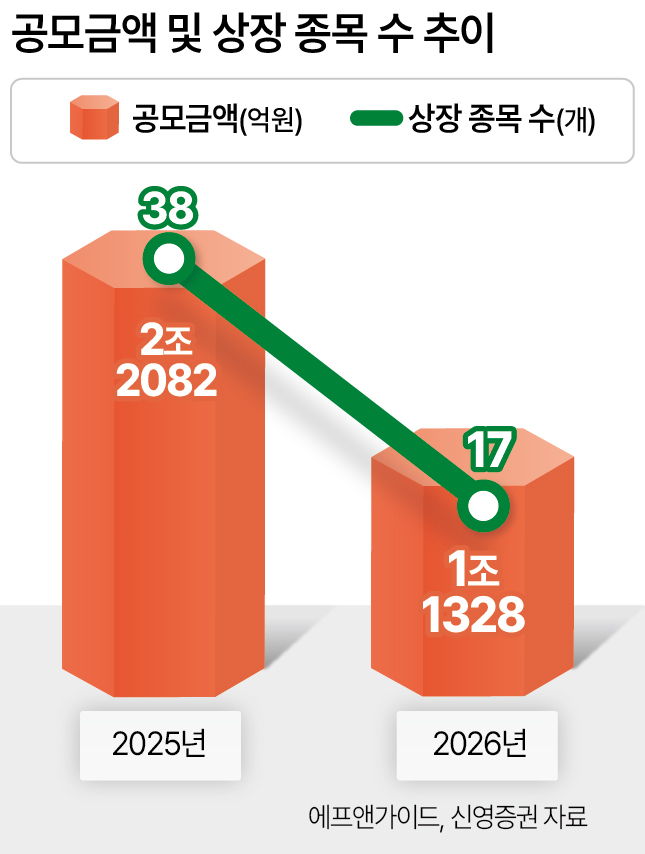
Funds raised through IPOs also fell to roughly half last year's level. Total proceeds in the first half of this year came to 1.13 trillion won ($767 million) — 498 billion won from Kospi and 634.8 billion won from Kosdaq — down 48.7 percent from approximately 2.21 trillion won in the first half of last year.
Weakness in the Kosdaq market further dampened investor appetite for newly listed stocks. Kosdaq fell 18.8 percent from 925.47 at the end of last year to 751.09 on Wednesday. Over the same period, market liquidity concentrated in select semiconductor stocks, leaving investors with relatively little interest in newly listed companies.
"Domestic market flows have been concentrated around parts of the semiconductor value chain," said Oh Gwang-young, a researcher at Shinyoung Securities. "That has left investors less interested in newly listed stocks, which tend to have relatively fragile profit structures."
Changes to the IPO regulatory regime and controversy over dual listings were also cited as factors behind the decline. Oh said the market has been going through an adjustment period since the second half of last year, when reforms took full effect — including expanded mandatory lock-up commitments for institutional investors and tighter eligibility requirements for book-building participation. He added that dual-listing issues affecting major candidates such as Essex Solutions and Netmarble Neo, along with weak post-listing share price performance, also weighed on new listing activity.
Strong first-day returns for newly listed stocks proved short-lived. As of the end of last month, the 17 companies that listed in the first half of this year posted an average return of minus 14.1 percent against their offering prices. Only four stocks were trading above their IPO price, while the remaining 13 had fallen below it, with an average decline of 37 percent.
As Kosdaq's underperformance dragged on relative returns, IPO fund flows turned negative from May. After net inflows from January through April, money began flowing out again in May. Last month alone, 206.8 billion won left IPO funds, marking a second consecutive month of net outflows. As of the end of last month, domestically listed IPO funds had total assets under management of 2.83 trillion won and net assets of 3.77 trillion won.
IPO fund returns also lagged sharply behind the semiconductor-driven market rally. The one-month return stood at minus 2.31 percent, while the six-month and one-year returns were limited to 2.77 percent and 8.31 percent, respectively.
However, the second-half IPO market is expected to recover gradually from the first half. Shinyoung Securities projected 64 to 68 new listings for the full year, with total IPO proceeds in the range of 3.4 trillion to 3.9 trillion won. Analysts also noted that a smaller IPO fund base could ease competition for IPO allocations, potentially creating a more favorable environment for fund performance going forward.
"In the second half, a number of companies that have applied for or received listing approval are waiting in the pipeline, and there is a possibility that companies drawing strong investor interest could also list," Oh said. "If some companies that have been preparing in line with the dual-listing guidelines succeed in going public, we expect major large-cap candidates to follow suit and enter the IPO market."

kacew@heraldcorp.com