South Korea's economy delivered a second consecutive quarter of surprise growth, raising the odds of achieving an annual GDP growth rate of 3% or above. With strong momentum now confirmed, attention is turning to July consumer price data due early next month — if inflation remains elevated, expectations for a consecutive benchmark interest rate hike in August will gain further weight.
The Bank of Korea said Thursday that real GDP expanded 0.6% in the second quarter, more than triple the 0.2% the central bank had forecast in May. The result reflected continued strong export growth led by semiconductors, with domestic demand also lending support.
Lee Dong-won, director general of the Bank of Korea's Financial Statistics II Department, said the growth rate was lower than in the first quarter but noted that a sharp deceleration typically follows an exceptionally strong quarter. "The fact that we sustained 0.6% growth following the high 1.8% expansion in the first quarter shows that the growth momentum has strengthened," he said. He added that real gross domestic income rose 13.2% and 15.6% year-on-year in the first and second quarters, respectively, and that the first-half increase of 14.4% was an exceptionally high rate. He said this was achieved even as the Middle East war drove a sharp rise in import prices, particularly for crude oil, in the second quarter.
Lee said that while some had expected growth to be driven primarily by exports, domestic demand and net exports each contributed equally in both the first and second quarters. "Looking at real GDP and real GDI together, both domestic demand and net exports contributed evenly to growth — not just in the first quarter but in the second as well," he said.
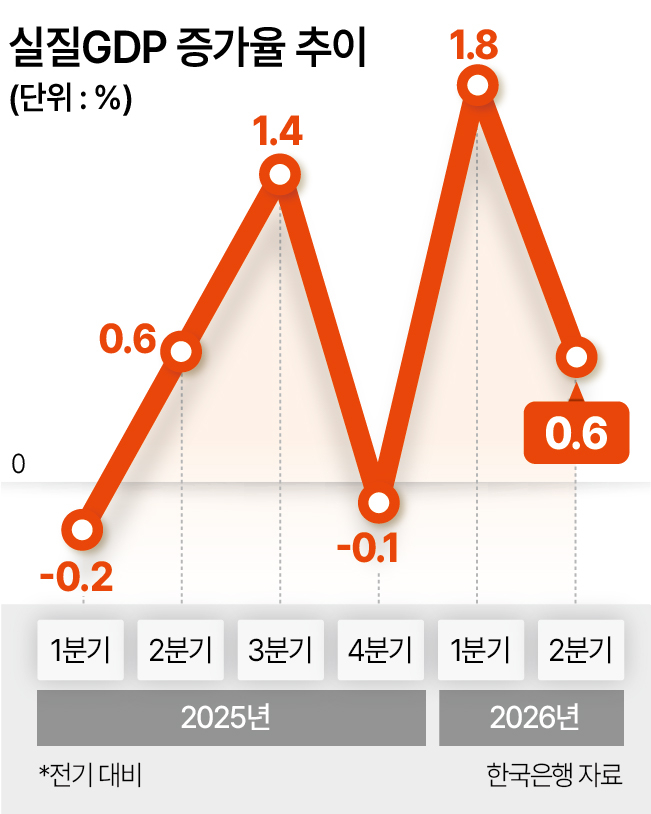
Breaking down the 0.6% quarter-on-quarter growth, domestic demand and net exports each contributed 0.3 percentage points. On a year-on-year basis, domestic demand contributed 2.2 percentage points and net exports 1.6 percentage points. The Bank of Korea attributed the improvement in private consumption to government support measures including a victim support fund for high energy prices, a Samsung Electronics gift-card rebate campaign, and rising share prices.
The back-to-back upside surprises have increased upward pressure on the annual growth forecast. The Bank of Korea has steadily revised its outlook higher since late last year. The forecast was first set at 1.8% in November 2024, then cut 0.2 percentage points to 1.6% in May of last year before being raised back to 1.8% in November of that year. This year, the bank lifted the projection to 2% in February and again to 2.6% in May.
The likelihood has grown that the Bank of Korea will raise its annual growth forecast into the 3% range at its revised economic outlook on Aug. 27. "Based on first-half growth, a simple arithmetic calculation shows that if second-half quarter-on-quarter growth averages as low as minus 0.1%, annual growth of 3% is achievable," Lee said. "That would be the first time growth has exceeded 3% in five years, since the 4.7% recorded in 2021." He cautioned, however, that the implementation of the Middle East ceasefire agreement was not proceeding as expected, and that last year's pattern of weaker first-half and stronger second-half growth could weigh on the outlook. "There is a risk that the second half could be affected by those factors," he said.
Bank of Korea Governor Shin Hyun-song said at a press conference following the Monetary Policy Board meeting on Thursday that the current 2.6% growth forecast was too low and would be revised up "by a considerable margin" at the August policy meeting. The government has also set a 3% growth target for this year in its second-half economic growth strategy.
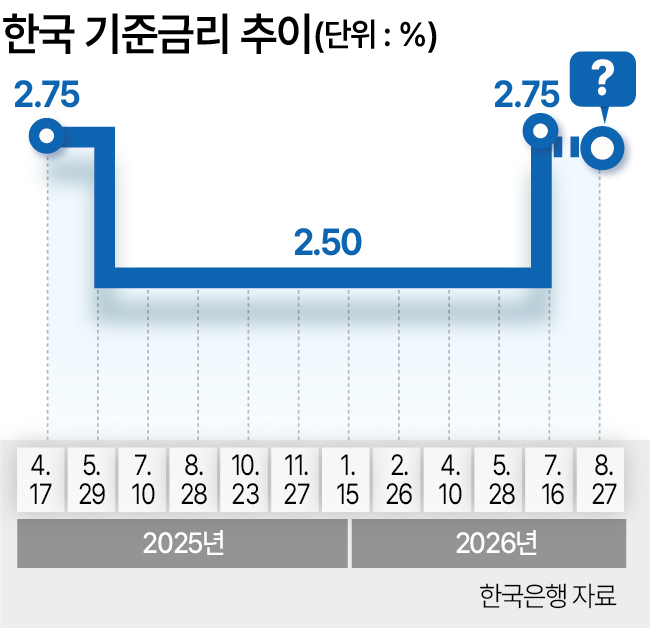
The stronger-than-expected growth has raised the likelihood that the Bank of Korea will accelerate its monetary tightening. With one additional rate hike already anticipated before year-end, the prospect of a consecutive increase at next month's Monetary Policy Board meeting is gaining traction. The board raised the benchmark interest rate by 0.25 percentage points on Thursday and formally signaled further hikes, saying monetary policy "needs to continue on a rate-hiking path." It also added the word "pace" to its policy statement — a term absent from the previous statement — saying the timing and pace of additional hikes would be determined by monitoring inflationary pressures, the trajectory of economic improvement, and financial stability conditions.
The key variable going forward is the July consumer price index, due early next month. With inflation accelerating since the outbreak of the Iran war, a continuation of that trend would add further weight to expectations for a consecutive rate hike. Consumer prices have risen steadily since the conflict began — from 2% at the start of the year to 2.2% in March, 2.6% in April, 3.1% in May and 3.2% in June — moving further from the 2% price stability target. Some analysts expect the pace of increase to ease slightly in July compared with June.
The Bank of Korea is paying particularly close attention to core inflation rather than the headline consumer price index. Core inflation excludes highly volatile items such as energy and food and is used to gauge the underlying, long-term trend in prices. The index excluding food and energy — the central bank's preferred core inflation measure — rose from 2.2% in March and April to 2.5% in May and June.
Governor Shin said at Thursday's press conference that inflation "appears likely to remain above the target level for a considerable period." He added that the Bank of Korea would "respond until we are confident that inflation is converging stably toward the target level," and that "how aggressively we respond will be determined by the data we receive going forward."
kimstar@heraldcorp.com