
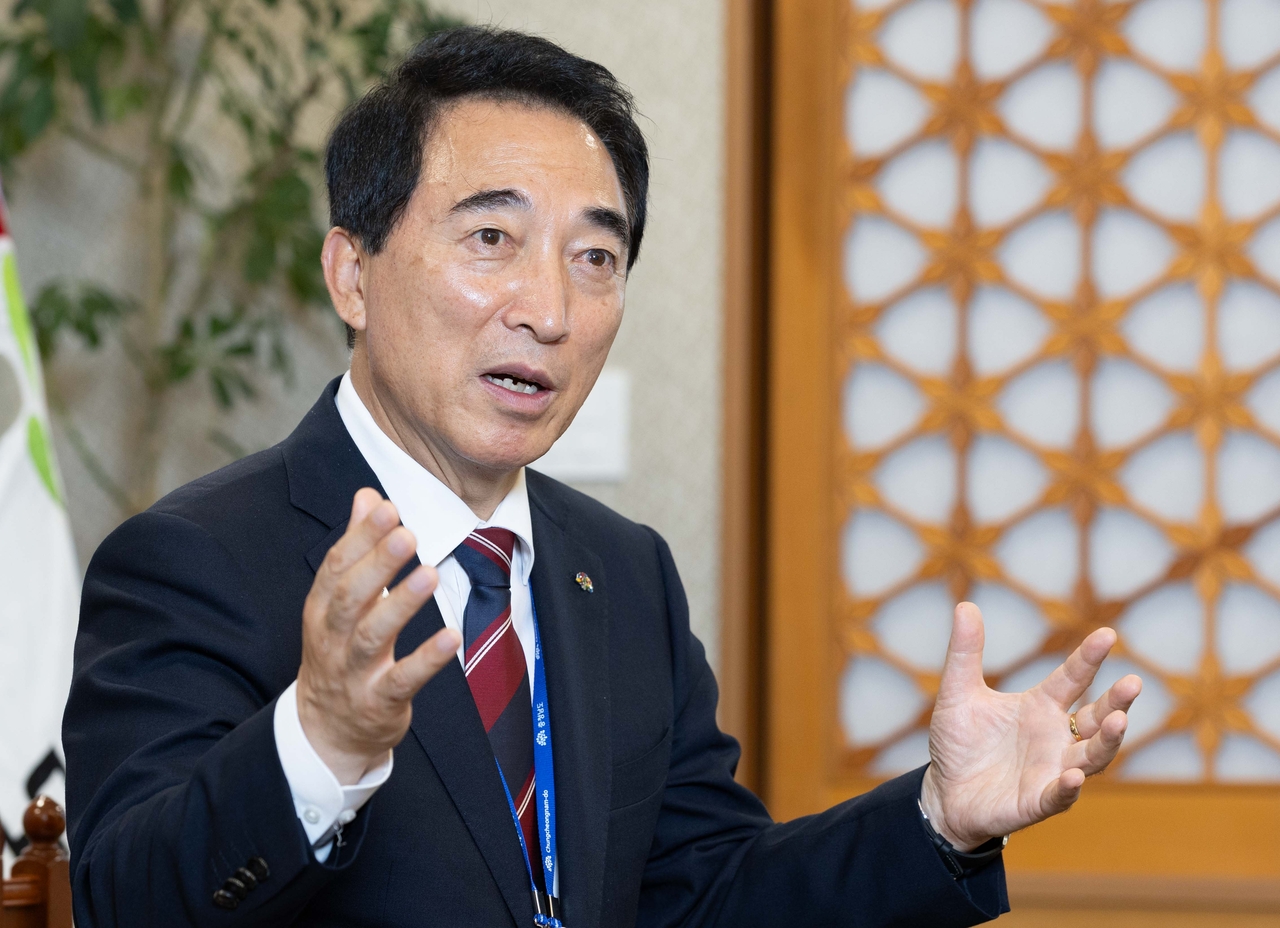
South Chungcheong Province Gov. Park Soo-hyun called the province's inclusion in the government's Mega Project — which brings more than 200 trillion won ($135 billion) in investment to the region — "the greatest opportunity since the founding of the nation," pledging that the provincial government would "do everything in its power to seize leadership in the era of AI transformation." On the push to merge the Daejeon and South Chungcheong administrations, he said the goal of holding a unified mayoral election alongside the 2028 general election "remains valid," adding that as chair of the Chungcheong Metropolitan Union he would "more than make up for the gap left by the suspension of administrative integration."
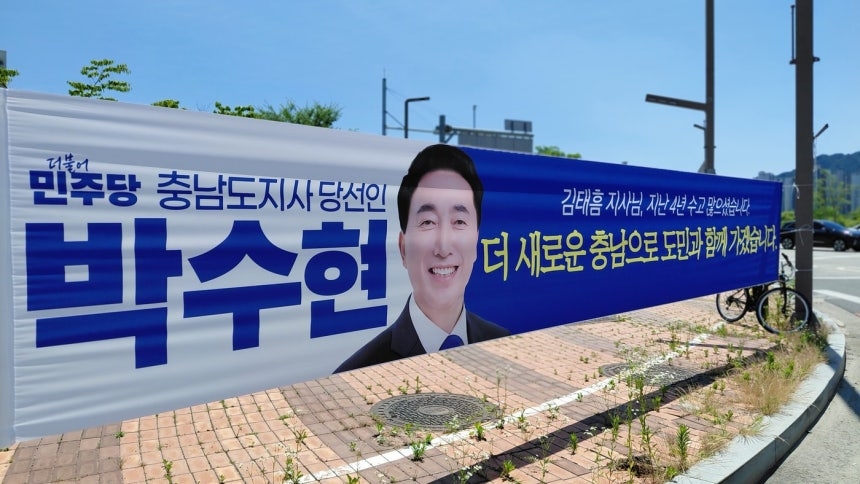
After the June 3 election, banners reading "Governor Kim Tae-heum, thank you for your four years of hard work — we will move forward with the people toward a newer South Chungcheong" appeared across the province. Even after the launch of the ninth directly elected administration under the banner "South Chungcheong That Connects," traces of former Gov. Kim have not disappeared. Signs bearing Kim's provincial vision, "Strong South Chungcheong," remain posted throughout the provincial government building — an unusual sight compared with past transitions, when incoming administrations routinely replaced such signage.
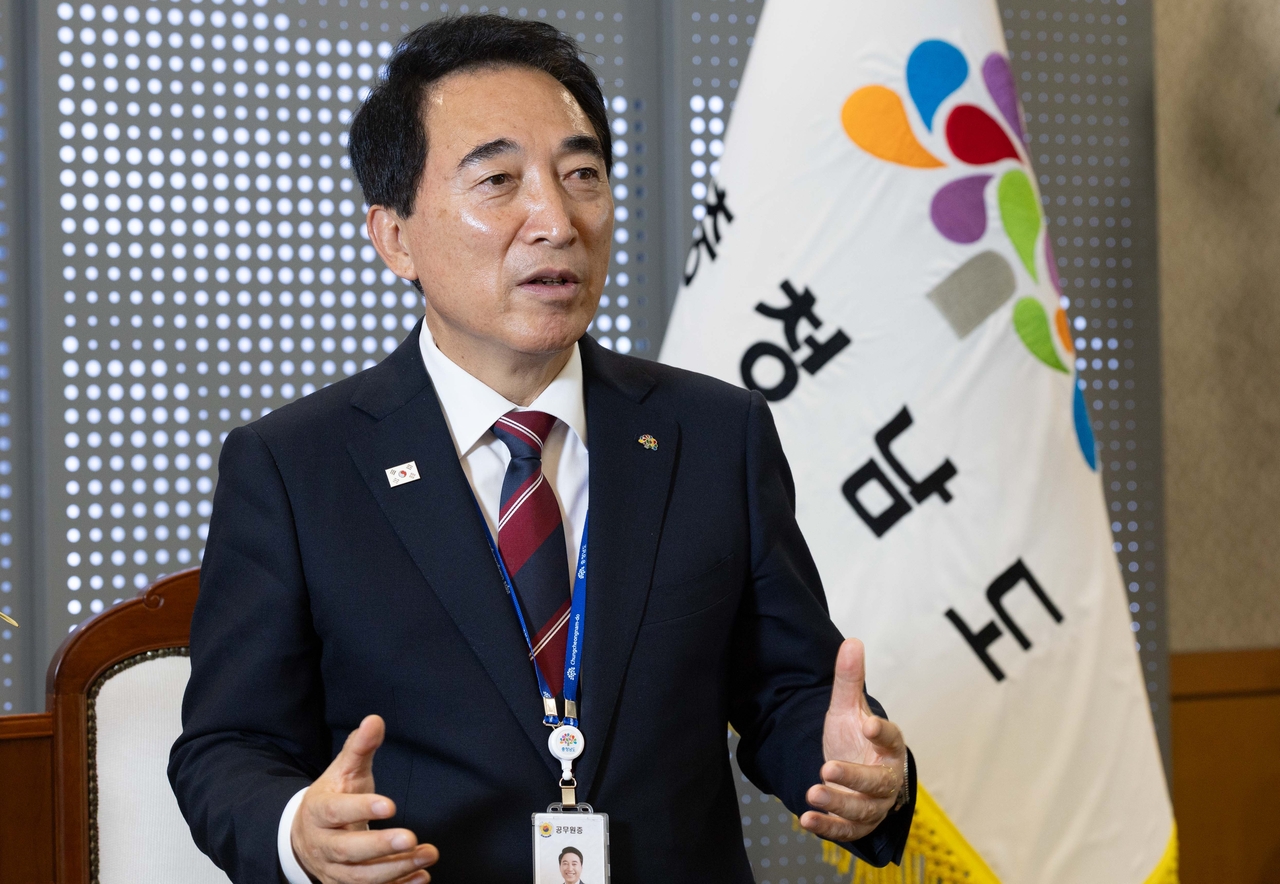
The Herald Business sat down with Park at his office in the South Chungcheong Provincial Government building in Hongseong-gun on Tuesday to hear his blueprint for the ninth directly elected administration. Park pledged to "build this administration on top of the four years of the eighth." Meeting with this reporter for the second time in just over a month — first as a candidate, now as governor — he reiterated that "inheriting what is worth inheriting and honestly supplementing what falls short is responsible governance for the people." The following is an edited transcript of the interview.
— What are your thoughts on winning the election?
▶ It is an honor, but I also feel an enormous weight of responsibility. During the campaign I filled three notebooks with the voices of residents, written in tiny letters — I called them the "South Chungcheong Notebooks." Those three notebooks feel like 3 tons. When I was a National Assembly member, there was time to catch my own mistakes. There was a preparation period, and errors could be corrected through standing committee deliberations. But as governor, the moment I sign something it affects the lives of residents. I will not forget for a single moment the promises contained in those three notebooks. I will serve not only those who supported me but also those who did not, and I will build a united South Chungcheong — not a South Chungcheong divided by elections.
— What is the governing direction for the ninth directly elected administration?
▶ I will make communication the method of governance, AI the future of South Chungcheong, and balanced growth the center of administration. "South Chungcheong That Connects" is not a mere slogan — it means an administration where residents' voices are reflected in policy, budgets, personnel and administration. I will realize "South Chungcheong as the AI capital of South Korea" while ensuring that the fruits of industrial growth are distributed equitably to young people, small and medium-sized enterprises, rural and fishing communities, and vulnerable groups. I will run a practical, continuous administration that inherits the good policies of the previous administration and supplements what was lacking.
— What was the significance of choosing "restoration of loyalty, filial piety and propriety" and "open, communicative governance" as your first official acts?
▶ It means opening the future with advanced technology while also upholding the spirit of the Chungcheong region that has sustained our community. Loyalty is the commitment to fulfilling one's responsibilities to the community and the nation. Filial piety is the practice of respecting elders and the parent generation. Propriety is the basic social order of consideration and mutual respect. I will not let these values remain as slogans of the past — I will put them into practice through concrete policies such as honoring veterans, caring for the elderly, flying the national flag and keeping diaries of love. "The Governor's Office That Connects" is a promise that the governor will open the door first and directly listen to the opinions and criticism of residents, public servants and the press. Only when the future of AI and the roots of these values come together can we complete a people-centered South Chungcheong.
— The Mega Project has been announced. South Chungcheong has been allocated a total of 202 trillion won for future advanced industries including semiconductors and displays. What are your plans for using it?
▶ I will not let the 202 trillion won investment plan stop at an announcement — I will connect it to ground-breakings, employment and regional income. I will link the HBM production base in Cheonan and Asan, next-generation displays, a battery mother factory and AI data centers into a single advanced industry ecosystem. I will proactively build infrastructure — water supply, industrial land and transportation networks — and form a joint task force with the central government and companies to accelerate investment. I will link corporate support and industrial incentives to local talent hiring, local procurement and reinvestment within the province so that added value circulates within South Chungcheong. Of the 392 trillion won earmarked for the Chungcheong region, I will convert the 202 trillion won planned for South Chungcheong into real productive capacity that leads South Korea's decisive edge in AI and semiconductors.
— You have identified power, water and workforce — the so-called "3-force innovation" — as the key to the success or failure of the Mega Project.
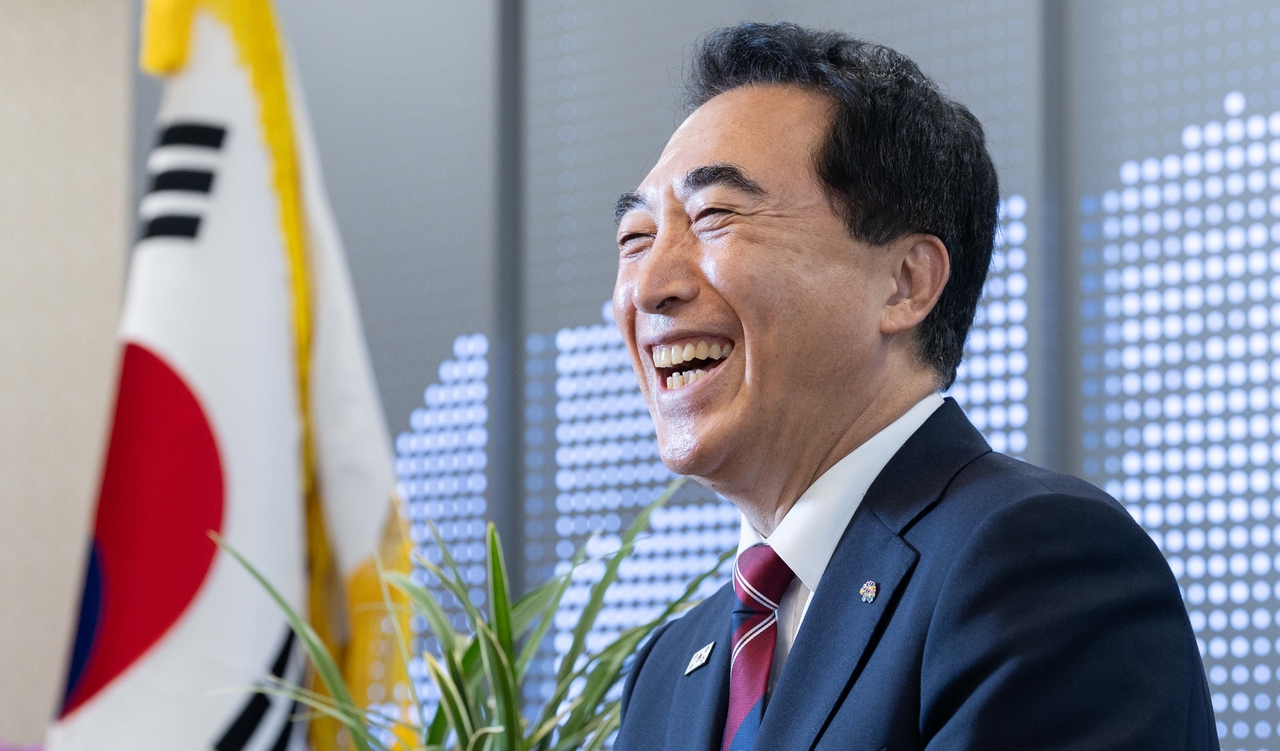
▶ South Chungcheong is receiving 202 trillion won in investment. Through advanced technology investment, the province faces the greatest opportunity in its history to forge ahead. It is a golden chance for South Chungcheong to seize leadership in the nation's AI transformation. To make the most of it, the provincial government will pour everything it has into the 3-force innovation — power, water and workforce. Through the 3-force innovation, we will underpin the AI transformation and advanced industry investment. On power, we rank third or fourth nationally — that is sufficient. Water, however, is a different matter: we do not yet know how much will be needed or whether there will be a shortage. We are currently assessing that through a commissioned study.
— What are South Chungcheong's unique strengths?
▶ Investment in other regions starts literally from the ground up. Just selecting a site, going through the various administrative procedures and actually breaking ground takes five years. South Chungcheong already has the best infrastructure in the country for semiconductors and displays, centered on Cheonan and Asan. This is not investment on bare land — it is more like a scale-up or additional investment on top of what already exists. Sales and exports happen immediately, and jobs are created right away. South Chungcheong is the ideal destination for advanced investment in the AI era. If the front-end processes are being invested in Honam in the southwest, then Cheonan and Asan handle the back-end processes. No matter how much is invested in front-end processes, they are useless without this back-end packaging. I believe the front-end investment going into Honam will ultimately benefit South Chungcheong.
— You have called for an AI transformation centered on balance.
▶ Looking at the pledges and situations of the other 15 metropolitan and provincial governments, they all talk about AI transformation, but it is all focused solely on industrial innovation. South Korea has a precedent of people being left behind and gaps widening during the digital transformation era. The same kind of hard-to-overcome divide could emerge in the AI transformation era — that is why balance is needed. First, there is the balance between industry and people. There is also the need for balance between large corporations and small and medium-sized enterprises. Large companies can carry out AI transformation on their own, but the small and medium-sized enterprises that make up their supply chains are left staring at the sky. Local governments must support those companies. South Chungcheong is not only advanced industry — traditional industries such as fisheries, agriculture, forestry and livestock farming also form a major part of the economy. AI support for those sectors is necessary. These three kinds of balance must not be left out of "South Chungcheong-style AI transformation." If it succeeds, other metropolitan governments that emphasize only industry will envy the model. South Chungcheong can become the AI capital of South Korea.
— On the way to the provincial government building, I heard from a taxi driver that "people aren't gathering in Naepo new town."
▶ There was a logic that Sejong City would substitute for an innovation city, so Daejeon and South Chungcheong were not designated as innovation cities. The thinking was that building Sejong City well would be better than an innovation city, and people trusted what the government said. South Chungcheong gave Sejong land, population and tax revenue. But Sejong City was never completed as a self-sufficient city. The original goal was a self-sufficient city of 500,000 people. After the Constitutional Court ruling that declared the administrative capital unconstitutional, the original plan was cut in half when it became an administrative-centered complex city. Under former President Lee Myung-bak, there was an attempt to cut it in half again by turning it into an enterprise city. Through this process, the plan for a self-sufficient city of 500,000 collapsed. When a new town is properly completed, it draws in surrounding areas like a black hole and then later fills those surrounding areas in return — just look at Gwacheon. But because the concept and political will surrounding the administrative capital changed with every administration, Sejong City was never properly completed. As a result, surrounding cities were simply drawn in and suffered losses without receiving any of the benefits. Because we were not benefiting from Sejong City, we demanded that Naepo new town be designated an innovation city. The designation finally came — belatedly, in 2020. But not a single public institution has relocated there yet. The second round of public institution relocations begins next year. Because the designation came so late, I plan to demand that, as compensation, the pace be faster and more public institutions be sent down.
— What are your research and development plans for Naepo new town and South Chungcheong as a whole?
▶ I will develop Naepocheonan as the core R&D hub of South Chungcheong while building a region-specific specialized R&D network rather than concentrating all functions there alone. The Chungnam National University Naepocheonan campus passed the central investment review on July 9, and is being developed with a total project cost of 46.9 billion won, a capacity of 252 students, and a target opening year of 2031. Centered on departments in animal quarantine, biohealth and digital agricultural mobility, along with related research centers, I will develop Naepocheonan as an industry-academia-research hub for green biotech and future mobility. Cheonan and Asan will specialize in semiconductors, displays and manufacturing AI; Seosan and Dangjin in petrochemicals, steel and hydrogen energy; Nonsan and Gyeryong in the defense industry; and the southwestern region in agricultural life sciences and marine biotech. I will connect universities, companies and research institutions across each region so that all of South Chungcheong becomes one vast R&D campus.
— You have pointed to the problem of gross regional domestic product leaking outside the province. What are the specific solutions?
▶ I will transform the economy into one where earnings, spending and reinvestment all happen within South Chungcheong. In attracting large-scale corporate investment, I will encourage not only production facilities but also headquarters functions, research institutes and decision-making functions to take root in South Chungcheong. I will link corporate support and industrial incentives to local talent hiring, local procurement and reinvestment within the province so that added value circulates within the region. I will develop high-value service industries — in healthcare, education, culture, tourism and finance — where the province is currently weak, so that residents' spending does not flow out to the greater Seoul area. This is not a promise to reduce the outflow to zero overnight, but a commitment to clearly restructure the outflow pattern during my term and produce results in which residents' real incomes actually increase.
— The president has mentioned realistic difficulties. How is the Daejeon-South Chungcheong administrative integration proceeding?
▶ My will and direction on administrative integration have never changed. The goal of holding a unified mayoral election alongside the 2028 general election remains valid, and I believe the Chungcheong region must work together to resolve the practical challenges of integration. At his first-anniversary press conference, the president said that further administrative integration would "realistically be impossible before the next local elections." I see this not as a signal that the direction has changed, but as an expression of regret that there are many practical challenges to resolve — such as adjusting local councils and redrawing electoral districts. Gwangju and South Jeolla Province have already integrated and are moving ahead of us. The later we are, the further behind we will fall — I feel a strong sense of urgency about that.
— If the 2028 integration proceeds as planned, what about the burden of a by-election? Is there any communication with Daejeon Mayor Heo Tae-jeong?
▶ Mayor Heo and I share an understanding of the need for integration and the direction it should take. We will closely coordinate the method, timing and details of special provisions through a joint consultative body. However, integration must be decided not on the basis of the two leaders' political schedules, but on the future of the residents of Daejeon and South Chungcheong.
— You are expected to be elected chair of the Chungcheong Metropolitan Union later this month. What role will you play?
▶ In a situation where administrative integration cannot be realized immediately, the Chungcheong Metropolitan Union is the vehicle needed to secure large-scale government support. The union was launched but has failed to secure supra-regional projects and budgets. We must therefore actively identify and pursue shared agendas — regional transportation networks, industry and tourism. Even without administrative integration, we can raise the competitiveness of the region as a whole, and we must make proper use of the special local government body that aligns with the government's "5-pole, 3-special" strategy. With the passage of a balanced development law this past May, the Chungcheong Metropolitan Union, as a special local government body, gained the authority to request its own budget. I will fully activate the union through practical measures and more than make up for the gap left by the suspension of administrative integration. I will rally the region around the 392 trillion won Chungcheong advanced industry investment plan as the flagship joint initiative.
— The Summer Universiade will be held in the Chungcheong region starting Aug. 1 next year. How are preparations going?
▶ It is one of my biggest concerns. Things drifted along aimlessly in the aftermath of former President Yoon Suk Yeol's insurrection. There are also worries about a repeat of the "Jamboree incident." Fortunately, the People Power Party governors and mayors in the eighth directly elected administration had been working through the Chungcheong Metropolitan Union on the Universiade. It is a concern, but it is also something we absolutely must pull off. When I was at Cheong Wa Dae, I was directly involved in or witnessed the preparations for the 2018 PyeongChang Winter Olympics. PyeongChang's preparations were lacking, but the Moon Jae-in administration pushed forward with force and made it a successful "Peace Olympics." The Gyeongju APEC summit, prepared under the previous administration, was also a major concern when the Lee Jae Myung government took office — but we pulled it off. I have that experience of working together through the National Policy Planning Committee, so as union chair I will do my utmost to use the Chungcheong Metropolitan Union to make this Universiade a success.
— What policies of the previous governor will you carry forward?
▶ There is no distinction between predecessor and successor, or between ruling and opposition parties, when it comes to good policy — I will carry forward without wavering any policy that is necessary for residents. I will continue to pursue the Chungnam National University Naepocheonan campus, the development of the defense industry, the Chungcheong Metropolitan Union, public institution relocation and the just transition for regions where coal-fired power plants are being decommissioned. In particular, I will connect the industrial foundation and large-scale investment plans established in the eighth administration to the ninth administration's AI transformation strategy to produce even greater results. The decision not to hastily remove the previous administration's symbols or unnecessarily change the office furnishings and official vehicles was also intended to demonstrate the continuity of governance and a commitment to saving the budget. Inheriting what is worth inheriting and honestly supplementing what falls short is responsible governance for the people.
■ Park Soo-hyun — career profile
Born in Gongju, South Chungcheong Province, in 1964.
Graduated from Gongju Teachers' College High School in 1983; enrolled in the Department of Western History at Seoul National University before withdrawing.
Earned a bachelor's degree in public administration from Korea National Open University in 2001.
Earned a master's degree in public administration from Yonsei University's Graduate School of Public Administration in 2002.
Served as presidential spokesperson at Cheong Wa Dae in 2017.
Served as chief of staff to the National Assembly Speaker in 2018.
Served as senior presidential secretary for public communication in 2021.
Served in 2025 as chair of the Balanced Growth Special Committee under the National Policy Planning Committee and as chief spokesperson of the Democratic Party of Korea.
Served as a National Assembly member in the 19th and 22nd Assemblies, representing Gongju and later the Gongju-Buyeo-Cheongyang constituency in South Chungcheong Province.
The 40th governor of South Chungcheong Province.
ken@heraldcorp.com
cook@heraldcorp.com



