
![Hyundai Motor's factory in Piracicaba, São Paulo state, Brazil. [Hyundai Motor]](https://wimg.heraldcorp.com/news/cms/2026/07/23/news-p.v1.20260722.8ac721661f7c4bd4a0132b872079a0bc_P1.jpg)
Hyundai Motor posted double-digit sales growth in Brazil in the first half of this year. The automaker is now targeting a return to fourth place — a ranking it lost to China's BYD — by leveraging its local production base to drive sales higher in the second half.
Brazil's National Association of Motor Vehicle Distributors said Thursday that Hyundai Motor registered 96,643 passenger cars in the country in the first half of this year, up 14.5% from 84,372 units in the same period last year. The automaker ranked fifth, trailing Volkswagen (199,826 units), Fiat (142,731 units), General Motors (117,098 units) and BYD (98,655 units).
Hyundai Motor had held fourth place in the first half of last year but was pushed down one spot by BYD this year. The gap between the two stood at just 2,012 units, but the pace of growth differed sharply: BYD more than doubled its sales from about 47,100 units in the first half of last year to 98,655 units this year.
Hyundai Motor nonetheless outsold Toyota by roughly 40,000 units, with Toyota recording 55,488 units in the period.
Market share trends also diverged. Hyundai Motor's share of the passenger car market slipped 0.7 percentage points, from 9.6% in the first half of last year to 8.9% this year. The overall Brazilian passenger car market expanded 23.7%, from 878,517 units to about 1.09 million units over the same period, outpacing Hyundai Motor's own growth rate. BYD lifted its share from around 5% to 9.1%.

HB20, Creta hold strong, but BYD's EV push intensifies
Hyundai Motor's sales were driven by the HB20, its locally tailored model, and the compact SUV Creta. The HB20 recorded 38,930 registrations in the first half, up 5.6% from a year earlier, though steeper growth by rival models pushed its overall ranking down from fourth to sixth. The Creta grew 15.2% to 35,925 units, holding third place in Brazil's SUV segment. The sedan variant HB20S posted the highest growth rate among Hyundai Motor's key models, surging 37.9% to 20,588 units and ranking 19th overall.
Combined, the three models accounted for 95,443 units — about 98.8% of Hyundai Motor's total passenger car sales in Brazil. That reflects a stable sales base built around locally produced models, but heavy concentration in a handful of nameplates remains a challenge.
BYD, by contrast, saw its Dolphin Mini rank eighth among all models with 35,669 units, while the Song, a plug-in hybrid SUV, placed 10th with 31,524 units. The Dolphin also sold 18,047 units.
![The HB20, Hyundai Motor's Brazil-focused model. [Hyundai Motor]](https://wimg.heraldcorp.com/news/cms/2026/07/23/news-p.v1.20260722.89eb9b28fc6047b3ba4765eafa5cc1ef_P1.jpg)
BYD's advance was particularly pronounced in the retail segment. In first-half retail sales, BYD held a 13.1% share compared with Hyundai Motor's 7.9%. In direct sales — which include corporate fleet and rental car purchases — Hyundai Motor led with 10.1% against BYD's 4.2%. Hyundai Motor retains an edge in corporate demand, while BYD has been building its presence primarily among private buyers.
The gap widened further in June alone. BYD sold 21,219 units for a 10% share, while Hyundai Motor sold 16,425 units for a 7.7% share — a monthly difference of 4,794 units.
Euisun Chung to visit Brazil amid $1.1 billion investment review
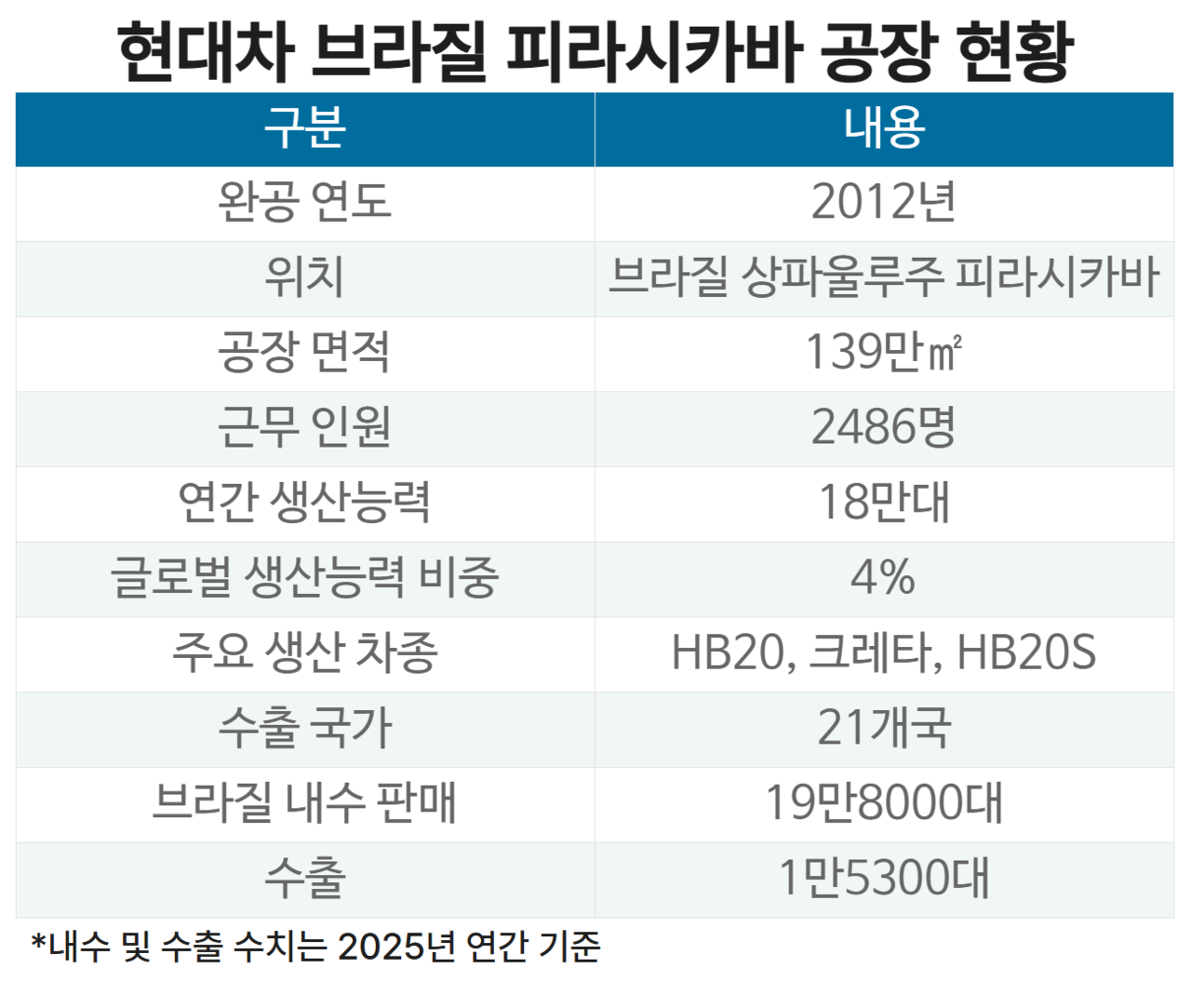
Hyundai Motor entered the Brazilian market in 1992 and has operated a factory in Piracicaba, São Paulo state, since 2012. The plant covers 1.39 million square meters and has an annual production capacity of 180,000 vehicles, serving as the manufacturing hub for locally focused models including the HB20.
Local production offers a significant competitive advantage by letting Hyundai Motor avoid import tariffs that can reach as high as 35%. The Piracicaba plant sold 104,228 vehicles in the first half of this year, up 8.0% from the same period last year. Exports fell 21.9% to 6,869 units, but domestic sales in Brazil rose 11.0% to 97,359 units, driving overall growth.
Kia still has a much smaller footprint in Brazil than Hyundai Motor. The brand sold about 2,200 units in the first half of this year, including 2,044 units of the K2500 light commercial vehicle and 127 units of the Carnival. Without a local production facility, Kia relies entirely on imports, and tariff and logistics costs weigh on its price competitiveness. The company is set to launch the Tasman pickup truck in August to broaden its lineup, and is expected to explore local production over the medium to long term depending on sales volumes and policy developments.
Hyundai Motor Group Chairman Euisun Chung is scheduled to accompany President Lee Jae-myung on a state visit to Brazil from Sunday through Wednesday as part of an economic delegation.
Chung met Brazilian President Luiz Inácio Lula da Silva in 2024 and announced plans to invest $1.1 billion in Brazil through 2032. The investment targets include hybrid vehicles, electric vehicles and green hydrogen technology. During Lula's state visit to South Korea in February, the two sides also discussed expanding local business operations and cooperation in advanced industries.
During this visit, the agenda is expected to cover progress on the existing investment plan, expansion of local hybrid and electric vehicle production, research and development, and strengthening of parts supply chains.
kwater@heraldcorp.com




