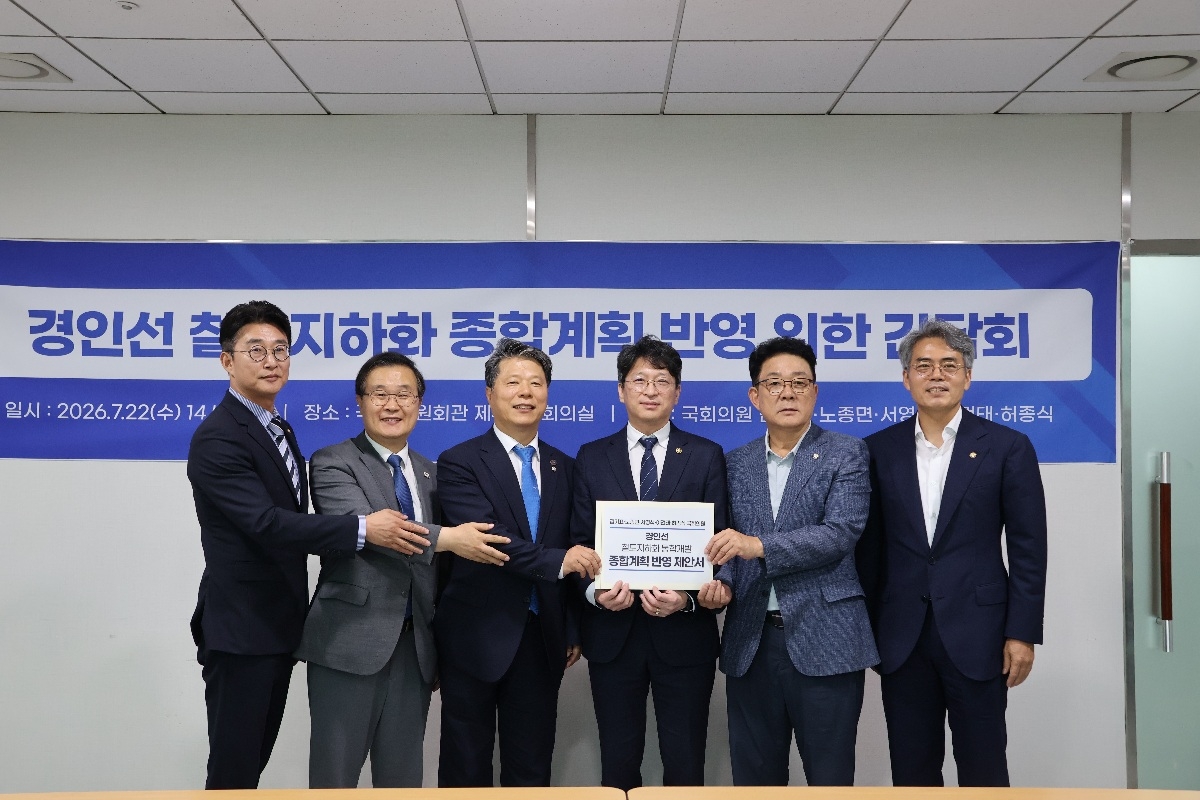
National Assembly members from Incheon and Bucheon have joined forces to push for the undergrounding of the Gyeongin Line as part of the government's national planning framework.
The lawmakers are backing a plan to bury the above-ground Gyeongin Line — long cited as an obstacle to development in older urban cores — and pursue integrated development of the surface space as a catalyst for urban regeneration.
Reps. Heo Jong-sik and No Jong-myeon of Incheon, along with Reps. Kim Gi-pyo, Seo Yeong-seok and Lee Geon-tae of Bucheon, met with Hong Ji-seon, second vice minister of the Ministry of Land, Infrastructure and Transport, at the National Assembly building on Wednesday to discuss plans for undergrounding the line.
The lawmakers asked the ministry to include in its forthcoming comprehensive railway undergrounding and development plan a proposal to underground a 22.8-kilometer stretch covering 17 stations from Incheon Station to Onsu Station.
They also said integrated development of existing rail sites and surrounding areas was essential to restoring the competitiveness of older urban districts.
The lawmakers said the Gyeongin Line had for decades divided city centers along an east-west axis, hampering balanced regional development and worsening residents' living conditions through noise, vibration and traffic disruption.
They said the railway had fragmented urban functions and constrained development in the older urban cores of Incheon and Bucheon, and that a national-level solution was needed.
"The Gyeongin Line is the key rail corridor linking the western Greater Seoul area, so it must be approached not merely as a transportation project but as a national undertaking for urban regeneration and the restoration of city competitiveness," the lawmakers said in a joint statement. "Now that the political communities of Incheon and Bucheon have united, the government must move forward with urgency."
Vice Minister Hong said the ministry would "actively review and reflect regional views in the course of pursuing the project, given its structural connection to the Gyeongbu Line undergrounding project around Guro Station."
The Ministry of Land, Infrastructure and Transport is currently drawing up a comprehensive plan covering railway undergrounding and the use of rail sites nationwide under a special act on railway undergrounding and rail site development.
If the Gyeongin Line is included in the plan, it is expected to provide the institutional foundation needed to move the project forward.
gilbert@heraldcorp.com