
As the Lee Jae Myung administration pushes to reclaim wartime operational control before the end of its term, conservative voices warned Wednesday that rushing the transfer without meeting the agreed conditions could dissolve the Combined Forces Command and weaken the South Korea-US alliance.
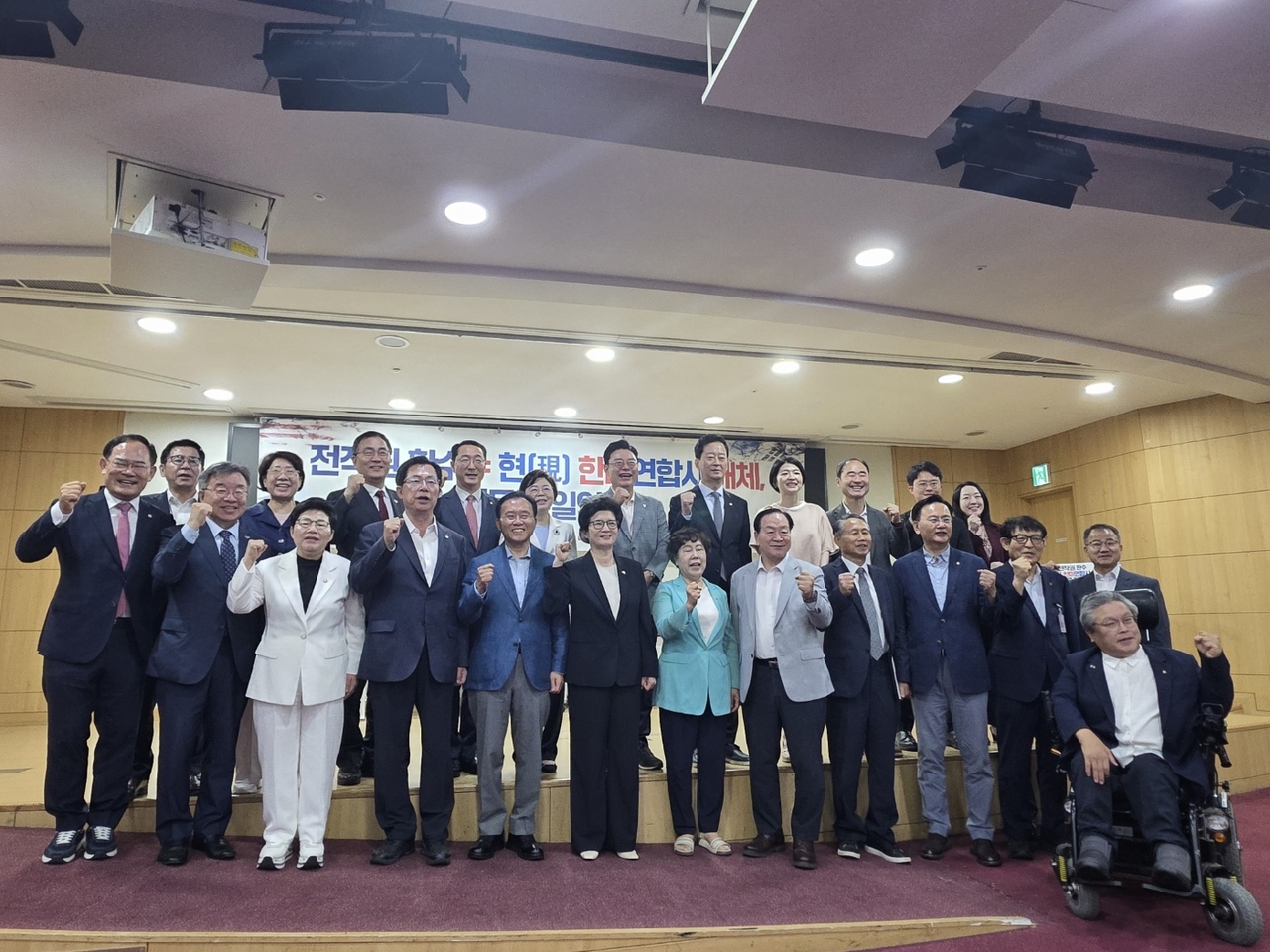
People Power Party lawmaker Kang Seon-young and the Korea Peninsula Advancement Foundation's North Korean Nuclear Response Research Council co-hosted the forum "Is OPCON Transfer — and Dissolving the Current CFC — Something to Rush?" Wednesday morning at the National Assembly Members' Office Building.
In her opening remarks, Kang said the OPCON debate "is a matter that the National Assembly and the public must fully discuss and deliberate on, sharing sufficient information — not just the government, the military and alliance partners."
She said that with North Korea, China and Russia accelerating military modernization, and Kim Jong-un deepening his aggressive foreign strategy — dispatching troops to Russia's war, attending Vladimir Putin's Victory Day events and holding a summit with Xi Jinping — "there is no angle from which the conditions for OPCON transfer can be seen as having improved."
She also criticized what she described as President Lee Jae Myung and Defense Minister Ahn Gyu-back's apparent view that reclaiming OPCON as early as Thursday would pose no problem, saying the administration is rushing toward an early transfer by 2027.
She said "pushing OPCON through as a political sprint amid worsening military coordination among North Korea, China and Russia, and North Korea's increasingly aggressive posture, is a dangerous gamble tied to secret negotiations that have not been explained to the public," and called on the government to transparently disclose the negotiating variables and security risks it has been concealing.
Park Hwi-rak, chairman of the Korea Peninsula Advancement Foundation's North Korean Nuclear Response Research Council, directly challenged the current government's approach to OPCON transfer in a presentation titled "Misconceptions and Arrogance Surrounding OPCON Transfer."
Park said OPCON transfer "is being consumed only as a symbol of self-reliant defense," adding that it "has devolved into a competition of political and ideological symbols, spreading an 'early transfer' frame that ignores actual security conditions and military requirements."
He said OPCON "is not a simple symbol of sovereignty, but a complex concept combining specific military capabilities, alliance structure and command systems."
Park warned that advancing the timetable before the dual command-and-control design — a Korean commander paired with a US deputy commander, operating through a Military Coordination Committee — "has been sufficiently matured and verified is a dangerous experiment."
Jang Jae-gyu, a professor in the department of military studies at Yeungnam University, addressed the alliance-politics context of OPCON transfer and the challenges it poses for combined defense. He argued that any structural change to OPCON would inevitably require adjusting USFK's role and redesigning the South Korea-US alliance.
Jang said dissolving or restructuring the CFC "is not a simple organizational overhaul, but a process of rewriting the alliance's 'political contract' — covering USFK's roles and missions, C4I (command, control, communications, computers and intelligence) systems, DEFCON transitions in a crisis, and the operation of joint delegated authority." He warned that "if a political sprint proceeds without sufficient strategic dialogue and domestic political consensus, cracks could form in alliance trust and crisis-management mechanisms."
Hong Tae-hwa, a fellow at the Foreign Policy Research Institute in the United States, argued that American strategy and OPCON transfer are not a cause-and-effect relationship but mutually interacting dynamics, and that the transfer would accelerate a US drift away from the Korean Peninsula.
Hong said that while OPCON transfer "is a path that must eventually be taken, the question is one of speed, form and conditions," and added that "it has been one of the ties that at least kept the focus of US regional strategy anchored to the Korean Peninsula — and a hasty transfer could become South Korea's own choice to cut that tie."
rimsclub@heraldcorp.com




