
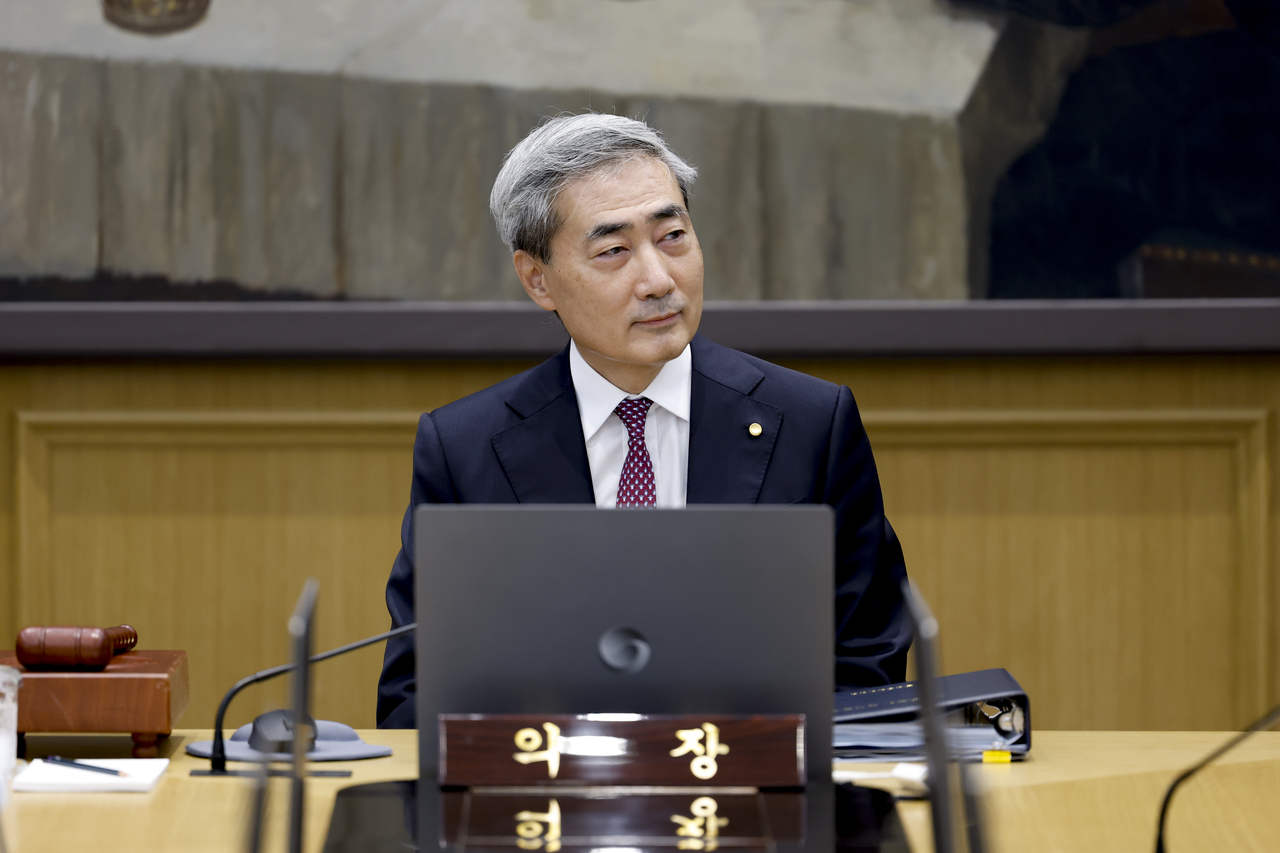
With the Bank of Korea entering its first full tightening cycle in three and a half years, markets are closely watching how far the benchmark interest rate will rise. Analysts say that if the government's 3 percent potential growth rate target is realized, the neutral interest rate — the benchmark for setting policy rates — will also climb, pushing borrowing costs higher.
Financial industry sources said Tuesday that the government's pledge in its "Second-Half 2026 Economic Growth Strategy" to lift the potential growth rate to 3 percent has fueled expectations that the neutral rate will follow suit.
The potential growth rate refers to the pace at which an economy can expand when all its resources are fully utilized. A falling potential growth rate signals weakening economic fundamentals and diminished long-term growth capacity; a rising one signals the opposite.
Potential growth rates and neutral interest rates generally move in tandem. The neutral rate is the interest rate level at which the economy can grow steadily without pushing inflation up or down — an ideal policy rate, and a compass for monetary policy.
When the potential growth rate rises, the neutral rate tends to rise with it, increasing the likelihood that the benchmark rate will also move higher. "The potential growth rate is an indicator of the average return on capital that can be expected from economy-wide investment, and the neutral rate also reflects the economy's average rate of return," a Bank of Korea official said. "In general, all else being equal, when the potential growth rate rises, the neutral rate rises too, and there is more room to raise the benchmark rate."
Bank of Korea analysis estimates South Korea's potential growth rate at 3.4 percent between 2011 and 2015. The figure has been on a steady decline from around 5 percent in the early 2000s and has recently fallen as low as 2 percent. By OECD estimates, South Korea's potential growth rate has been declining since 2012, when it stood at 3.6 percent, and is projected at 1.66 percent this year — with a further drop to 1.52 percent forecast for next year.
According to the Korea Capital Market Institute, South Korea's real neutral interest rate fell from 1.7 percent in the early 2000s to minus 0.3 percent in 2023 — tracking the decline in the potential growth rate over more than two decades.
Domestic and international institutions had long forecast that the potential growth rate would continue to fall, driven mainly by an aging population. Recently, however, a growing number of analysts expect the AI-led "knowledge revolution" to reverse that trend. "In the past, more attention was paid to downside risks to the potential growth rate, but now, as AI spreads, expectations are growing that it could push the rate higher," a Bank of Korea official said.
The Bank of Korea currently estimates the nominal neutral rate at between 2 and 3 percent. At that range, the current benchmark rate of 2.75 percent is close to equilibrium. But if the neutral rate rises, the current rate would fall below that equilibrium. "If the neutral rate were to rise to 3.5 percent, then 2.75 percent would still be low and accommodative," a Bank of Korea official said.
A higher neutral rate would push up both lending and deposit rates. The dynamic echoes the early 2000s, when deposit rates ran at 4 to 5 percent alongside a potential growth rate of 5 to 6 percent. Data obtained by People Power Party lawmaker Lim Se-jun from the Bank of Korea show that a 0.25 percentage point increase in mortgage rates would raise the annual interest burden on all borrowers by 1.8 trillion won ($1.21 billion).
The key question going forward is whether the current semiconductor-led economic expansion proves a temporary surge or takes hold as a structural growth trend. In a recent report, the Bank of Korea said the current semiconductor upcycle "is driven not merely by short-term supply-and-demand factors but by structural demand growth stemming from the spread of AI, making it likely to exceed past cycles in both magnitude and duration."
Markets are focused on the second-quarter real GDP flash estimate due Thursday. The first-quarter real GDP preliminary figure rose 1.8 percent quarter-on-quarter, the highest quarterly growth rate since the third quarter of 2020, when it expanded 2.3 percent. For the second quarter, export growth led by semiconductors is expected to support the growth rate despite headwinds from the Iran war and a high base effect from the first quarter. The Bank of Korea had earlier projected second-quarter growth at 0.2 percent. At a press conference following the Monetary Policy Board's rate decision on Thursday, Gov. Shin cited second-quarter GDP and gross domestic income figures as the first key variables in determining the timing and pace of future rate hikes.
Some market participants forecast the benchmark rate will reach a terminal rate of 3.5 percent by next year, including one additional hike within this year. The possibility of back-to-back rate increases at the August Monetary Policy Board meeting is also being discussed.
kimstar@heraldcorp.com




