![Members of the Hyundai Motor branch of the Korean Metal Workers' Union hold a rally ahead of collective bargaining negotiations in May. [Provided by Hyundai Motor union]](https://wimg.heraldcorp.com/news/cms/2026/07/21/news-p.v1.20260721.6e824532848f4307898f280c537c7795_P1.jpg)
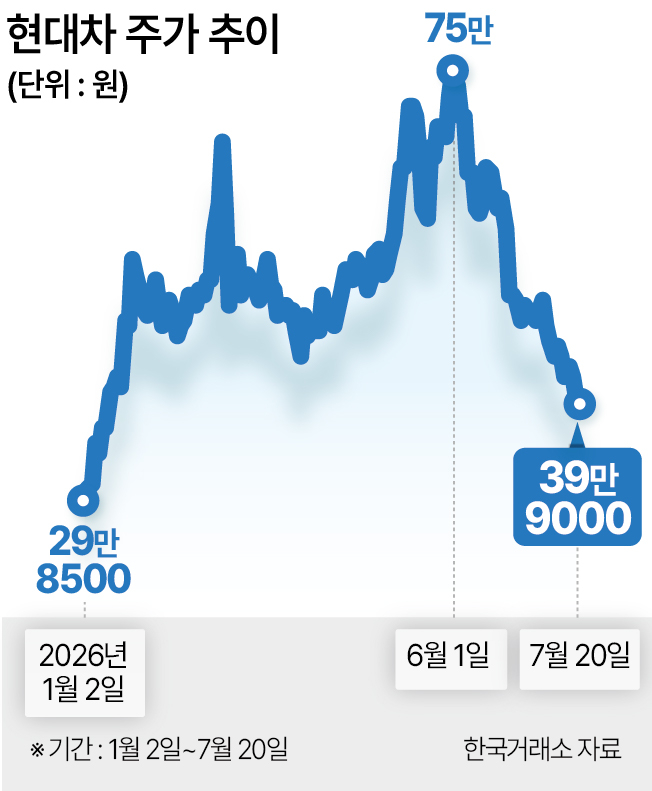
Hyundai Motor's share price, which once approached 800,000 won ($540), has been nearly halved. A massive exodus of foreign investors, compounded by production disruptions from a parts supplier fire and the risk of a union strike, has rapidly chilled investor sentiment. Brokerages have been cutting their target prices for the stock in succession — yet most still see upside of at least 60 percent from current levels.
According to Korea Exchange, Hyundai Motor's maximum drawdown from its all-time high of 783,000 won stood at -49.61 percent as of Monday, effectively cutting the share price in half. The stock fell as low as 394,500 won intraday Monday before closing at 399,000 won — the first time the closing price had broken below 400,000 won since Jan. 12. The stock was down more than 3 percent in early trading Tuesday.
The decline exceeds the losses posted by Samsung Electronics (-35.91 percent) and SK Hynix (-43.82 percent), the first- and second-largest companies by market cap on the Kospi, both of which have also fallen sharply in recent months.
Heavy foreign selling lies at the heart of the share price collapse. Foreign ownership of Hyundai Motor, which stood at 35.95 percent at the end of last year, had plunged to 25.17 percent as of Monday — a drop of more than 10 percentage points.
Foreign investors have net sold 10.88 trillion won worth of Hyundai Motor shares this year. That compares with net purchases of 2.74 trillion won in 2024 and net selling of just 1.61 trillion won last year, underscoring how sharply the selling pressure has intensified in 2026. Institutional investors also leaned toward selling, offloading a net 707 billion won. Retail investors, by contrast, absorbed the selling pressure with net purchases of 11.05 trillion won.
The earnings outlook for the second quarter is equally grim. Brokerages expect Hyundai Motor's second-quarter operating profit to fall more than 20 percent from a year earlier. On Monday, KB Securities projected second-quarter operating profit at 2.71 trillion won, while Mirae Asset Securities estimated 2.86 trillion won — both below the market consensus of 3.02 trillion won. Hyundai Motor is scheduled to report its second-quarter results Thursday.
Kang Seong-jin, an analyst at KB Securities, said a fire at a parts supplier in Daejeon in March had reduced domestic sales by about 20,000 units compared with expectations, while a production suspension at the company's factory in Turkey for electric vehicle line construction had cut European sales by roughly 15,000 units. He added that the won-dollar exchange rate at the end of the quarter came in 5.1 percent higher than expected, prompting the company to book an additional 223.2 billion won in warranty costs.
Adding to the uncertainty is the risk of a strike over wage negotiations. The Hyundai Motor branch of the Korean Metal Workers' Union staged four-hour partial strikes by shift on Monday and is expected to continue four-hour partial strikes Tuesday and Wednesday. The union is demanding that the bonus rate be raised from the current 750 percent to 800 percent, an extension of the retirement age, and the reinstatement of members dismissed for illegal activities during past union actions.
Kim Jin-seok, an analyst at Mirae Asset Securities, said the domestic production disruption appeared to have been resolved in June, but added that with the market hoping for a sales recovery in July, the outcome of ongoing negotiations over the partial strikes would be worth watching.
Against this backdrop, brokerages have been lowering their targets for the stock. KB Securities cut its target from 1.2 million won to 900,000 won, while Mirae Asset Securities trimmed its target from 950,000 won to 840,000 won. Heungkuk Securities and Shinhan Investment set their targets at 780,000 won, Daishin Securities at 740,000 won, and Hyundai Motor Securities at 630,000 won. Even so, all brokerage targets remain at least 60 percent above the current share price.
Kim Gwi-yeon, an analyst at Daishin Securities, said Hyundai Motor's share price had quickly priced in long-term growth expectations tied to robotics since early this year, which also made it more sensitive to the broader market correction. She said the stock was expected to rebound once robotics momentum resumed, and that Hyundai Motor would continue to serve as the sector's bellwether.

jiyun@heraldcorp.com