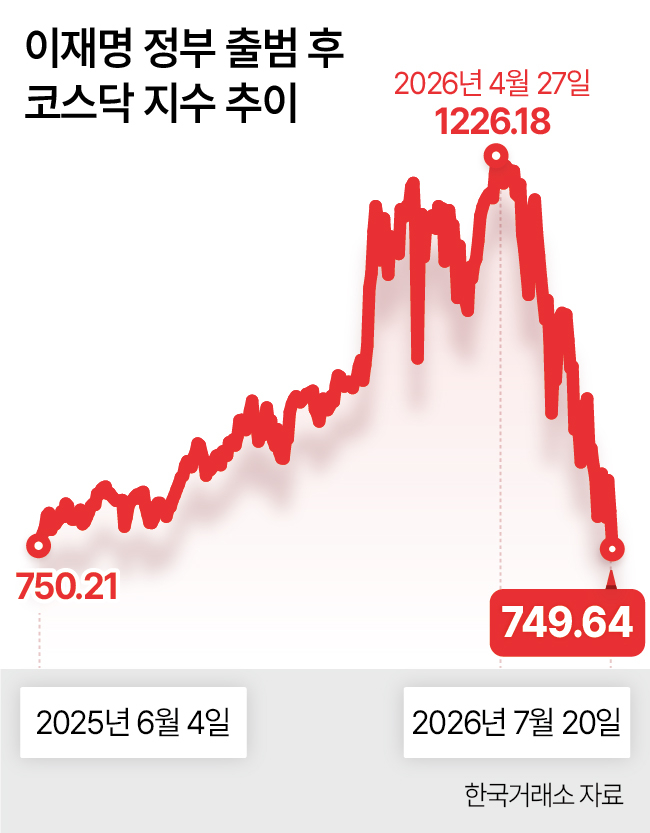
The government has rolled out a series of measures to revive the Kosdaq market, but the money needed to support it has yet to arrive. The index slid to the low 730s during intraday trading Tuesday, setting a new 52-week low. Based on Monday's closing price, it had already fallen below the level recorded on the day President Lee Jae Myung took office. While overall margin lending across the broader market has surged, Kosdaq's own margin balance and trading volume have both declined — leading analysts to conclude that supply-demand deterioration is outpacing any policy effect.
According to Korea Exchange data, the Kosdaq stood at 734.01 as of 9:37 a.m. Tuesday, down 15.63 points, or 2.09 percent, from the previous session. It briefly touched 731.82 in early trading, marking a fresh 52-week low.
On Monday, the index closed at 749.64, down 42.20 points, or 5.33 percent. That was below the closing level of 750.21 recorded on June 4, 2025 — the day President Lee was inaugurated — marking the first time since the administration took office that the index closed below its inauguration-day level.
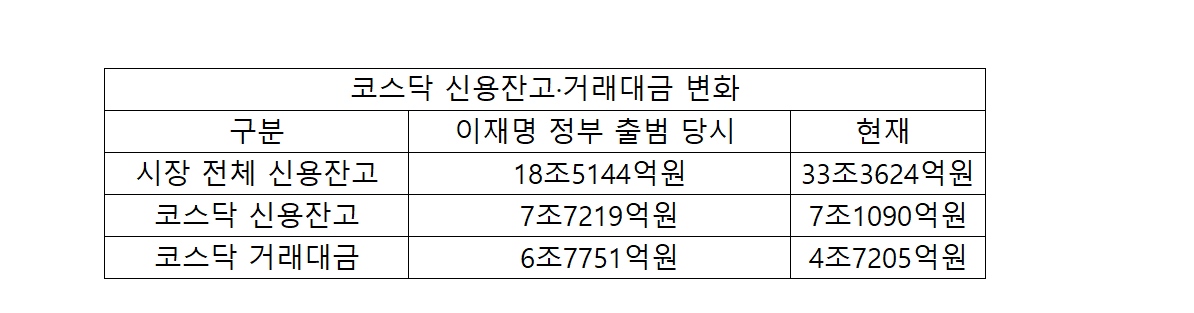
Market liquidity has deteriorated alongside the index. Data from the Korea Financial Investment Association show that Kosdaq trading volume fell 30.33 percent — from 6.78 trillion won ($4.57 billion) on June 4, 2025, when the administration launched, to 4.72 trillion won on July 16. Margin lending tells a similar story of divergence: total margin loan balances across the broader market surged 80.20 percent, from 18.51 trillion won to 33.36 trillion won over the same period, while Kosdaq-specific margin balances shrank 7.94 percent, from 7.72 trillion won to 7.11 trillion won.
Securities industry officials say buying interest capable of supporting Kosdaq is simply insufficient. "There was no external shock like a financial crisis, yet within less than three months of the late-April peak, the index has been pushed back to where it was when the Lee administration launched," one industry official said. "The simultaneous decline in margin balances and trading volume means there just isn't enough buying demand to absorb Kosdaq."
The government has not been idle. The Financial Services Commission announced a plan in December to overhaul Kosdaq's credibility and innovation profile, pledging to reshape the market around a "high-birth, high-exit" structure — making it easier for innovative companies to list while accelerating the removal of underperformers. The FSC also outlined plans to expand tax support for Kosdaq venture funds and strengthen incentives for pension fund investment, laying the groundwork for a shift toward institutional, long-term capital inflows.
To that end, the authorities introduced tailored technology-exception listing pathways for companies in nationally strategic sectors such as AI, space and energy, and created a panel of sector-specific technology advisers within Korea Exchange's listing review process. At the same time, the regime was tightened on the exit side: companies that pivot their core business away from the technology that earned them a tech-exception listing are now subject to delisting review, raising the bar for staying listed even as the entry threshold was lowered.
In February, the government announced additional delisting reforms. The market-capitalization threshold for delisting was raised from 4 billion won to 15 billion won this year, with further increases to 20 billion won starting this month and 30 billion won from next year — all ahead of the original schedule. Stocks trading below 1,000 won were added as a new delisting criterion, and standards for disclosure violations and complete capital impairment were also tightened. The maximum improvement period granted to companies under delisting review was shortened from 18 months to 12 months. Korea Exchange projected that the overhaul would raise the annual number of companies subject to delisting from around 50 to roughly 150.
In March, the government followed up with a capital market structural reform plan that fleshed out Kosdaq's company-screening framework and long-term capital inflow strategy. The plan calls for dividing Kosdaq into segments — including a Premium tier and a Standard tier — with a promotion-and-relegation system between them. A benchmark index and linked ETFs would be created around the top companies in the Premium segment. Blue-chip firms would be separately identified to serve as an investment benchmark for institutional investors, while companies at risk of delisting or carrying high trading risks would be placed in a monitored group to bolster market confidence.
Measures to attract long-term capital were also included. In January, the government revised fund management evaluation guidelines to change the domestic equity benchmark for pension funds from "100 percent Kospi" to "95 percent Kospi plus 5 percent Kosdaq." The government also committed to deploying more than 30 trillion won through the National Growth Fund this year and channeling more than 20 trillion won in new venture capital through large investment banks by 2028. The overarching aim is to rebalance Kosdaq's investor base — currently dominated by retail investors — toward pension funds and policy-backed long-term capital.
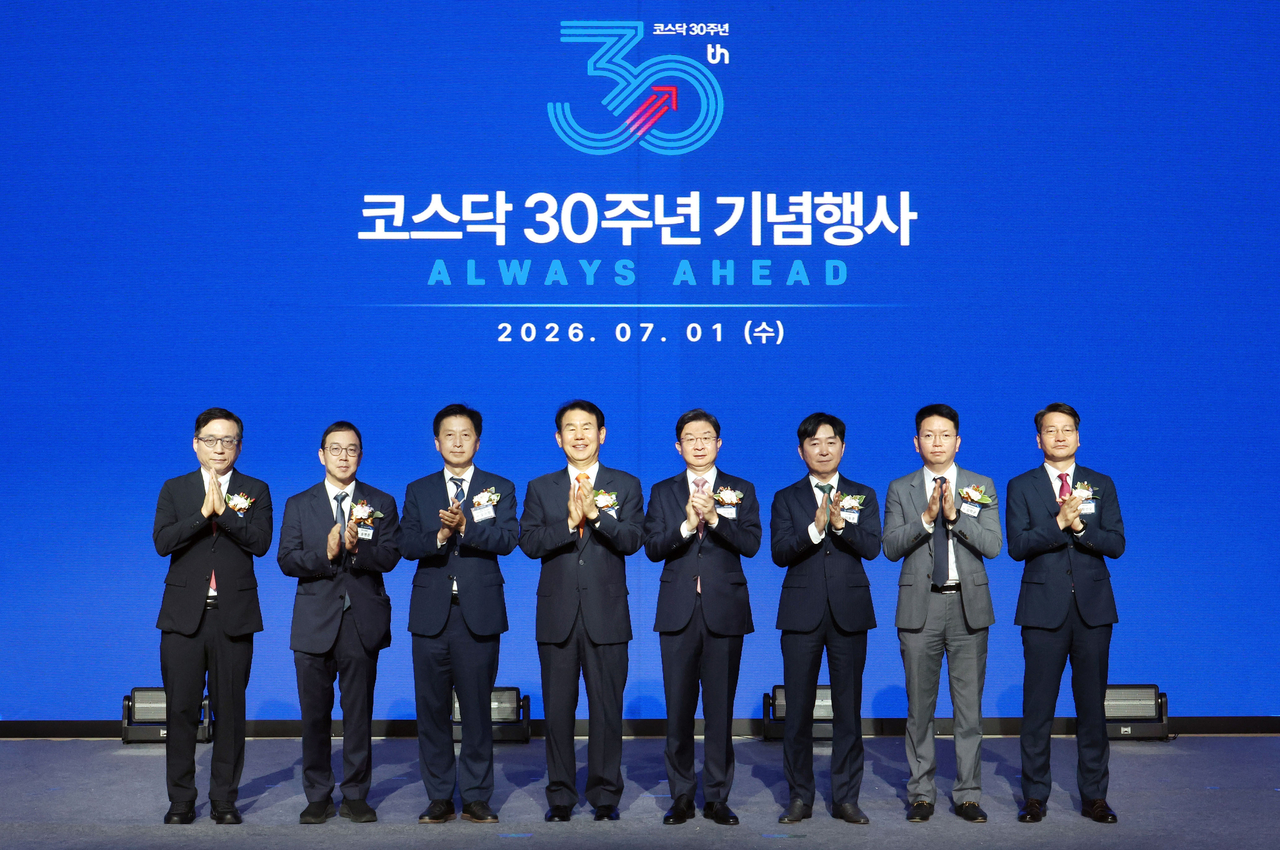
The policy direction was reaffirmed at the Kosdaq 30th anniversary event held July 1. Korea Exchange Chairman Jeong Eun-bo stressed the need for structural reform of the Kosdaq market, while Choi Ji-woo, executive director of the Kosdaq Market Division, presented proposals to address the market's undervaluation through the introduction of market segments. FSC Chairman Lee Eok-won said the government would support innovative companies' fundraising through the National Growth Fund and expanded venture capital supply from large investment banks.
But the market responded to supply-demand dynamics before policy could take hold. Kosdaq fell below President Lee's inauguration-day closing level less than 20 days after the 30th anniversary event, with both trading volume and margin balances declining from where they stood when the administration began.
Market analysts point to a passive, large-cap-driven market environment as the main drag on Kosdaq. Capital has concentrated in Kospi heavyweights such as Samsung Electronics and SK Hynix and in index-linked products, while active funds that pick individual growth stocks have pulled back — preventing buying interest from spreading across the broader Kosdaq market.
The launch of single-stock leveraged ETFs for Samsung Electronics and SK Hynix on May 27 is seen as having deepened the concentration further. Short-term return-seeking capital flooded into the large semiconductor names, absorbing some of the momentum-driven demand that would otherwise have overlapped with Kosdaq growth stocks.
"In the past, when the Kospi rose, some money would trickle down to Kosdaq — a kind of spillover effect," one securities industry official said. "Now we're seeing a 'straw effect,' where capital is being sucked up entirely by a handful of large-cap names like Samsung Electronics and SK Hynix. Policy matters, but ultimately what's needed is a steady stream of growth companies that investors actually want to buy. As long as fresh money isn't flowing into Kosdaq, it will be hard to feel the impact of any revitalization measures."
The government has moved to address the issue. President Lee on Wednesday directed authorities to swiftly draw up remedial measures related to single-stock leveraged ETFs. Whether follow-on policies — including a Premium-segment index, linked ETFs and the National Growth Fund — can translate into actual capital inflows is now seen as the key to any Kosdaq recovery.
Securities analysts, however, caution that policy effects will take time to feed through into tangible supply-demand improvement. "If government policy succeeds in easing the concentration of capital flows, the chances of a rotation into small- and mid-cap growth stocks that have been overlooked for a long time will also grow," said Lee Jae-won, a researcher at Yuanta Securities Korea. "There are also bottom-fishing opportunities in Kosdaq names that combine oversold conditions with upward earnings-per-share revisions."

hajun825@heraldcorp.com