The Kospi is expected to open Monday under pressure from a late-week slide in US equities driven by falling chip stocks and a deteriorating security situation in the Middle East.
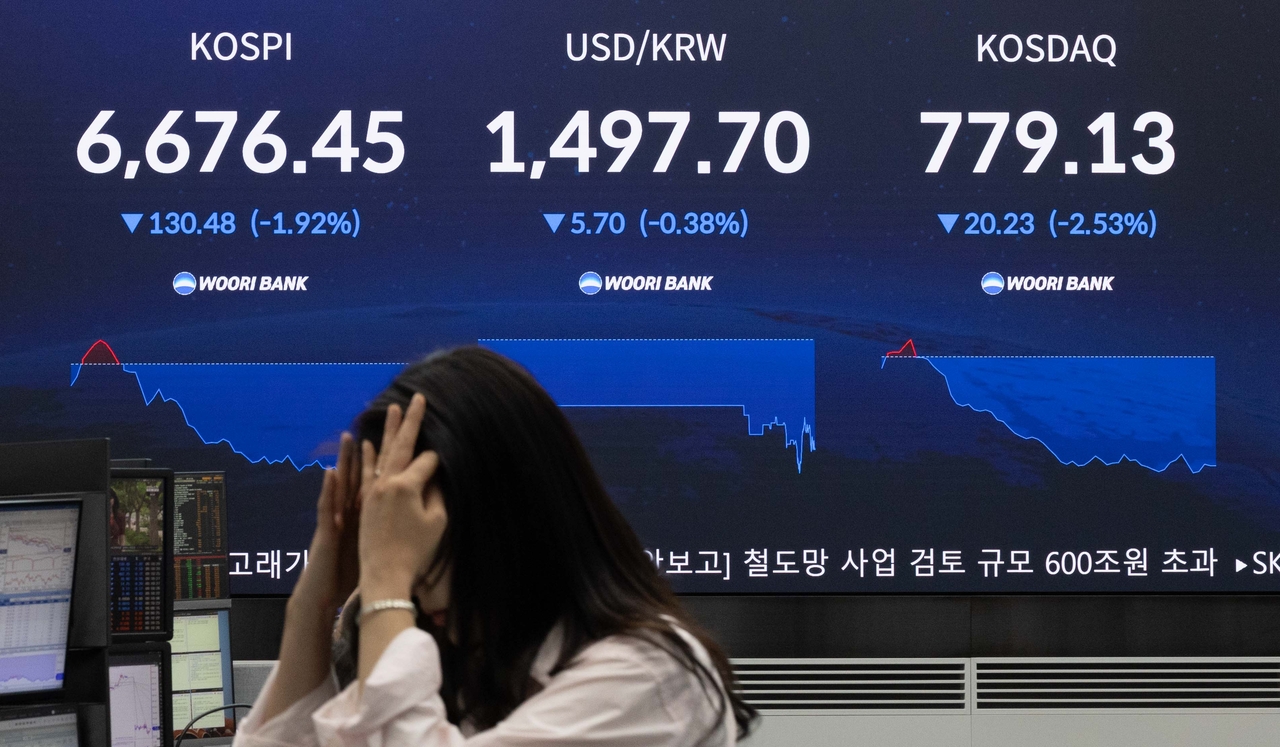
The Kospi closed at 6,820.60 on Thursday, according to Korea Exchange, breaking back below the 7,000 threshold — a level traders call "chilcheonpi."
The index opened down 323.91 points, or 4.45 percent, at 6,960.50 before extending losses to finish 463.81 points, or 6.37 percent, lower at 6,820.60. At its intraday low, the benchmark touched 6,730.87.
A sell-side sidecar was triggered on the KOSPI market at around 9:10 a.m. amid the sharp selloff — the 37th such circuit-breaker activation on the Kospi so far this year.
The plunge was driven by heavy losses in semiconductor-related stocks, which carry significant weight in the domestic market. Samsung Electronics fell 8.77 percent and SK hynix dropped 11.53 percent.
Sentiment toward chip stocks had already soured after Micron fell 8.02 percent and SanDisk dropped 8.12 percent in US trading on Sunday.
A Morgan Stanley report warned that data center construction cancellations and delays were spreading — citing Crusoe's postponement of a Wyoming data center project and a one-year deferral of a New York state data center — stoking fears of a slowdown in the semiconductor industry.
Markets already on edge over whether chip stocks had peaked reacted sharply to the news.
Even TSMC's disclosure of record net profit for the second quarter during the session was not enough to restore investor confidence in the sector.
The Kosdaq also closed down 37.59 points, or 4.53 percent, at 791.84.
A sell-side sidecar was triggered on the Kosdaq market as well, at around 10:20 a.m. — the 22nd such activation on the Kosdaq this year.
The weakness carried over to Wall Street, with all three major US indexes falling not only on Thursday but also on Friday, when South Korean markets were closed for Constitution Day.
The tech-heavy NASDAQ Composite fell 2.85 percent over the two sessions.
News that Moonshot AI, a Chinese artificial intelligence startup, had released its latest model, Kimi K3, for free — with performance said to rival top-tier models from OpenAI and Anthropic — also weighed on related stocks.
Seo Sang-young, a managing director at Mirae Asset Securities, said the Kospi plunged 6.37 percent on Thursday as investor sentiment toward the semiconductor sector deteriorated, with SK hynix and Samsung Electronics alone accounting for roughly 333 points of the index's decline.
He added that chip stocks fell sharply on Wall Street on Thursday as well, and that while bargain hunters pushed the market higher intraday on Friday, gains were surrendered or reversed as hedge position adjustments ahead of options expiration and profit-taking emerged.
That mood is expected to weigh on the domestic market Monday.
Indicators used to gauge Korean market sentiment continued to weaken. The MSCI Korea ETF tumbled 4.82 percent on Thursday before falling a further 0.50 percent on Friday, while the MSCI Emerging Markets ETF declined 2.10 percent and 1.40 percent on Thursday and Friday, respectively.
KOSPI 200 night futures also fell 4.31 percent in the previous session.
Oil prices surged over the weekend. West Texas Intermediate crude futures climbed to around $85 a barrel.
The move came amid mounting speculation that a full-scale resumption of hostilities between the United States and Iran was imminent. Reports that three US soldiers were killed or went missing at a base in Jordan have intensified exchanges between the two sides.
The global rout in chip stocks is another variable. Samsung Electronics has fallen as much as 34 percent from its peak on a maximum drawdown basis, while SK hynix has dropped 43.82 percent. Kioxia Holdings is down 53.76 percent from its high, Micron Technology 35.93 percent, Nvidia 19.75 percent and TSMC 19.41 percent.
Han Ji-young, a researcher at Kiwoom Securities, said the Kospi would enter a phase of testing downside support this week, buffeted by weakness in US and Japanese chip stocks during the market holiday, the US-Iran geopolitical standoff, earnings from US big-tech names including Alphabet, Intel and Tesla, results from domestic heavyweights such as Hyundai Motor, Doosan Enerbility and KB Financial Group, and shifts in fund flows following the announcement of leverage regulations on single-stock products.
Han added that the AI earnings season beginning this week would serve as a pivotal test of whether AI demand remains durable and whether chip stocks can escape their current deleveraging and derating cycle. She set a weekly Kospi trading range of 6,300 to 7,300.
Some analysts also see room for bargain buying given the scale of the recent chip-stock selloff. Lee Gyeong-min, a researcher at Daishin Securities, said the Kospi's 12-month forward price-to-earnings ratio (PER) had reached 5.81 times, a historically low valuation level, adding that because the Kospi had entered a correction phase ahead of global peers, it was likely to lead the recovery as well.

jiyun@heraldcorp.com