

With the World Health Organization having declared a Public Health Emergency of International Concern over the Bundibugyo strain of Ebola virus disease in Africa, South Korea is launching a dedicated research and development support program targeting diagnostics for the outbreak.
The Research Investment for Global Health Technology Foundation — known as the RIGHT Foundation — said it will issue a call for proposals under its product development research fund to strengthen preparedness and response capacity for Ebola diagnostics, including for Bundibugyo virus disease. The initiative marks the first major move by Lee Min-won, who took the helm of the RIGHT Foundation in March.
Unlike the better-known Zaire strain, the Bundibugyo virus now spreading primarily across the Democratic Republic of Congo and Uganda has no approved vaccine or treatment, leaving early diagnosis — and the isolation and containment it enables — as the only available response. According to WHO, confirmed cases in the DRC surpassed 1,600 as of early July, with a case fatality rate approaching 32 percent.
The outbreak has also exposed a critical flaw in existing diagnostic systems. Early in the epidemic, samples tested at local provincial laboratories using standard GeneXpert machines returned negative results, only for the National Institute for Biomedical Research to later confirm Bundibugyo infection through additional molecular diagnostics and genomic analysis. Conventional RT-PCR methods, which rely on specialized laboratories, also face inherent limitations in low-infrastructure settings, where transporting samples and waiting for results can take considerable time.
"When there is no vaccine or treatment, the most immediate and effective response is to rapidly screen, confirm and isolate suspected patients," Lee said in an interview at the RIGHT Foundation's office in Jongno-gu, Seoul, on Wednesday. "We decided to launch this support program to use the strong diagnostic technology capabilities of South Korean companies to fill the gaps in global health response."
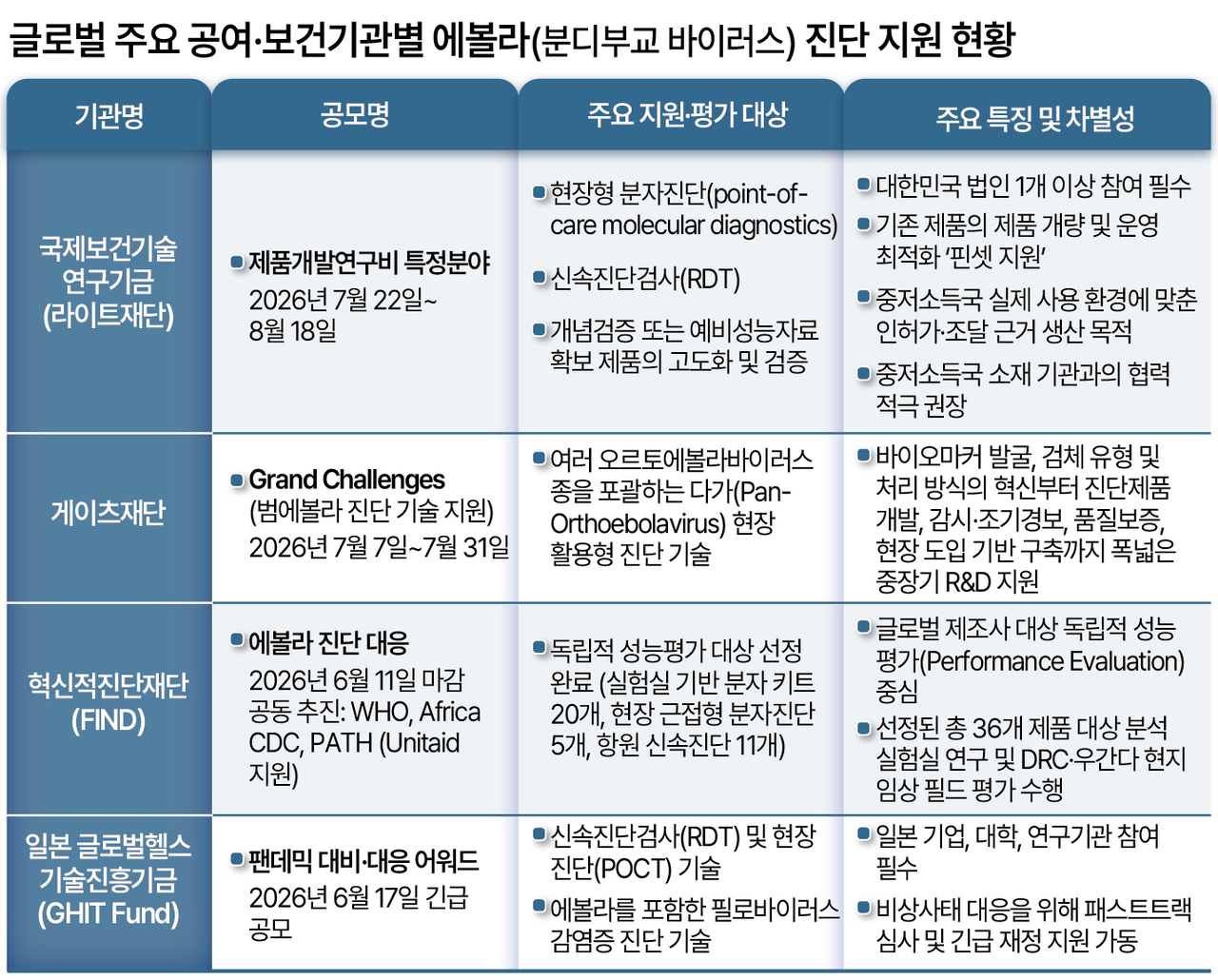
Rather than funding basic research, the program focuses on upgrading and validating existing diagnostic products and platforms — those that have already completed proof-of-concept or generated preliminary performance data — for use in low- and middle-income country settings. Point-of-care molecular diagnostics and rapid diagnostic tests are the priority targets. The foundation aims to encourage development of products that can be stored at room temperature, require minimal sample preparation and are competitively priced, in recognition of the unstable power supply and weak medical infrastructure in affected areas.
"Current Ebola confirmatory testing relies mainly on molecular diagnostics performed in specialized laboratories, which means it can take time to transport samples, process them and receive results," Lee said. "If point-of-care molecular diagnostics and rapid diagnostic tests become available for use close to the patient, they will reduce the time needed for rapid triage and isolation of suspected cases, linkage to confirmatory testing, and contact tracing."
The RIGHT Foundation will provide up to 500 million won ($337,000) per project for a maximum of nine months, reflecting the urgency of the situation. At least one South Korean legal entity must be included in any application, and the foundation strongly encourages consortium arrangements with institutions or research centers based in low- and middle-income countries to facilitate clinical trials and sample collection in Africa.
Major global health donors are also mobilizing. The Bill & Melinda Gates Foundation has launched a large-scale diagnostic technology R&D call spanning biomarker discovery through product introduction, and Japan's Global Health Innovative Technology Fund has activated an emergency grant mechanism. Against that backdrop, the RIGHT Foundation is positioning its approach as a targeted intervention — leveraging proven South Korean biotech capabilities to rapidly upgrade existing products and channel them into public procurement markets. WHO initiated its Emergency Use Listing application process for in vitro diagnostic products in late May.
Lee is a 30-year veteran of global health administration, having served as director of the pharmaceutical policy division and head of international cooperation at the Ministry of Health and Welfare, director of the emergency operations center at the Korea Disease Control and Prevention Agency, and health attaché at South Korea's mission in Geneva. "Through the MERS and COVID-19 crises, the R&D capabilities of South Korean diagnostic companies and their sense of mission to contribute to humanity have risen to world-class levels," he said. "I hope this program becomes an opportunity for South Korean diagnostic technology to contribute more swiftly and substantively to the needs of the global health community."
The RIGHT Foundation is a public-private partnership fund established jointly by the Ministry of Health and Welfare, the Bill & Melinda Gates Foundation, and South Korean pharmaceutical and biotech companies. Since its launch in 2018, it has supported a cumulative 82 research and development projects — covering vaccines, treatments and diagnostic devices — with a total of 141.7 billion won, working to advance health equity.
"Infectious diseases in vulnerable regions like Ebola have limited market size and commercial viability, making it difficult for private companies to sustain investment on their own," Lee said. "Through the RIGHT Foundation, which serves as a bridge between government, international donors and industry, I will work to firmly establish a medium- to long-term response roadmap so that South Korea's biotech capabilities can contribute to improving global health equity and defeating infectious diseases."
silverpaper@heraldcorp.com




