Identifying regulations that hinder advanced industry growth
Copyright rules on data use slow AI training
Standards needed for ultra-low-pressure hydrogen vehicle charging
The Korea Enterprises Federation has identified 112 outdated regulations it says are undermining South Korea's competitiveness in AI, robotics and semiconductors, and has formally called on the government to revise them. The federation said unclear copyright rules governing data collection for AI training — a problem unique to South Korea among major economies — are discouraging corporate investment and technology development, and that regulatory reform is urgently needed.
The federation said Tuesday it had submitted 112 regulatory reform proposals across five categories — future industries (29 cases), corporate management (24), environment and safety (26), labor (6), and on-site difficulties (27) — to the Office for Government Policy Coordination's public-private joint regulatory rationalization task force and the Ministry of Trade, Industry and Energy, among other agencies.
The most prominent item on the list was reform of copyright regulations governing the use of data for AI training. The federation said it is practically impossible for AI models to obtain individual permission for every piece of copyrighted material they collect and learn from during training. It said ambiguity in current rules has already triggered legal disputes, and that the risk of criminal prosecution for copyright infringement is chilling corporate research and investment.
The federation said South Korea should follow the lead of Japan and Singapore, both of which have established safe-harbor provisions for the use of copyrighted works in AI training.
In the robotics sector, the federation raised a separate concern: unlike autonomous driving applications, original data cannot be used for AI training in research and development. Because only blurred video and distorted audio are currently permitted, companies face significant limitations in advancing AI systems that rely on high-quality data such as facial expressions and natural speech.
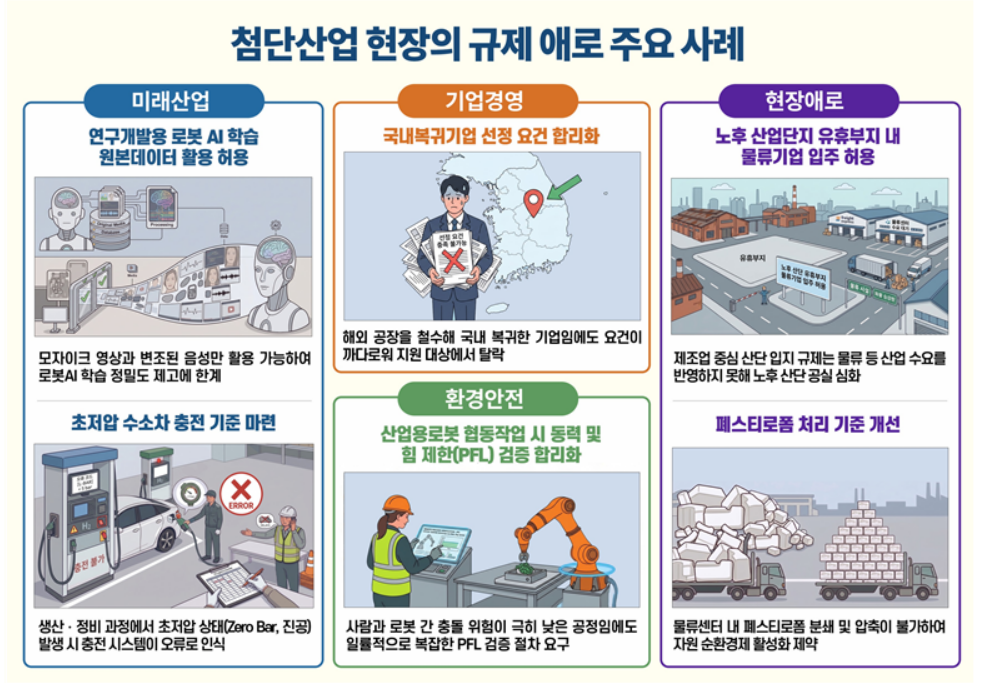
In the hydrogen sector, the federation said dedicated charging technology is needed for hydrogen vehicles in an ultra-low-pressure state (0 bar) — a condition that arises during production and maintenance. It also called for rationalizing safety-glass standards at hydrogen charging stations to reflect actual risk levels, creating special exemptions for the placement of mobile hydrogen charging stations, and eliminating redundant safety performance evaluations (Hy-PAS) for new charging stations.
Power system reform to support AI infrastructure was also flagged as a priority. The federation called on the government to establish a certification and trading system for carbon-free energy sources — including nuclear power and hydrogen — to ensure stable electricity supply for AI data centers and advanced semiconductor manufacturing. It also said direct power purchase agreements between generators and companies should be permitted more flexibly. The federation noted that because AI data centers operate around the clock, intermittent renewable energy alone cannot guarantee stable power supply.
On corporate management, the federation called for easing eligibility requirements for companies returning production to South Korea from overseas, and for restructuring the large business group designation system. It said some companies that want to close overseas facilities and invest in idle domestic factories are being excluded from government support due to overly strict criteria, and that the current system places excessive personal liability on the controlling shareholder during the data submission process for large business group designation.
On labor, the federation said the legal standards and procedures for dismissing long-term underperforming employees should be codified, and that the list of occupations eligible for worker dispatch — based on a job classification system dating to 2000 — should be comprehensively revised to reflect changes in industrial structure.
The federation also proposed allowing logistics companies to move into idle land within aging industrial complexes, and permitting logistics centers to crush and compress waste styrofoam on-site.
Kim Jae-hyun, head of the federation's regulatory reform team, said companies must be freed from outdated regulations that cannot keep pace with the speed of AI and robotics development if South Korea is to secure a leading position in the global AI race. "Swift regulatory rationalization is essential to building core AI infrastructure on time," he said.
He added: "To nurture future growth engines beyond semiconductors — including physical AI and robotics — we must create an environment where companies can innovate freely under a 'permit first, regulate later' principle."
eyre@heraldcorp.com