
![A semiconductor image. [Getty Images]](https://wimg.heraldcorp.com/news/cms/2026/07/20/news-p.v1.20260707.2c2f9cd5ac3449c7bc7ba8d5600d41ff_P1.jpg)
Foreign investors are growing more selective in the AI semiconductor market, dumping large positions in established AI leaders such as Samsung Electronics and SK Hynix while actively buying into semiconductor value-chain stocks expected to post stronger earnings in the second half. The shift suggests investors are scrutinizing individual company fundamentals and growth prospects rather than cutting exposure to the chip sector as a whole.
According to Korea Exchange data, foreign investors net sold 6.9996 trillion won ($4.72 billion) worth of SK Hynix shares and 6.6697 trillion won worth of Samsung Electronics shares from July 1 through July 16. SK Square (758.7 billion won), KB Financial Group (414.9 billion won) and Isupetasys (397.7 billion won) rounded out the top net-sold names. On the buy side, LG Innotek (785.2 billion won), Hanmi Semiconductor (364.1 billion won), Hyundai Motor (310.8 billion won), DB HiTek (300.9 billion won) and Leeno Industrial (244.2 billion won) led net purchases.
Market analysts interpret the recent pullback in memory chip stocks as profit-taking after a steep rally since the start of the year rather than a sign of deteriorating industry conditions. Kim Rok-ho, an analyst at Hana Securities, said the sharp share-price declines at domestic chipmakers and peers such as Micron and Kioxia have fueled peak-out concerns, but added that "it is more reasonable to read the moves as a correction in stocks that rose too fast and too far, rather than a collapse in AI demand." He added that the recent trend "is largely a supply-and-demand issue, given how heavily concentrated flows had become in memory chip names."
Financial investment industry analysts said foreign buying is spreading beyond memory chips into a broader range of AI-linked value-chain segments, including equipment, testing, power semiconductors and substrates.
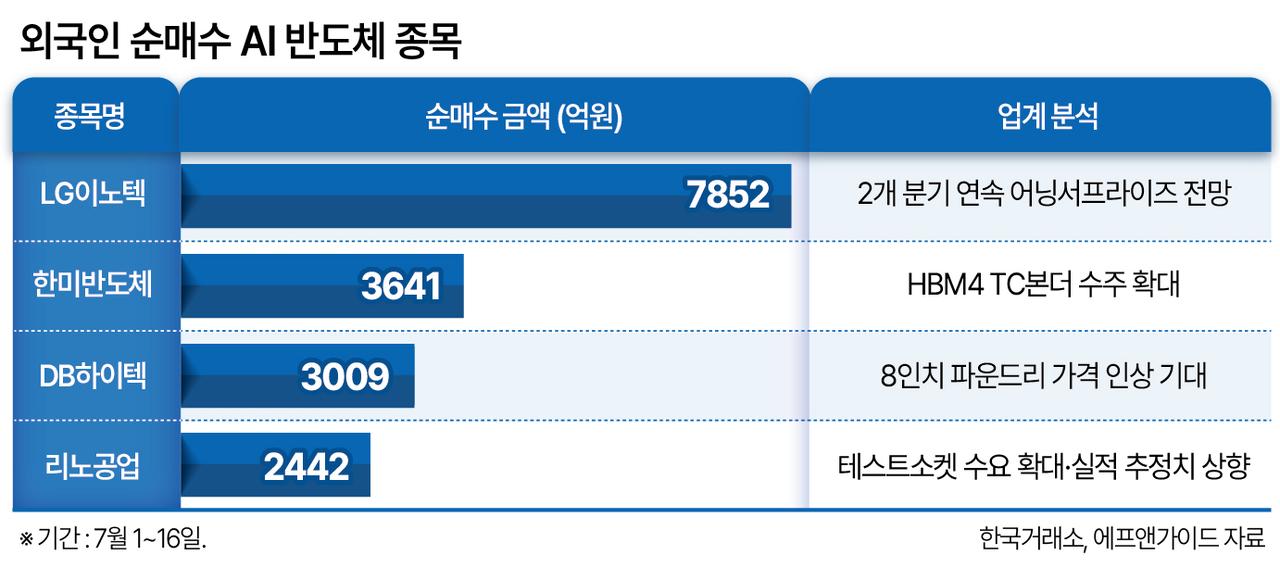
Hanmi Semiconductor is widely seen as a prime beneficiary of rising demand for thermal-compression (TC) bonders used in HBM4 production. Securities analysts forecast the company will post record annual sales of 819.6 billion won and operating profit of 382.2 billion won this year, as HBM4 TC bonder orders begin flowing through to revenue from the second quarter and shipments to North American customers expand. In the second half, logic TC bonders and high-bandwidth flash (HBF) TC bonders are expected to emerge as new growth drivers, broadening the equipment's addressable market beyond HBM to logic chips, NAND and substrates.
DB HiTek stands to benefit directly from surging demand for power management integrated circuits (PMICs) driven by the expansion of AI servers. Demand for automotive and industrial semiconductors remains solid, and AI server PMIC orders are rising rapidly, yet major players including TSMC and Samsung Electronics are scaling back 8-inch production capacity to focus on advanced 12-inch processes. Analysts forecast DB HiTek's operating profit will climb 35 percent year-on-year to 375.2 billion won this year as supply shortages trigger price increases and its factories run at full capacity. Its foundry business for next-generation power semiconductors based on silicon carbide (SiC) and gallium nitride (GaN) is also cited as a medium-to-long-term growth driver.
Leeno Industrial is expected to benefit from growing demand for test sockets used to verify AI chip performance. LS Securities raised its second-quarter operating profit estimate for the company to 70.2 billion won from 67.9 billion won, reflecting broader non-memory semiconductor research and development spending. The company also plans to relocate to a new factory in the fourth quarter that will expand production capacity two to three times. The application range for its test sockets, previously centered on mobile devices, is extending into AI devices, supporting a medium-to-long-term growth trajectory.
LG Innotek's flip-chip ball grid array (FC-BGA) substrate business for AI servers is emerging as a new growth pillar. Analysts forecast second-quarter operating profit of 244.8 billion won — roughly 22 times the year-earlier figure and 36 percent above market consensus. In the second half, average selling prices for optical solutions are expected to rise 30 to 40 percent on new product launches, underpinning further earnings improvement. A full-scale expansion of FC-BGA capacity for AI servers is also under way, drawing fresh attention to the growth potential of the company's semiconductor substrate business.
The global AI investment cycle underpinning these growth outlooks remains strong. TSMC, the world's largest foundry, reported second-quarter results that beat market expectations and raised its full-year sales growth forecast to "more than 40 percent" from "more than 30 percent." It also widened its annual capital expenditure plan to between $60 billion and $64 billion from $56 billion, reaffirming the strength of AI investment momentum.
ASML, the world's largest semiconductor equipment maker, also raised its annual sales guidance to between 43 billion and 45 billion euros ($51.4 billion), citing continued AI investment expansion. Moon Jun-ho, an analyst at Samsung Securities, said that while concerns about slowing AI demand have recently surfaced, "TSMC's capex expansion and ASML's investment plans show that AI demand remains solid."
Earnings reports from major US technology companies beginning this week, along with their capital expenditure plans, are seen as a pivotal test for a recovery in semiconductor investor sentiment. Lee Jae-man, an analyst at Hana Securities, said the trigger for a rebound in chip stocks will be results from US hyperscalers starting in late July. "If capex growth is confirmed at Alphabet, Microsoft, Meta and Amazon, expectations for expanding AI investment will revive and the semiconductor sector, which has been under pressure recently, is likely to stage a recovery," he said.

hajun825@heraldcorp.com




