
![A loan counter at a bank in Seoul [Herald DB]](https://wimg.heraldcorp.com/news/cms/2026/07/16/news-p.v1.20260714.0aa664f3cda0438785b25bc18489a1d1_P1.png)
Last July, a borrower identified only as A took out a 470 million won ($316,000) mortgage from a bank to buy an apartment in Dobong-gu, Seoul — a 30-year loan with equal monthly principal-and-interest payments. The rate at the time was 4.2 percent per year, pegged to the six-month new COFIX (Cost of Funds Index).
Early this year, A received a notice from the bank that the loan rate had been raised to 4.55 percent annually, as the six-month variable-rate cycle had reset and COFIX had risen along with market rates. Monthly payments climbed from 2.29 million won to 2.39 million won, but A said the increase was simply "the cost of buying a home" and did not worry much about it.
Six months later, in July, A received another rate-change notice. With financial market volatility rising, COFIX had climbed again, pushing the loan rate to 4.71 percent. Monthly payments will now reach 2.43 million won for the next six months. A had paid about 13.8 million won over the first six months of the loan; the next six months will cost about 14.6 million won. "I have to pay about 140,000 won more every month — that's enough to change my quality of life," A said. "I'm worried because they say the benchmark rate could go even higher."
The Bank of Korea raised its benchmark interest rate from 2.50 percent to 2.75 percent per year on Thursday — its first hike in three and a half years — formally shifting monetary policy into a tightening stance. Mortgage borrowers are now expected to face higher repayment burdens as a result. The central bank is widely expected to raise rates further before year-end, citing prolonged Middle East tensions and inflation concerns. Financial authorities' push to rein in household debt is also raising the bar for new loans, compounding the pressure on borrowers.
The Bank of Korea's Monetary Policy Board met Thursday and voted to raise the benchmark interest rate by 0.25 percentage points. Markets are now pricing in the possibility that the central bank could lift rates to 3 percent by year-end.
The rate hike is expected to make higher interest costs unavoidable for variable-rate mortgage holders. Data submitted to the office of People Power Party lawmaker Lee Jong-wook by the Bank of Korea show that as of the end of March, every 0.25-percentage-point increase in mortgage rates adds about 1.8 trillion won to the annual interest burden across all borrowers. The average per-borrower interest cost rises from 5.84 million won to 6.14 million won — an increase of 296,000 won.
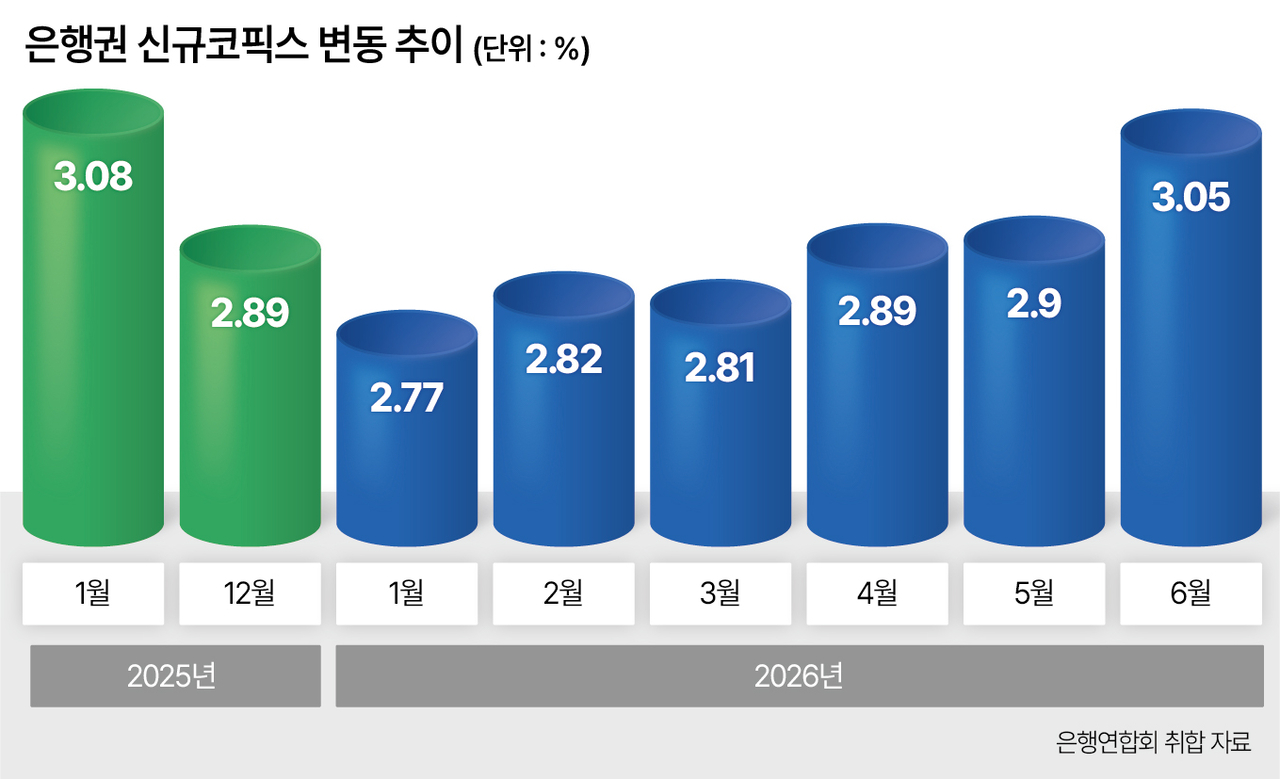
The new COFIX — one of the key benchmark rates for variable-rate mortgages — has been climbing in anticipation of Thursday's rate hike. The Korea Federation of Banks announced Wednesday that the new COFIX for June came in at 3.05 percent per year, surpassing the 3 percent threshold for the first time in 17 months since January 2025, when it stood at 3.08 percent.
The new COFIX is the weighted average rate on funds raised monthly by eight domestic banks, reflecting changes in rates on deposit products, savings accounts and bank bonds. When the benchmark rate rises, both bank bond issuance rates and deposit rates move up, pulling COFIX higher in turn. With further hikes from the Bank of Korea widely anticipated, COFIX is expected to keep rising.
The six-month bank bond rate — another benchmark for variable-rate mortgages — also hit 3.290 percent per year on Wednesday, its highest level in about 18 months since it reached 3.332 percent in 2024.
Prospective homebuyers are facing a more difficult calculus as well. As of Wednesday, fixed-rate mortgage rates at the five major banks — KB, Shinhan, Hana, Woori and NH NongHyup — ranged from 4.17 percent to 7.41 percent per year, with the upper end rising sharply from the 3.93–6.25 percent range recorded on Dec. 31 last year.
A borrower who took out a 300 million won loan at last year's upper-end rate of 6.25 percent — on a 30-year, equal-installment basis — would pay 1.85 million won per month. At Wednesday's upper-end rate of 7.41 percent, that monthly payment rises to 2.08 million won. If fixed mortgage rates reach 8 percent by year-end, as some in the market expect, monthly payments would climb further to 2.2 million won.
Banks are also raising lending barriers to comply with financial authorities' household loan volume caps, adding further to the funding burden on new borrowers.
Financial authorities this year tightened the target growth rate for household lending across the financial sector to 1.5 percent, down from 1.7 percent the previous year. That leaves the five major banks with a combined new lending quota of 4.34 trillion won for the year — and as of last Thursday, 78 percent of that limit had already been used up.
To stay within the growth target for the remainder of the year, banks are expected to raise loan rates by trimming preferential rate discounts. Borrowers are effectively caught in a double bind — squeezed by both the Bank of Korea's rate hike and financial authorities' lending restrictions.
"Rather than cutting individual borrower limits, we will likely respond by restricting branch-level lending quotas or reducing preferential rates, given the inconvenience that would cause for genuine end-users," an official at one commercial bank said.
hyuk@heraldcorp.com




