![Officetel listings are posted at a real estate agency in Seoul on June 25. [Yonhap]](https://wimg.heraldcorp.com/news/cms/2026/07/16/rcv.YNA.20260625.PYH2026062523070001300_P1.jpg)
By market price, a unit that would normally rent for 1 million won a month — someone will list it at 1.15 million won. You'd think, 'That's too expensive, it'll never move.' But a tenant gets found right away.
A rental crunch that began in Seoul's apartment market — driven by land transaction permit regulations and a shortage of listings — is spreading to non-apartment housing such as officetels and villas. Monthly rent contracts for Seoul officetels at 1 million won ($672) or more have jumped 363 percent over four years, and rents have climbed by tens of thousands of won in a matter of months in many cases. Seoul officetels are now posting a "triple rally," with sale prices, jeonse and monthly rents all rising simultaneously. Because officetels serve as a key rung on the housing ladder for young workers, college students and newlyweds, concerns are growing that youth housing insecurity is deepening.
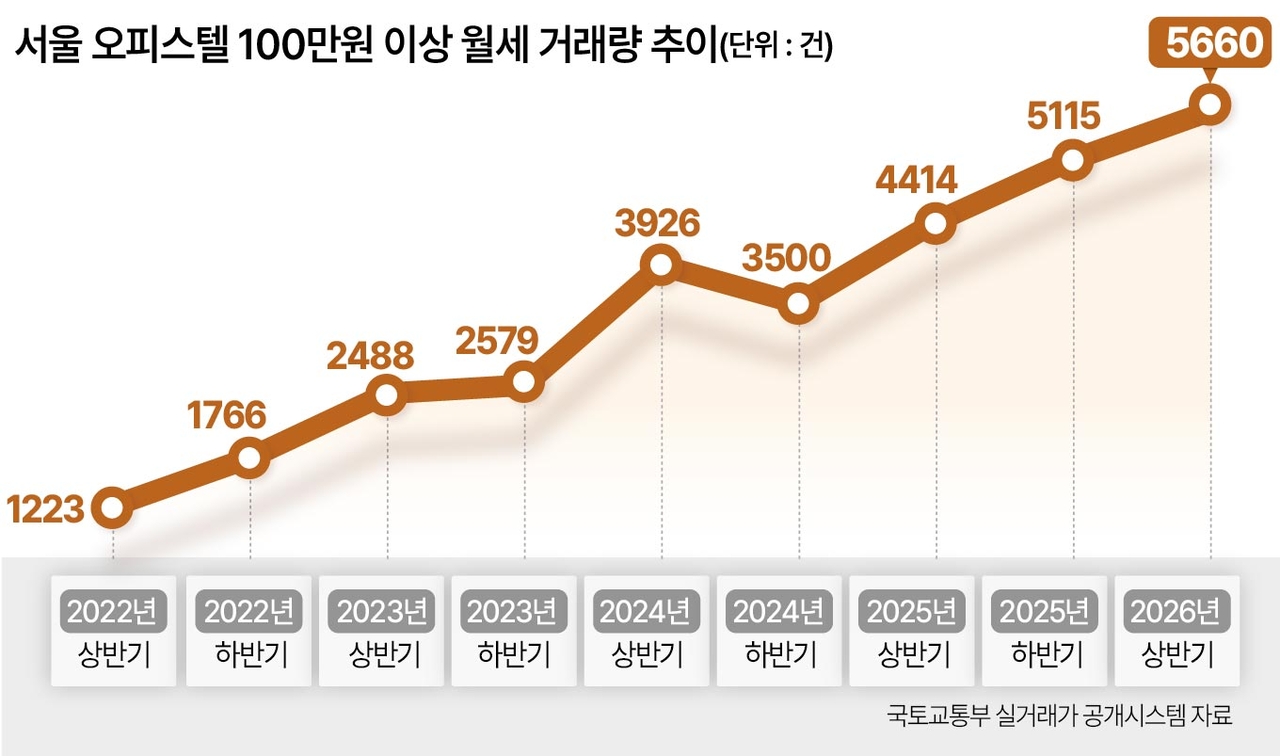
According to the Ministry of Land, Infrastructure and Transport's actual transaction price disclosure system, 5,660 new monthly rent contracts for Seoul officetels were signed in the first half of this year at 1 million won or more. That is up about 11 percent from the previous half-year period (5,115 transactions) and up 28 percent from the first half of last year (4,414 transactions). At this pace, the full-year total could exceed 10,000 transactions for the first time in history.
Looking at the five-year trend by half-year period, officetel monthly rent contracts at 1 million won or more numbered in the low thousands in both halves of 2022. Since the first half of 2022 (1,223 transactions), the figure has grown by 4,437 transactions — a 363 percent increase in four years.
High-rent officetel transactions are no longer confined to premium neighborhoods. In the first half of this year, monthly rents exceeding 1 million won were recorded not only in the Gangnam three districts (Gangnam, Seocho and Songpa-gu), Yongsan-gu and the Han River belt (Gangdong, Gwangjin, Dongjak, Mapo and Seongdong-gu), but also in outer and mid-to-low-price areas including Nowon, Dobong and Gangbuk-gu, Geumcheon, Gwanak and Guro-gu, and Gangseo, Dongdaemun, Seodaemun, Yeongdeungpo, Jung and Jungnang-gu.
Rent increases have also been steep. A residential officetel unit at Hillstate Cheongnyangni Station in Cheongnyangni-dong, Dongdaemun-gu — with an exclusive use area of 41 square meters — signed a new monthly rent contract on June 27 at a deposit of 50 million won and a monthly rent of 1.65 million won. The same unit type rented in August last year at a deposit of 50 million won and a monthly rent of 1.37 million won, meaning rent climbed nearly 300,000 won in under a year.
A 39-square-meter unit at Yongsan Park Xi in Hangang-ro 1-ga, Yongsan-gu, signed a new contract on June 26 at a deposit of 20 million won and a monthly rent of 1.3 million won — up 180,000 won from 1.12 million won at the same deposit in January. A 62-square-meter unit at KGM Platinum City Complex 1 in Dorim-dong, Yeongdeungpo-gu, also saw its monthly rent jump from 1.35 million won in May last year to 1.6 million won in June this year — a 250,000-won increase — at a deposit of 30 million won.
The broad-based rent surge across officetel sizes reflects a mass migration of rental demand away from apartments, where rising jeonse prices have become unaffordable, combined with a supply shortage. As apartment jeonse and monthly rent listings have dried up sharply, officetel rental inventory has effectively frozen. KGM Platinum City Complex 1, a 626-unit development, currently has zero jeonse or monthly rent listings on the market. Yongsan Park Xi, with 995 units in total, has just one jeonse listing and no monthly rent listings.
A real estate agent surnamed K operating in Hangang-ro 1-ga said landlords are increasingly converting jeonse contracts to semi-jeonse or monthly rent arrangements and raising asking prices, partly because meeting deposit insurance requirements for jeonse has become complicated. "The Yongsan area draws strong demand from workers commuting to Yeouido or Gwanghwamun, so there are almost no officetel listings available right now," K said.
Market indicators for Seoul officetels are all trending upward. According to the Korea Real Estate Board's officetel price survey for the second quarter of this year, Seoul officetel sale prices rose 0.24 percent from the previous quarter, while jeonse and monthly rent prices climbed 0.40 percent and 0.90 percent, respectively, over the same period. The jeonse-to-monthly-rent conversion rate also rose to 6.06 percent as of last month, up from 5.95 percent in January.
With even non-apartment housing entering a triple rally and housing anxiety growing among working-class residents and young people, calls are mounting for expanded non-apartment supply through incentives such as eased lending and construction regulations. Kim Deok-rye, a senior research fellow at the Housing Industry Research Institute, said at a Ministry of Land, Infrastructure and Transport forum on Tuesday that there is a national and governmental consensus that non-apartment supply is urgently needed. She added that normalizing the non-apartment sector, where supply has contracted, requires significantly reducing the future uncertainty surrounding these projects.
hwshin@heraldcorp.com