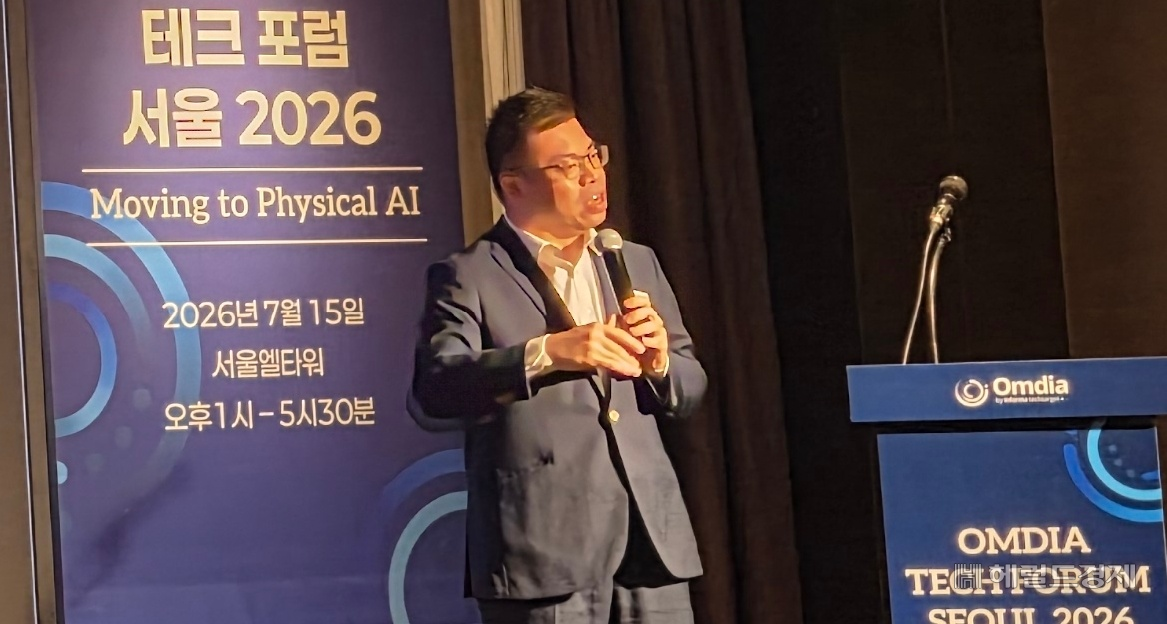
"South Korea has a high likelihood of becoming a third-way alternative to China and the United States in physical AI. Samsung Electronics, SK Hynix, and Boston Dynamics under Hyundai Motor Group are completing a physical AI full stack." — Lian Jye Su, chief analyst, Omdia Singapore
As the physical AI market begins to open up in earnest, analysts say South Korea has a real opportunity to become a fast follower in the space.
Market research firm Omdia Korea held the "Omdia Tech Forum Seoul 2026" on Wednesday at L Tower in Seocho-gu, Seoul, under the theme "The Full Journey from Data Centers to Physical AI." Lian Jye Su, chief analyst at Omdia Singapore, led five Omdia Asia-Pacific analysts in sessions covering semiconductor innovation, the future of manufacturing, modular prefab construction for AI data centers, and the automotive industry — all through the lens of physical AI.
Kim Su-yeon, managing director of Omdia Korea, said physical AI goes beyond AI that simply thinks and responds — it is technology that perceives, understands and acts directly in the real world. "If digital transformation once determined corporate competitiveness, going forward the key will be how effectively companies combine AI, semiconductors, data and robots — the physical infrastructure," she said.
She added that South Korea possesses world-class manufacturing capabilities along with strong semiconductor, automotive and ICT infrastructure. "The physical AI era is both a new challenge and a critical opportunity for us to lead the global market," she said.
Speaking first, Lian Jye Su outlined the opportunities and challenges surrounding physical AI, arguing that the sector represents a clear opportunity for South Korea.
Su said that while quadruped robots currently see wider deployment than humanoid robots, the humanoid market is growing steadily. Global humanoid robot shipments stood at roughly 17,000 to 18,000 units last year and are expected to nearly double to about 36,000 to 40,000 units this year.
That figure is projected to surge to about 2.6 million units by 2035 and to about 930 million by 2050. The overall physical AI market is forecast to expand from $8.14 billion in 2025 to $1.15 trillion in 2035 — when physical AI is expected to become mainstream — at an average annual rate of 33.5 percent.
Su highlighted South Korea's potential to emerge as a third-way alternative to China and the United States. "In physical AI, China leads in scale and the United States leads across the broader technology landscape, but other countries may not want to be entirely dependent on either," he said. He predicted demand would grow for fully localized robot supply chains covering components and suppliers. Currently, 87 percent of humanoid robots are shipped from China.
South Korea, Su argued, stands as an attractive option in that context. "Korea not only has a very strong technology supply chain but also a strong channel distribution strategy," he said, adding that the country needs to clearly define its supply chain strategy and work with partners and distributors across that supply chain.
Su estimated it would take at least another decade before home-use robots — the final stage of physical AI — reach mass commercialization. "A robot does not have to be exactly like a human to succeed. Having just one or two killer features is enough," he said. "But if you do not build a strong foundation now — such as training AI on high-quality data for the next 10 years — commercialization will take even longer."
Su identified three tasks South Korea must tackle to prepare for the next decade: securing talent to cultivate robotics engineers; encouraging companies within the robot supply chain to collaborate with broader robot and chipset manufacturers to build a wider ecosystem; and acquiring the high-quality data needed to train robots. He noted that companies designing robots specifically for the Korean market must secure high-quality data tailored to that market.
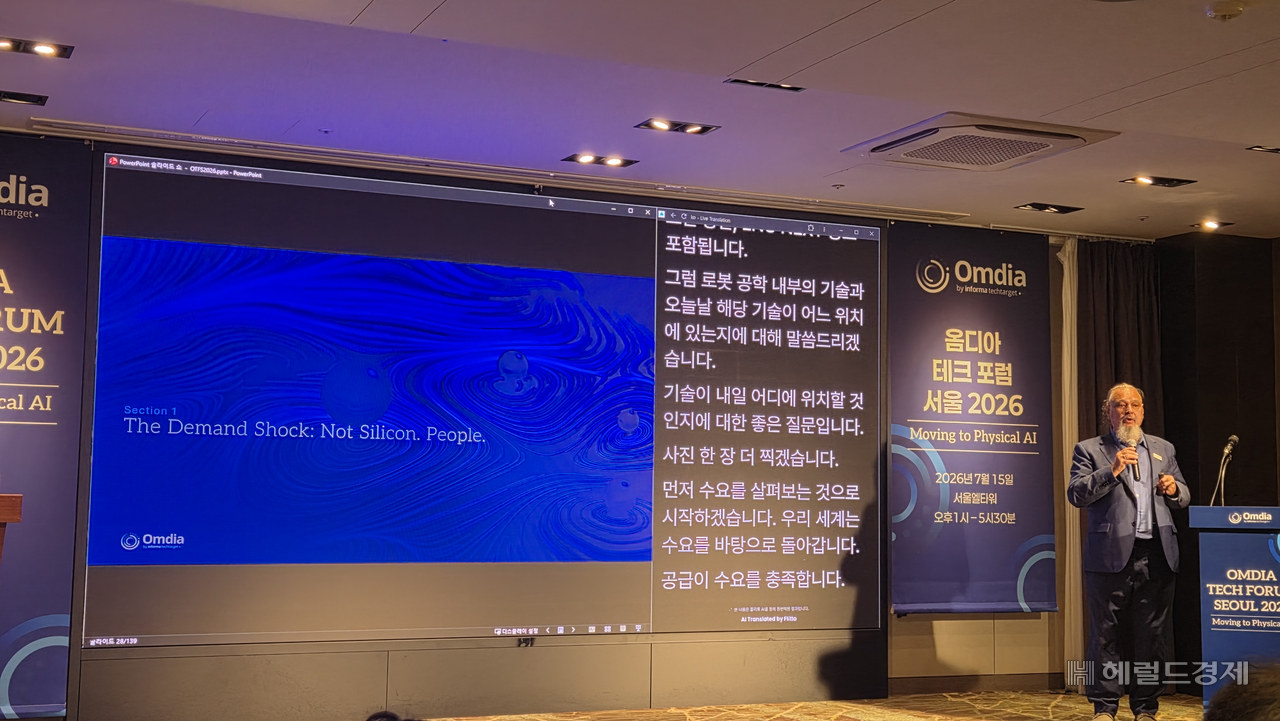
The expansion of the physical AI market is also driving a surge in semiconductor demand. According to Omdia, the semiconductor market is projected to balloon from $687 billion in 2024 to $1.6 trillion in 2026 and $2.1 trillion in 2028. Analysts noted that 2026 represents only the peak of growth speed — the market will continue expanding through 2028 even after infrastructure buildout is complete. On-device semiconductors are expected to see particularly strong growth driven by the physical AI market.
Bruce Bateman, senior semiconductor analyst at Omdia Taiwan, opened by saying the semiconductor supercycle and labor shortages are two sides of the same coin. He argued that South Korea, Taiwan and Japan — which have some of the world's lowest birth rates and face structural labor shortages — have no choice but to drive physical AI as a structural solution.
"The core challenge of physical AI is what to do about the spine — the central nervous system," Bateman said. "It is important to reduce latency so that a robot can respond within 0.2 seconds, just like a human. To achieve that, microcontrollers need to be built inside humanoid robots so that a human 'brain' is no longer required."
That need, he said, means microelectromechanical systems — the semiconductor equivalent of human nerves — will become a major trend in chips for robotics. Chipmakers that dominate the force, torque and tactile sensor space will be the new winners in the robotics industry, he said. According to Omdia, the torque sensor market is forecast to grow from $500 million in 2024 to $7.9 billion in 2032, a compound annual growth rate of 48 percent.
Bateman said on-device semiconductors will become the central battleground as the physical AI era takes hold. "HBM is currently very expensive, but with the advancement of edge AI, HBM prices are expected to fall around 2030," he said. "That said, there is no way to resolve the memory shortage until new fabs are built."
go@heraldcorp.com