![CXMT's DDR5 memory chip. [Captured from CXMT website]](https://wimg.heraldcorp.com/news/cms/2026/07/15/9/news-p.v1.20260528.8d8391db2b5c4cb7b635e4c34877c592_P1.png)
CXMT, the world's fourth-largest DRAM maker, said ahead of its initial public offering that its latest DRAM technology is competitive with that of Samsung Electronics and SK Hynix, the two global leaders in memory chips. The Chinese chipmaker added that it is mass-producing DDR5 (double data rate) chips for servers and LPDDR5X (low-power double data rate) chips for mobile devices — the most advanced DRAM specifications currently on the market.
CXMT plans to raise up to 66.6 billion yuan ($9.82 billion) through the IPO, with the proceeds earmarked for upgrading its memory production lines and funding research and development of next-generation products. The company has expressed ambitions to first overtake Micron, the American chipmaker ranked third in DRAM globally, and ultimately narrow the technology gap with Samsung Electronics and SK Hynix.
CXMT set its IPO offer price at 8.66 yuan per share on Tuesday, according to industry sources. Strong demand during the book-building process more than doubled the fundraising target from an initial projection of 29.5 billion yuan. The company is expected to list on the Shanghai Stock Exchange on July 27.
Founded in 2016, CXMT has led China's push to develop domestically produced DRAM. China accounts for roughly 25 percent of global DRAM consumption but had long depended on imports. CXMT focused on commodity DRAM to challenge established global chipmakers, becoming China's top and the world's fourth-largest DRAM manufacturer. Its global DRAM market share stood at around 8 percent in the first quarter of this year.
The company's IPO prospectus reflects that confidence. CXMT said it has built mass-production capabilities for the latest DRAM products that are competitive even against market leaders Samsung Electronics and SK Hynix, positioning it to supply all major product categories that currently dominate the market.
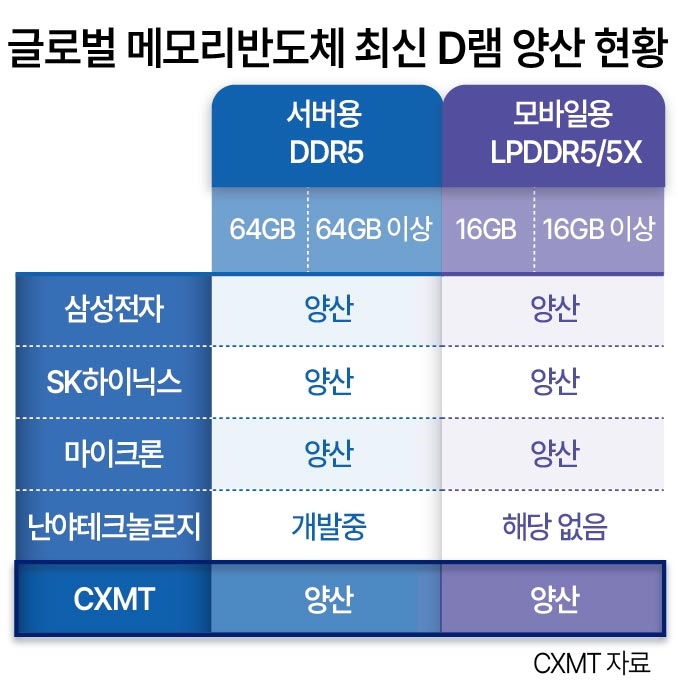
For server applications, CXMT said it is mass-producing DDR5 chips in capacities of 64GB and above — a technically demanding threshold that signals readiness to enter the high-performance data center market. The company unveiled an 8,000 Mbps DDR5 product at the China International Semiconductor Expo last November and has since moved into full-scale production expansion.
On the mobile side, CXMT formally launched mass production of LPDDR5 and LPDDR5X chips in October last year. Its 12GB and 16GB products operate at speeds of up to 10,667 Mbps, performance the company says is comparable to equivalent offerings from Samsung Electronics and SK Hynix.
However, analysts note that while CXMT may have closed the raw performance gap, South Korean chipmakers still hold a lead of roughly two to three years in process technology, yield rates and power efficiency. China's restricted access to EUV lithography equipment has limited its ability to advance to finer process nodes, which in turn constrains its cost competitiveness.
A notable comparison in the prospectus is with Taiwan's Nanya Technology, which holds a 2 percent share of the global DRAM market and, like CXMT, is a late entrant to the industry. CXMT said Nanya Technology's DDR5 server chips remain in the development stage. CXMT did not separately indicate whether Nanya Technology has developed or begun mass-producing LPDDR5 and LPDDR5X mobile chips, though Nanya has recently been reported to have joined the supply chain for Nvidia's SoCam 2.
As CXMT ramped up its commodity DRAM production capabilities, it turned profitable for the first time last year. Full-year 2025 sales reached 61.8 billion yuan and net profit attributable to the parent company came to 1.9 billion yuan. With the broader DRAM market — from high-bandwidth memory to commodity chips — facing supply shortages, further earnings growth is widely expected. In the first quarter of this year, CXMT posted sales of 50.8 billion yuan and net profit of 24.8 billion yuan, already surpassing its full-year 2025 figures on both measures.
CXMT plans to channel the IPO proceeds into next-generation DRAM development and production capacity upgrades. According to its disclosed investment plan, the company will allocate 7.5 billion yuan to retrofitting existing production lines, 18 billion yuan to upgrading DRAM memory technology, and 9 billion yuan to advanced DRAM research and development. With fundraising expected to exceed initial projections, the pace of its technology development is also likely to accelerate.
jeongwan@heraldcorp.com