![Deputy Prime Minister and Minister of Economy and Finance Koo Yun-cheol briefs President Lee Jae Myung on emergency governance and response measures related to the Middle East war at a Cabinet meeting held at Cheong Wa Dae on Tuesday. [Yonhap]](https://wimg.heraldcorp.com/news/cms/2026/07/14/rcv.YNA.20260714.PYH2026071406720001300_P1.jpg)
The government is strengthening an emergency response framework spanning prices, energy, employment and finance as geopolitical risks from the Middle East have flared again following the resumption of armed conflict between the United States and Iran.
Despite rising tensions around the Strait of Hormuz, Seoul intends to keep crude oil supplies stable while pressing ahead with youth employment measures, a won internationalization roadmap and supply chain diversification policies.
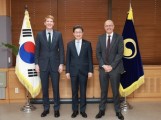
Deputy Prime Minister and Minister of Economy and Finance Koo Yun-cheol briefed President Lee Jae Myung on "emergency governance and response measures related to the Middle East war" at a Cabinet meeting held at Cheong Wa Dae on Tuesday.
The government assessed that tensions in the region have risen again following the resumption of US-Iran armed conflict and Iran's declaration of a Strait of Hormuz closure. The risk level for vessels transiting the strait has been raised to "Serious."
Escalating Middle East tensions have pushed international oil prices higher. As of Monday morning, Brent crude stood at $79.3 per barrel and West Texas Intermediate at $74.5. The won-dollar exchange rate has been fluctuating in the low 1,500-won range, partly on expectations of dollar inflows from SK Hynix's issuance of American depositary receipts in the United States.
The government said, however, that the domestic economy's fundamental strength remains intact, supported by strong exports, an expanding current account surplus and stable energy supplies.
The current account surplus for May reached $38.61 billion, a record high on a monthly basis. The cumulative surplus for January through May totaled $141.28 billion, already surpassing last year's full-year figure of $123.05 billion. The International Monetary Fund and the Asian Development Bank have both raised their growth forecasts for South Korea this year to 2.6 percent from 1.9 percent.
Crude oil and naphtha supplies are also stable for now. The government has secured more than 100 percent of the average prior-year volume for crude oil imports scheduled for July and August, and has secured enough naphtha to meet July demand. Domestic gasoline and diesel prices have fallen to the 1,800-won-per-liter range following a reduction in the maximum price ceiling.
The government said, however, that a prolonged rise in international oil prices could increase pressure on consumer prices, corporate production costs, employment and financial markets broadly, and it plans to raise its level of response accordingly.
As a first step, the government will move quickly to implement "livelihood price stabilization measures" targeting fuel and everyday consumer goods, and will prepare additional measures to stabilize prices ahead of the Chuseok holiday season. The goal is to keep the consumer price inflation rate below 3 percent in the second half of the year.
Supply chain responses will also be strengthened. The government will maintain emergency supply-and-demand measures for naphtha and petrochemical products while building a "K-supply chain" encompassing domestic production promotion, expanded stockpiling, overseas production base development and import source diversification. Emergency supply adjustment measures for petrochemical feedstocks and other materials have been extended through Aug. 26, and a ban on hoarding syringes has been extended through the end of next month.
Youth employment measures will be released promptly. The government plans to draw up a "youth jobs recovery plan" calling for training more than 200,000 skilled young professionals by 2030 and creating more than 200,000 quality jobs across the private and public sectors.
Financial measures to address exchange rate and interest rate volatility will run in parallel. The government plans to announce a "won internationalization roadmap" this month to promote won-denominated transactions, and will restructure the Bank Intermediary Support Loan program to expand financial support for small and medium-sized enterprises in regional areas.
The government will also promote the conversion of variable-rate loans into long-term fixed-rate loans and improve the overdue-debt management systems of public financial institutions, with the aim of easing the financial burden on vulnerable borrowers including small businesses and self-employed individuals.
The government is also preparing for uncertainty in crude oil supplies from September onward. About 74 percent of the volume scheduled for September delivery has been secured; if needed, the government plans to resume strategic petroleum reserve swaps and move early to expand joint international stockpiling arrangements with Saudi Arabia and the UAE.
On-site inspections to encourage gas station price reductions will be expanded. The government will publish a list of high-priced gas stations and increase the number of stations subject to special inspections from 1,000 to 3,000. Cooperation with major oil-producing countries on crude oil procurement and stockpiling will also be continuously strengthened.
The Ministry of Foreign Affairs will maintain cooperation with existing Middle Eastern oil producers — Saudi Arabia, the UAE and Qatar — while pursuing country-specific economic cooperation with the six Gulf Cooperation Council member states and Iraq. Over the medium to long term, the government plans to broaden energy and supply chain cooperation to the Americas, Africa and Central Asia to reduce dependence on the Middle East.
fact0514@heraldcorp.com