
![An aerial view of the Gangnam area in Seoul, where apartments and multi-family housing are intermixed. [Yonhap]](https://wimg.heraldcorp.com/news/cms/2026/07/14/rcv.YNA.20260713.PYH2026071309020001300_P1.jpg)
As the government prepares to unveil a real estate tax reform package as early as the end of this month, attention is turning to whether the official thresholds for high-end and ultra-luxury homes will be revised. The Oct. 15 real estate measures announced last year introduced financial regulations capping mortgage loan limits at between 200 million won ($153,000) and 600 million won depending on home price, making it likely that the tax system will also be recalibrated around similar price benchmarks.
Current government definitions of a "high-priced home" vary by tax category. For the comprehensive real estate holding tax, the threshold is a publicly assessed value exceeding 1.2 billion won; for capital gains tax, a single-household owner is exempt on homes with an actual transaction price up to 1.2 billion won; and for acquisition tax, the cutoff is a purchase price of 900 million won.
In practice, however, the market has long treated 1.5 billion won in market price as the dividing line for a high-priced home. The comprehensive real estate tax threshold of 1.2 billion won in assessed value corresponds to roughly 1.5 billion won at market rates, and the government itself used 1.5 billion won as the benchmark for its lending restrictions.
The problem is that surging home prices have sharply expanded the number of properties that fall under these high-priced home regulations. Industry observers say that even if the government tightens real estate taxes, it may set a separate, higher threshold for what counts as a high-priced home.
According to real estate data firm Budongsan114, 40.3% of apartments in Seoul — roughly four in 10 — had a market price above 1.5 billion won as of Friday, based on July 10 market price data. That is nearly double the 22% recorded in June 2021, according to Korea Real Estate Board data, when debate over raising the high-priced home threshold first gained traction.
The share is likely to keep rising. With Seoul apartment prices continuing to climb, the average market price of a Seoul apartment reached 1.68 billion won as of July 10 — up 243.4 million won from 1.44 billion won at the time of the government's June 27 measures last year — putting the average price effectively at the doorstep of the comprehensive real estate tax threshold.
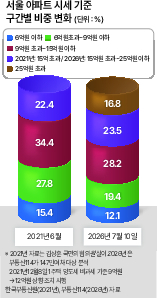
The 2.5 billion won threshold for ultra-luxury apartments — introduced under the Oct. 15 measures as the cutoff for a 200 million won mortgage cap — now applies to 16.8% of all Seoul apartments, a significant increase.
With the government having signaled that it intends to increase the tax burden on non-owner-occupied and ultra-luxury homes, calls are growing for the high-priced home threshold to be updated to reflect inflation and rising home values.
President Lee Jae-myung said on X (formerly Twitter) on Friday that the key issues include "what constitutes an appropriate holding tax on real estate, whether to differentiate between owner-occupied single homes and non-owner-occupied or multi-home properties, how large that difference should be, whether ultra-luxury primary residences should be treated separately, and what price level should define an ultra-luxury home subject to an additional holding tax burden."
Also drawing attention is whether the government will raise the thresholds for acquisition tax and capital gains tax surcharges to stimulate transactions, given its consistent push to bring non-owner-occupied and high-priced homes onto the market. The high-priced home threshold for capital gains tax exemption was held at 900 million won from 2008 before being raised to 1.2 billion won in 2021 as Seoul home prices surged.
Woo Byung-tak, a senior specialist at Shinhan Bank's Premier Pathfinder unit, said that if the comprehensive real estate tax threshold — based on assessed value — is raised to between 1.5 billion and 1.8 billion won to reflect the growing number of homes above 1.5 billion won, "all properties in the Han River belt and above would be included." He added that the threshold for ultra-luxury homes "appears likely to be set at 3 billion won or more in assessed value, equivalent to a market price of around 4.3 billion to 4.4 billion won."
According to the Ministry of Land, Infrastructure and Transport, high-priced homes with a 2026 publicly assessed value of between 1.5 billion and 3 billion won — totaling 271,692 units — are concentrated 87.9% in Seoul and 10.5% in Gyeonggi Province, meaning 98.4% are in the Seoul-Gyeonggi area. Ultra-luxury homes with an assessed value above 3 billion won number 50,869 nationwide, with 99.3% in Seoul, making them the primary target of any tightened ultra-luxury threshold.
Should the ultra-luxury threshold be set at an assessed value of 3 billion won or more, a large number of newly built and reconstruction apartments in the three Gangnam districts would fall within its scope — including the 84-square-meter units at Maple Jaye in Jamwon-dong, Seocho-gu, which are currently trading at around 5 billion won.
Industry experts, however, are skeptical that raising the high-priced home threshold will do much to stabilize prices. Yoon Ji-hae, head of the research lab at Budongsan114, said that while the 1.5 billion won lending benchmark could prompt a new tax threshold at that price level for certain categories such as capital gains tax, "it would also be possible to subdivide the price brackets and apply heavier tax rates without changing the threshold itself."
Yoon added that "there has never been a case where adjusting the holding tax caused prices to fall," noting that "tax increases have historically been passed on to buyers, and in a rising market, blocking genuine demand through taxes alone has its limits."
A separate real estate expert said that "when a new high-priced home threshold is announced, properties just below that level typically rise in price to meet the new benchmark," and that "even if the holding tax threshold is raised, owners of homes above that level tend to hold on, meaning the price impact from taxation is unlikely to be significant."
hope@heraldcorp.com




