
![Lee Gye-in (front row, fifth from left), president of POSCO International, and Heo Se-hong (front row, fourth from left), president of GS Caltex, pose for a photo at the completion ceremony for PT.ARC, an Indonesian palm oil refining joint venture, last year. [POSCO International]](https://wimg.heraldcorp.com/news/cms/2026/07/14/news-p.v1.20251120.028d604eda5741d9b54e6d59a4af1110_P1.jpg)
POSCO International is moving to acquire a stake in an overseas partner in the sustainable aviation fuel sector, positioning itself to capture early ground in a market with strong growth potential driven by the global decarbonization trend. The company plans to achieve 400 billion won ($265 million) in SAF sales by 2030 through aggressive investment.
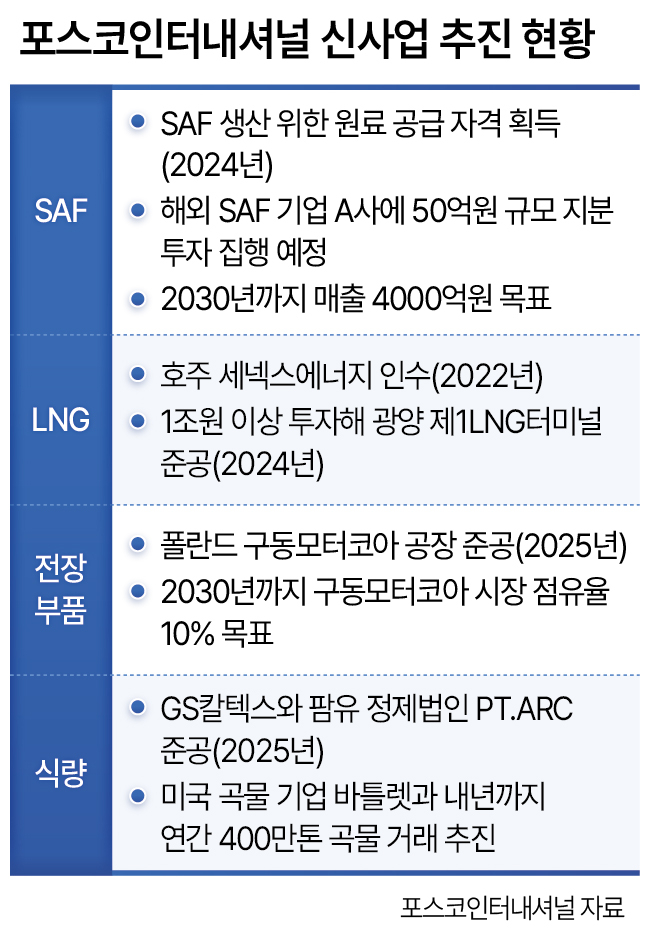
According to industry sources Tuesday, POSCO International has decided to invest approximately 5 billion won in a foreign company — identified only as Company A — that is developing an ethanol-based SAF project, with the investment expected to be executed as early as this year. "We are in the final stage, just before the investment is executed," a POSCO International official said.
POSCO International began laying the groundwork for its SAF business well in advance, recognizing the sector's potential early on. In 2024, the company obtained the ISCC CORSIA international certification, qualifying it to supply feedstock for SAF production.
Through its food business, the company has also built a palm oil value chain for SAF manufacturing. Last year, it partnered with GS Caltex to complete PT.ARC, a palm oil refining joint venture. PT.ARC produces 500,000 metric tons of refined palm oil annually — a key SAF raw material — equivalent to 80 percent of South Korea's annual refined palm oil imports. The palm oil needed in the refining process is sourced from palm plantations that POSCO International operates in Indonesia.
POSCO International aims to generate 400 billion won in SAF sales by 2030. To reach that target, the company plans to collaborate with a range of overseas firms with competitive strengths in the SAF sector. As part of efforts to scale up the business, the company is also reportedly considering adding SAF to its trading portfolio.
POSCO International has identified SAF as a key future growth engine, citing the sector's strong expansion prospects. Major economies are pushing to replace conventional jet fuel with SAF to cut carbon emissions, with the EU leading the charge. The bloc plans to raise its SAF blending mandate from 2 percent last year to 20 percent by 2035 and 70 percent by 2050. Buoyed by such green policy momentum, the global SAF market is forecast by industry observers to grow at an average annual rate of 46 percent, reaching 108 trillion won by 2034.
Once the SAF business reaches full stride, POSCO International's new-business portfolio is expected to become even more robust. The company has been cultivating energy, automotive components and food as future growth pillars as it works to move beyond its traditional trading-focused business model.
![The first prototype drive motor core signed by Lee Gye-in, president of POSCO International. [POSCO International]](https://wimg.heraldcorp.com/news/cms/2026/07/14/news-p.v1.20251002.8b41e9084d644a9f9308fd3123a77635_P1.jpg)
In energy, the company has been building up its liquefied natural gas capabilities. It acquired Australian natural gas producer Senex Energy in 2022 and completed the Gwangyang No. 1 LNG terminal in 2024, investing more than 1 trillion won. In automotive components, it is expanding production capacity for drive motor cores, a key electric vehicle part, and completed a factory in Poland last year. In food, it is increasing crude palm oil output in Indonesia and conducting annual grain transactions of up to 4 million metric tons with US grain trader Bartlett through next year.
The aggressive investments have paid off, with the new businesses establishing themselves as reliable profit contributors. Senex Energy posted operating profit of 31.3 billion won in the first quarter of this year, more than triple the 9.5 billion won recorded in the same period last year. Operating profit from the Indonesian palm business rose 10.2 percent over the same period to 33.4 billion won, while the drive motor core business also edged up to 2.8 billion won.
Driven by the strong performance of its new businesses, POSCO International posted sales of 8.41 trillion won and operating profit of 357.5 billion won in the first quarter of this year, up 3.1 percent and 32.3 percent, respectively, from the same period a year earlier.
yeongdai@heraldcorp.com




