![Quarterly BSI results and outlook trends over the past two years [Provided by Busan Chamber of Commerce]](https://wimg.heraldcorp.com/news/cms/2026/07/13/news-p.v1.20260713.d8472bc1239b49af9ca5c06ec381c366_P1.png)
Busan's manufacturing business sentiment index fell again in the third quarter of this year, marking two consecutive quarters of decline. Ongoing external risks — including raw materials supply disruptions stemming from the Middle East, a high exchange rate and elevated prices — have kept local manufacturers mired in deteriorating business conditions.
The Busan Chamber of Commerce on Monday released results of its third-quarter 2026 Busan Manufacturing Business Sentiment Index (BSI) survey, which covered 255 local manufacturers. A BSI reading above 100 signals improving conditions; a reading below 100 indicates deterioration.
The third-quarter BSI for Busan manufacturers came in at 64, down 6 points from the previous quarter's 70, extending a two-quarter losing streak. The index fell well short of the baseline as raw materials supply disruptions and exchange rate pressures are expected to persist. Busan's manufacturing sector is particularly exposed to the high exchange rate because of its heavy reliance on imported raw materials, which raises input costs and squeezes profitability.
By company type, exporters posted a BSI of 80, up 16 points from 64 in the previous quarter, buoyed by higher export revenues from the weaker won and stronger order books in the electrical, electronics, and shipbuilding and marine equipment sectors. Domestic-demand-oriented firms, however, fell to 61 from 71 — a drop of 10 points — as rising raw materials prices and weakening consumer spending reflected the direct and indirect impact of the Middle East war.
A sharp divide emerged across industries. The electrical and electronics sector posted a BSI of 154, far above the baseline of 100, driven by manufacturers of AI and semiconductor components. Shipbuilding and marine equipment (119) also remained in expansion territory, supported by growing demand to replace aging vessels and a surge in orders for eco-friendly ships such as LNG and ammonia carriers as environmental regulations tighten.
On the other end of the spectrum, chemicals and rubber (35) faced a double burden of soaring raw material procurement costs and supply disruptions caused by high oil prices and the elevated exchange rate. Light industries — including footwear (20), apparel and fur (27), and textiles (40) — continued to struggle as raw materials supply instability and rising purchase prices eroded profitability.
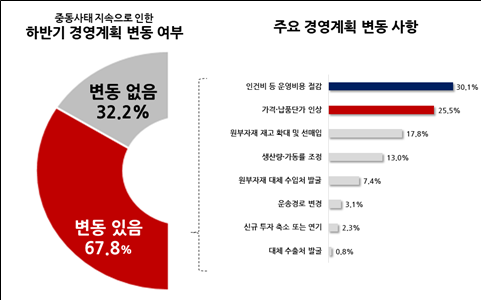
Meanwhile, a majority of local firms said revisions to their second-half business and operating plans are unavoidable. When asked whether their second-half plans had changed, 67.8 percent of respondents said they had — more than double the 32.2 percent who said they had not. The most common adjustment was cutting operating costs such as labor expenses, cited by 30.1 percent of firms, followed by raising prices or supply unit costs (25.5 percent), building up raw and subsidiary materials inventory through advance purchasing (17.8 percent), and adjusting output and operating rates (13.0 percent).
kaf2002@heraldcorp.com