South Koreans pay about 5.15 million won a year in insurance premiums per person (2025, Insurance Development Institute). This series — "Iboso" — is about making every won of those premiums count.
![Choi Sung-jin (pseudonym, 58) had been paying into a dementia insurance policy for three years when the disease struck. His family tried to file a claim, but because he was listed as the policyholder, the insured and the beneficiary all in one, there was no way to proceed without his signature. Would things have been different if he had designated a proxy by relationship rather than by name? [Created using Gemini]](https://wimg.heraldcorp.com/news/cms/2026/07/11/news-p.v1.20260711.fa5fcf1b8a694bad9b5e290070e85c5b_P1.png)
Choi Sung-jin (pseudonym, 58), a salaried worker who prided himself on his health, took out a dementia insurance policy three years ago, naming himself as both the insured and the beneficiary. "If I get sick someday, I should be the one to cover my own medical bills," he thought, and dutifully paid his premiums every month. But early this year, sudden symptoms of dementia left his communication and memory rapidly deteriorating. His family eventually tracked down the policy, only to be told there was nothing they could do: because Choi was listed as the policyholder, the insured and the beneficiary all at once, no claim could be filed without his handwritten signature or a power of attorney.
As South Korea entered super-aged society status — with people 65 and older now exceeding 20 percent of the population — enrollment in dementia and long-term care insurance has surged. Yet when serious illness strikes, the very person entitled to file a claim often loses the cognitive capacity to do so, leaving the money frozen. A proxy claimant designation system existed to prevent exactly this, but cumbersome procedures kept take-up low.
The proxy designation rate for dementia insurance policies actually slipped from 26 percent in 2021 to 23.1 percent in the first half of this year. In response, a new unnamed-designation system took effect July 1, allowing policyholders to specify a relationship — "spouse" or "child" — rather than a specific person's name. By recording only the relationship in advance, a family member can step in and file a claim on the policyholder's behalf when a crisis arrives.
What should people do now to avoid ending up like Choi? Below is a question-and-answer guide to what has changed.
What is a proxy claimant?
A proxy claimant is someone you designate in advance to file an insurance claim on your behalf if illness or injury leaves you unable to do so yourself. Death benefits are excluded from this arrangement.
Every insurance policy involves three roles: the policyholder who pays the premiums, the insured whose life or health is covered, and the beneficiary who receives the payout. In dementia and long-term care policies, all three roles typically belong to the same person — as in Choi's case. The problem is that when dementia or a serious illness actually arrives, the patient may forget they ever took out a policy, or may remember but be physically unable to complete the paperwork and sign a claim. The money was set aside for that person alone, yet that person is now the one person who cannot access it.
If a proxy claimant has been registered, a family member can immediately file the claim and use the payout for nursing or medical costs. Without one, the family must obtain a legal guardian through the court — a process that takes considerable time. In the interim, relatives may end up shouldering hospital bills themselves, triggering disputes, or find themselves unable to access the insurance money precisely when they need it most. To close this gap, financial regulators and the insurance industry overhauled the system effective July 1.
What changed this time?
Policyholders can now choose between two designation methods: named (specifying a person) or unnamed (specifying a relationship).
Under the old rules, designating a proxy required writing down a specific person's full name and resident registration number, and obtaining that person's consent to share their personal information. As a result, many people put off the designation at sign-up because they could not decide on the right person, or skipped it altogether because the process felt too burdensome. Others designated someone years earlier, then missed the update when family circumstances changed — leaving the system useless at the moment it was needed most. A name, in short, became a trap.
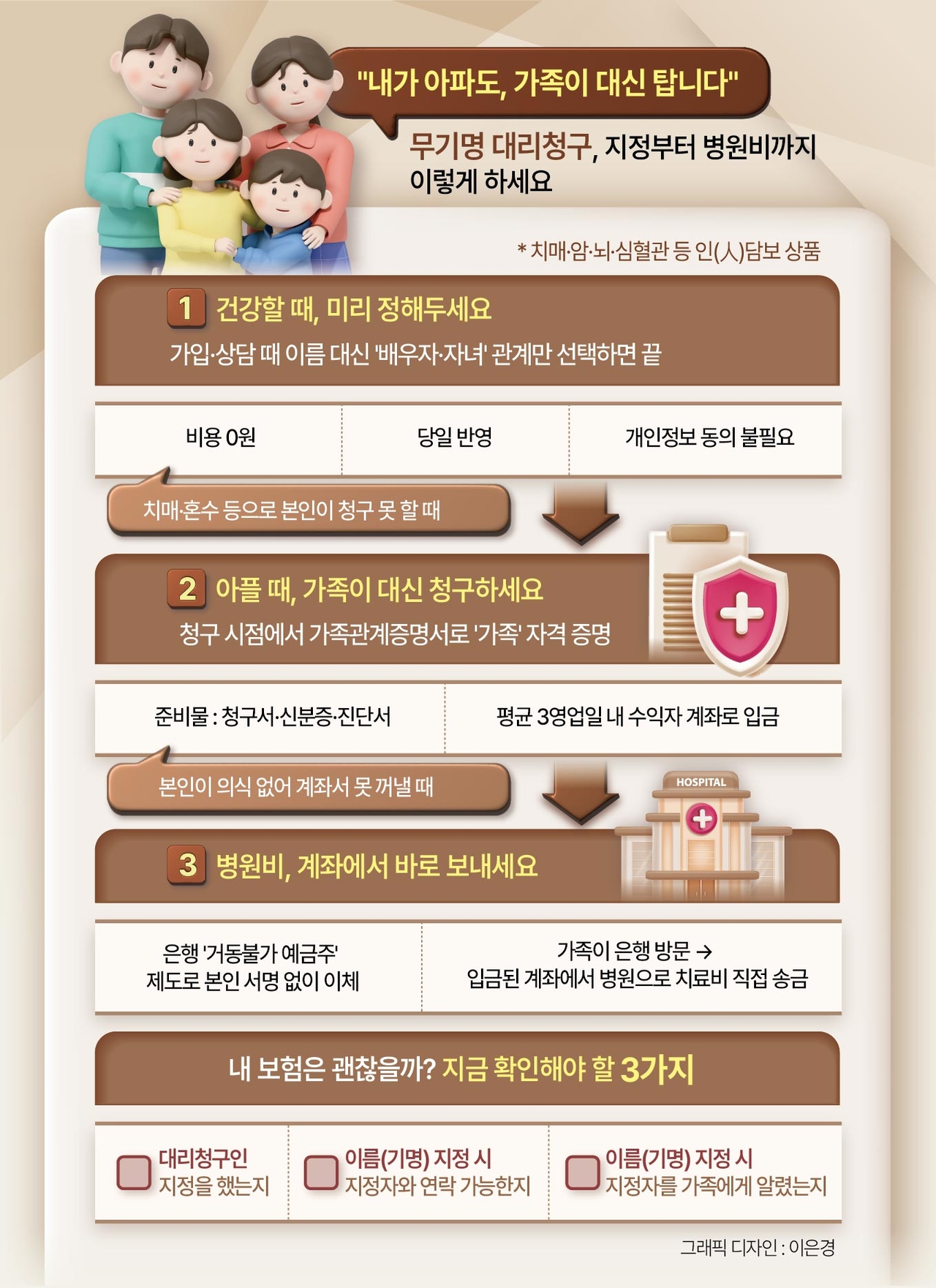
From July 1, policyholders can designate a proxy using a relationship — "spouse" or "child" — instead of a name. Because no personal details are recorded, no consent to share personal information is required. The relationship is set at sign-up; when a claim is actually filed, the proxy simply proves eligibility — for example, by presenting a family relations certificate confirming they are indeed that spouse or child.
Eligible relationships are defined by the insured's family register or marriage certificate, and cover a spouse or lineal ascendants and descendants as recorded in the resident registration. Lineal ascendants and descendants refers to those in a direct line above the insured — parents and grandparents — and those in a direct line below, such as children and grandchildren.
What if I get divorced or remarry?
There is no need to worry. Proxy claimant eligibility is determined not by the family register at the time of sign-up, but by the register at the moment the claim is actually filed.
If a policyholder designated "spouse" under the unnamed system and later divorced, the former spouse would no longer qualify at the time of the claim and would lose eligibility. If the policyholder remarried after signing up, the current spouse could file on their behalf. Whether family circumstances change through divorce, remarriage or death, there is no need to notify the insurer or submit a change request.
Isn't naming someone more reliable?
In practice, naming a specific person can backfire in ways that leave policyholders worse off.
Park Jeong-ja (pseudonym, 73), who lives alone, took out a dementia policy five years ago and named her eldest daughter — who lived nearby — as the designated proxy. Last year, however, the daughter emigrated to the United States after her husband was posted abroad. When Park's cognitive abilities recently began to decline, her son in Korea tried to file a claim, only to find the proxy designation was locked to the eldest daughter. Obtaining documents from overseas across different time zones and going through notarization caused significant delays in the payout.
The situation facing the family of Kang Ho-cheol (pseudonym, 61), who fell into a coma, was even more difficult. When relatives searched his policies to cover medical costs, the proxy claimant on record was his "spouse" from when he had signed up a decade earlier — an ex-wife he had long since divorced and whose contact details no one had. Told that a proxy claim was impossible without the ex-wife's consent and documentation, the family said they "suffered doubly — once from caregiving and again from fighting to file the claim."
In both cases, a designation had been made, but the requirement to name a specific individual was the problem. Because family circumstances can change at any time, designating a proxy by relationship is the more practical and secure choice.
How many proxies can I designate?
Under the named system, up to two people can be designated, but a lead proxy must be identified when two are chosen. The lead proxy files and receives the payout; the second person may only step in if the lead is unable to act — for example, due to death.
The unnamed system has no limit on the number of people who can qualify, but the policyholder must select a relationship category. The seven options are: spouse and lineal ascendants and descendants, spouse, parents, children, grandparents, lineal descendants, and lineal ascendants. The broader the category, the more family members can file a claim, so unless there is a specific reason to narrow it, choosing "spouse and lineal ascendants and descendants" offers the widest safety net.
How is the payout delivered?
The process differs slightly between the two systems. Under the named system, the proxy receives the payout and passes it on to the beneficiary. Under the unnamed system, the proxy files the claim but the insurer deposits the money directly into the beneficiary's bank account. In either case, the ultimate owner of the funds is the beneficiary; the proxy's role is solely to file the claim. The unnamed system is particularly secure in this regard, since the money goes straight to the beneficiary's account with no opportunity for the proxy to handle it along the way.
When a designated unnamed proxy — a spouse or child — files a claim, two sets of documents are required: the standard paperwork (claim form, a copy of the proxy's ID, the insured's medical diagnosis and receipts for medical expenses) plus a family relations certificate or marriage certificate current at the time of filing, to prove the proxy's eligibility. Barring cases that require investigation, the insurer pays the designated beneficiary within an average of three business days after the documents are received.
Can the money be used for hospital bills right away?
Yes — through the bank's "incapacitated account holder" service.
Under the unnamed system, the insurance payout is deposited into the insured's own account. But if the insured is unconscious, the money sitting in that account cannot be withdrawn to pay hospital bills. The insurer has released the funds, yet the family hits another wall at the bank. In this situation, the proxy claimant can visit the bank where the money was deposited and request a transfer for the purpose of paying medical costs; the bank can then wire the treatment fees directly to the hospital from the account, without requiring the account holder's signature.
The bank may ask for supporting documentation related to the medical costs. It is advisable to bring a doctor's diagnosis or medical opinion, the proxy's ID, a family relations certificate, and hospital receipts or tax invoices. Required documents vary by bank, so calling ahead before visiting can save an unnecessary trip.
Which insurance products are covered?
Proxy claimant designation is available across a range of insurance products. The Financial Supervisory Service has expanded the list of products for which confirming a designation at sign-up is mandatory — previously limited to dementia insurance, it now includes cancer, cerebrovascular and cardiovascular products. Full coverage across all disease insurance products is targeted for the first half of next year.
Hanwha General Insurance moved ahead of the regulatory timeline, extending the system from July 1 to all products that include personal coverage — covering injury, illness and death — with the exception of group and pension insurance. This means the proxy claimant system can now be used not only for dementia but also when a policyholder loses consciousness due to a sudden accident or cerebral hemorrhage.
The company also updated its systems. The sign-up screen now defaults to "unnamed — spouse and lineal ascendants and descendants," so customers benefit from the system without having to actively select it. Anyone who wants to skip the designation must choose a reason for not designating and manually type a statement confirming they do not wish to appoint a proxy claimant. The intent is to catch one more layer of cases where people sign up for coverage but end up unable to use it.
How do I apply now?
A designation can be made through an insurance agent, a customer service center, a branch visit or a mobile app, at no cost. Changes take effect the same day.
The options available vary by channel, however. Signing in person — through an agent or at a branch — allows the full range of choices: named, unnamed or no designation. Electronic signatures through a mobile app or messaging notification support only the unnamed and no-designation options. Anyone who wants to name a specific person must go through an agent or branch and sign on paper.
Existing customers will be able to designate or change a proxy claimant through a policy endorsement — a procedure for amending part of an existing contract. For now, existing policyholders are advised to check with their agent or customer service center whether a proxy claimant has already been designated on their policy. The endorsement function is currently under development and will be rolled out in stages once it is ready.
Can I designate a sibling?
Not under the unnamed system. To prevent legal disputes and keep the claims process straightforward, the unnamed designation is limited to the most intuitive family relationships: spouses and lineal ascendants and descendants. Siblings are collateral relatives, not lineal ones, and are therefore excluded.
There is an alternative. A sibling can be registered under the named system by recording their name and personal details directly. When the time comes, a named sibling has exactly the same authority to file a claim as any other designated proxy. For people living alone who have no spouse or children, the named system is well worth considering.

psj@heraldcorp.com