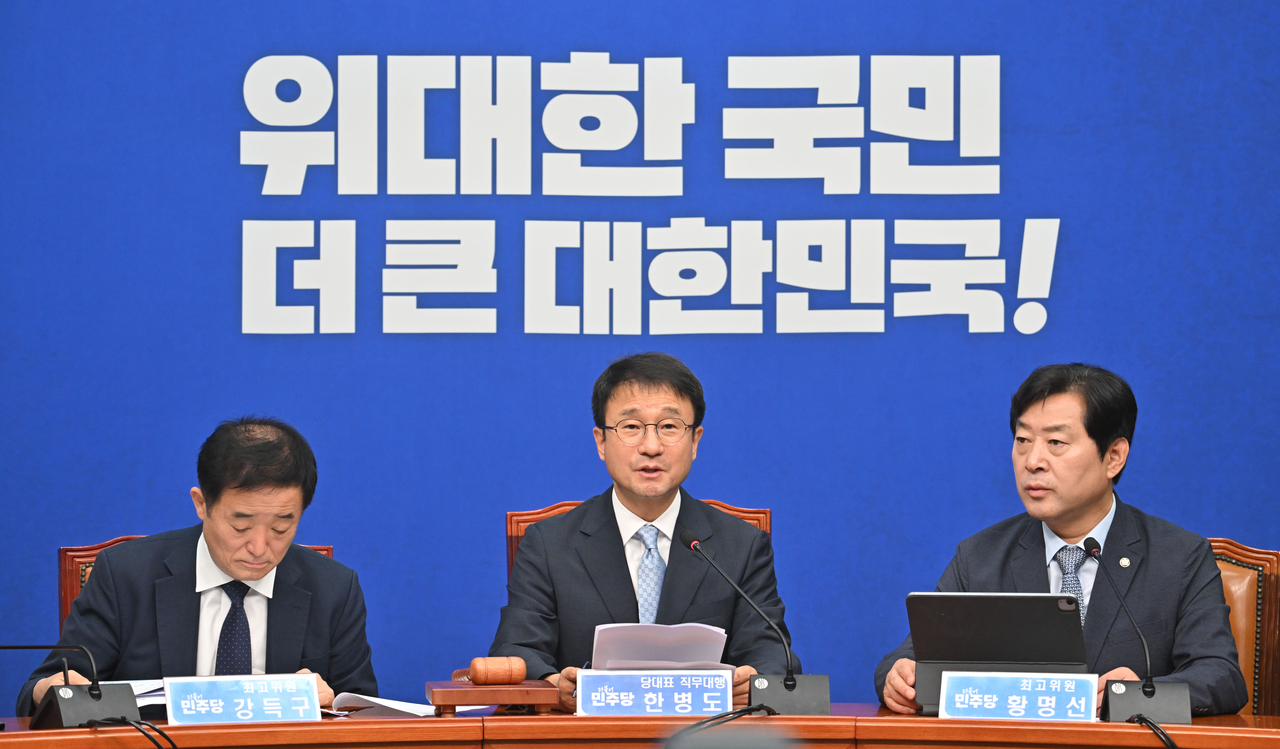
The Democratic Party of Korea is pushing to introduce a preferential voting system for the party leadership election at its Aug. 17 national convention, but the move has deepened a factional rift between supporters of Lee Jae Myung and those of Jung Chung-rae. A late-night supreme council meeting called to resolve the dispute fell through Friday, pushing the standoff into the weekend.
Party leadership had convened the emergency session that evening to defuse the controversy, but factional divisions proved too wide to bridge and the meeting was canceled. Han Byung-do, the Democratic Party's acting leader and floor leader, told reporters at the National Assembly: "We canceled the supreme council meeting. We need to try a bit harder. We'll have to do it over the weekend," adding, "We tried to wrap things up by Saturday, but it didn't work out."
The dispute surfaced after the party's convention preparatory committee proposed adopting a preferential voting system to elect the next party leader. Under the system, when there are two or more candidates, voters rank all candidates in order of preference. If one candidate secures a majority of first-preference votes, that candidate wins outright. If no candidate clears the majority threshold, the last-place candidate is eliminated and those votes are redistributed to the remaining candidates according to the next marked preference, continuing until a winner emerges.
The two factions clashed sharply over whether the system violates the party's constitution and bylaws. Lee Sung-yoon, a supreme council member aligned with the pro-Jung camp, wrote on Facebook that "the preferential voting system violates the party constitution and bylaws," arguing that "Article 8 of our constitution guarantees the autonomy of political parties, but that autonomy is recognized only within the bounds of the party constitution and bylaws." He added that introducing the preferential voting system "in clear violation of the party constitution and bylaws would only be possible after amending those rules first."
Kang Deuk-gu, a supreme council member aligned with the pro-Lee camp, took the opposite view, arguing the introduction of the system was procedurally sound. "The preferential voting system and the runoff system are not in conflict. The overarching principle under Article 25 of the party constitution is that the party leader must win more than 50 percent of the vote — that is the first principle," he said. "Whether a runoff is conducted through preferential voting was delegated to the convention preparatory committee, and the committee determined there was no issue with the party constitution or bylaws and reached its second conclusion in favor of the preferential voting system."
sunpine@heraldcorp.com