![An aerial view of the transit-oriented area around Guri Station in Gyeonggi Province. [Herald DB]](https://wimg.heraldcorp.com/news/cms/2026/07/10/ams.V01.photo.HDN.P.20260630.P12026063009211393706431386_P1.jpg)
Six out of every 10 people who bought their first home in Gyeonggi Province this year were in their 20s or 30s. As housing prices in Seoul climbed steeply, demand shifted to the greater metropolitan area, where the financial burden is comparatively lighter. Transaction volumes rose sharply in Dongtan and Giheung — areas buoyed by the semiconductor boom at Samsung Electronics and SK hynix — as well as in districts with strong access to Seoul.
According to the Supreme Court Registry Information Plaza on Friday, 43,171 people in their 20s and 30s made their first-ever purchase of a collective residential building — including apartments, townhouses, multi-family homes and officetels — in Gyeonggi Province during the first half of this year. That is up roughly 24 percent from 34,846 in the same period last year. The age group accounted for 60.2 percent of all 71,766 first-time buyers in the province.
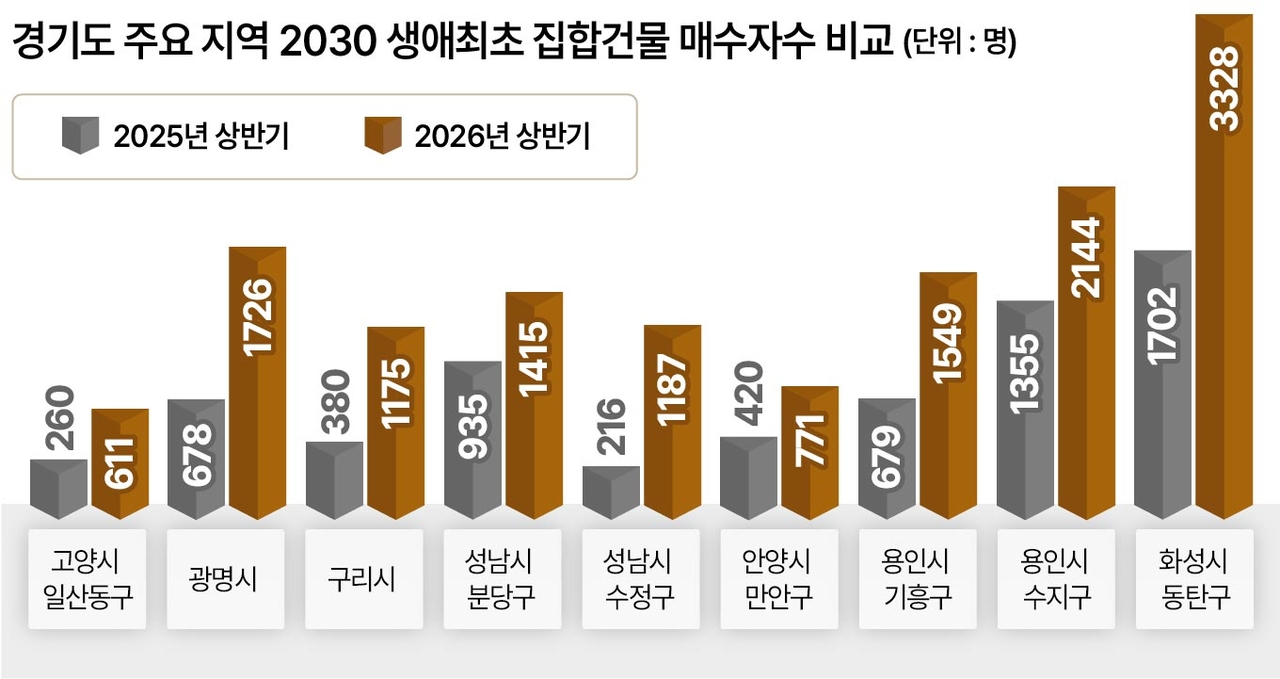
A breakdown by city and district shows the sharpest increases in regulated zones and areas with strong access to Seoul. Sujeong-gu in Seongnam — which borders Gangnam and Songpa-gu and offers easy access to Seoul — saw buyers in their 20s and 30s jump 450 percent, from 216 in the first half of last year to 1,187 in the first half of this year. Analysts attribute the surge to concentrated buying by younger purchasers near the Wirye new town development.
Uiwang, which sits within the Indeokhwon residential corridor and stands to benefit from the planned Greater Seoul Express Railway (GTX) line, also saw buyers in that age group nearly triple, rising from 297 to 1,181 — a gain of nearly 300 percent. Purchases more than doubled in several other districts: Suwon's Jangan-gu rose from 452 to 1,193 (up 164 percent), Gwangmyeong from 678 to 1,726 (up 155 percent), Goyang's Ilsandong-gu from 260 to 611 (up 135 percent), Gunpo from 366 to 835 (up 128 percent) and Seongnam's Jungwon-gu from 354 to 717 (up 103 percent).
Guri, Giheung and Dongtan — designated as regulated zones (speculation-overheated districts and adjustment-target areas) from Wednesday and as land-transaction permit zones from Sunday amid overheating in the first-home market — also recorded large increases among buyers in their 20s and 30s. In Giheung-gu, Yongin, the number jumped 128 percent from 679 to 1,549, while Guri surged 209 percent from 380 to 1,175.
Dongtan-gu in Hwaseong, where an influx of so-called "semiconductor money" — bonuses worth hundreds of millions of won confirmed for employees of Samsung Electronics and SK hynix — has been particularly pronounced, saw purchases rise 96 percent from 1,702 to 3,328. Dongtan accounted for the largest share of all collective residential buildings bought by buyers in their 20s and 30s across Gyeonggi Province in the first half of this year.
The trend extended beyond Dongtan to the adjacent Byeongjeom-gu in Hwaseong, where first-home purchases by buyers in their 20s and 30s rose 152 percent from 345 to 870. Among non-regulated areas, buying activity also expanded in Namyangju (from 824 to 1,460, up 77 percent) and Goyang's Deogyang-gu (from 723 to 1,056, up 46 percent), both of which border Seoul.
The broad concentration of buying by younger adults across Gyeonggi Province reflects soaring Seoul home prices and a worsening jeonse and monthly rent shortage, pushing demand toward major Gyeonggi areas with short commutes to workplaces. As prices have continued to rise, panic-buying sentiment — a fear of being priced out — has driven first-home purchases into mid-to-lower-priced areas less affected by lending regulations. The semiconductor boom has simultaneously produced a spillover effect into so-called "shuttle zones" in southern Gyeonggi Province, areas served by corporate shuttle buses from major chipmakers.
Nam Hyeok-woo, a real estate researcher at Woori Bank, said price momentum in southern Gyeonggi residential areas — which began in Dongtan on the back of optimism about the semiconductor industry — "remains strong." He added that buying demand "is consistently flowing into Suwon's Yeongtong-gu, a preferred location in southern Gyeonggi, and the price strength in other popular southern Gyeonggi areas such as Seongnam's Bundang and Jungwon (old Seongnam) is also being sustained."
However, Nam cautioned that factors limiting investment demand — including banks' voluntary total lending caps, heavier acquisition taxes and high interest rates — remain in place, "so whether this leads to a spillover effect as intense as in the past is something that needs to be watched a little longer."

hwshin@heraldcorp.com