![A study found that a 10% increase in the minimum wage raises the probability of business closure by 8.4 percentage points for self-employed owners with employees who have been operating for less than three years. The finding puts a number to long-held concerns that minimum wage hikes push already-marginal small business owners toward shutting down. Pictured are used kitchen appliances piled up for resale in Seoul's Hwanghak-dong kitchen supply district following business closures. [Yonhap]](https://wimg.heraldcorp.com/news/cms/2026/07/10/news-p.v1.20260710.7d6cf11d742c4bed8c285cb615510c2b_P1.jpg)
Prof. Ahn Tae-hyeon's analysis of self-employed business closures
Low-income employers see closure risk rise 8.8 percentage points
'Minimum wage alone cannot build a livelihood safety net'
'EITC expansion, career transition support and management assistance must go together'
A 10% increase in the minimum wage raises the risk of business closure by 8.4 percentage points for self-employed employers who have been operating for less than three years, according to new research. While the overall closure rate among all self-employed workers showed only a modest increase, the study found statistically significant rises in closure probability among self-employed owners with employees, low-income operators and those in the early stages of running a business.
Ahn Tae-hyeon, a professor in the economics department at Sogang University who authored the paper on minimum wages and the self-employed, described the minimum wage as a "blunt instrument." He said achieving the policy goal of guaranteeing a minimum standard of living requires a comprehensive approach — pairing the minimum wage with an expansion of the Earned Income Tax Credit (EITC), career transition support for self-employed workers who close their businesses, and management improvement assistance for small operators.
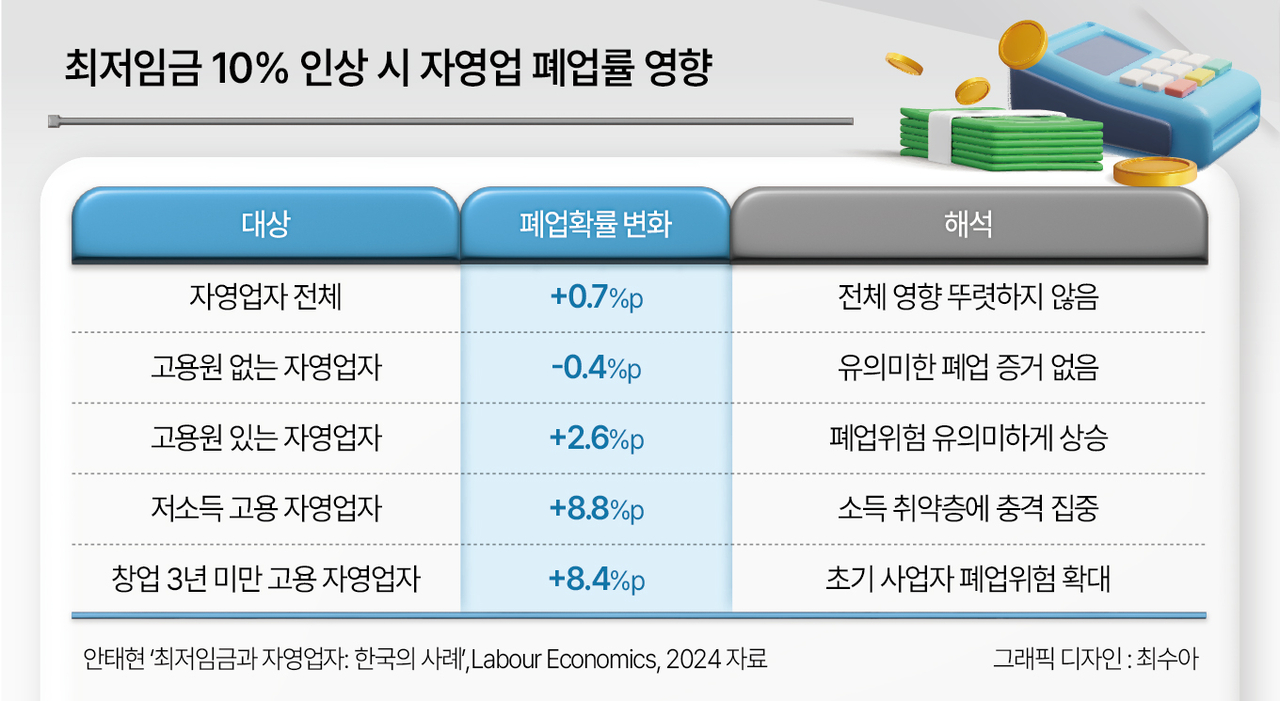
According to Ahn's paper, "Minimum Wages and the Self-Employed: The Case of Korea," a 10% increase in the minimum wage raises the probability of business closure by 2.6 percentage points among self-employed owners who employ workers. The paper combined data from the Korean Labor and Income Panel Study and the Regional Employment Survey to analyze business closures among the self-employed from 2013 to 2019.
Across all self-employed workers, a 10% minimum wage increase lifted the closure rate by just 0.7 percentage points — too small to suggest that minimum wage hikes meaningfully drive up closures overall. Among self-employed workers without employees, the closure probability actually fell by 0.4 percentage points, with no statistically significant evidence of increased closures.
The picture changed when the analysis focused on self-employed owners with employees. Their closure probability rose 2.6 percentage points with a 10% minimum wage increase — a figure the paper notes represents 30.9% of the average 8.4% closure rate for that group. "More important than any single number is the fact that the minimum wage increase did not affect all self-employed workers uniformly — it delivered a real shock specifically to those who employ workers," Ahn said in an interview.
The impact was even sharper for those in the early stages of running a business. Among self-employed employers who had been operating for less than three years, the closure probability rose 8.4 percentage points following a 10% minimum wage increase. No comparable spike appeared among employers who had been in business for three years or more. Early-stage operators are more vulnerable, the paper suggests, because they typically lack an established customer base, operational know-how and financial reserves to absorb a sudden rise in labor costs.
Low-income self-employed employers were also highly exposed. Among those with lower business income, the closure probability rose 8.8 percentage points with a 10% minimum wage increase, while higher-income employers showed no clear effect. The findings suggest that the burden of minimum wage increases falls disproportionately on operators already near the margins.
Ahn cautioned against dismissing these closures as simply the natural exit of failing businesses. "You could say that businesses that were going to fail anyway just failed sooner, but it is hard to view Korea's small self-employed operators purely as employers," he said. "Many of them started a business because they could not find a job, or opened a shop to make ends meet after retirement."

By industry, the accommodation and food service sector had the highest exposure to the minimum wage. The paper found that 45.4% of workers in that sector were earning below the minimum wage before the increase, and self-employed employers in accommodation and food services accounted for 19.4% of all self-employed employers — making it the sector with both the largest share of minimum-wage-affected workers and a heavy concentration of small employers.
The wholesale and retail trade sector was also significantly exposed. Workers affected by the minimum wage accounted for 22.3% of the sector's workforce, while self-employed employers in wholesale and retail made up 21.0% of all self-employed employers surveyed — the highest share of any sector. In repair and other personal services, the minimum-wage-affected worker share was 28.3%, with self-employed employers accounting for 6.6%. Health and social welfare services recorded a minimum-wage-affected worker share of 21.8%.
Manufacturing, by contrast, had a relatively high share of self-employed employers at 15.3%, but its minimum-wage-affected worker share was limited to 9.7% — illustrating how the impact of a minimum wage increase varies by the wage structure of each sector. "The food service and accommodation industries inevitably have high minimum wage exposure rates," Ahn said, "but these findings alone are not sufficient grounds for applying differentiated minimum wages by sector. The paper used sector-level minimum wage exposure rates as an analytical tool — it was not designed to validate differentiated application itself."
The research makes clear that the minimum wage debate cannot be reduced to a simple choice between raising or not raising the floor. The minimum wage sets a wage floor to help low-paid workers maintain a basic standard of living through employment. But it cannot, on its own, resolve the income problems of low-income households, the issue of workers dropping out of the labor market, or the livelihood pressures facing small self-employed operators.
"The point is not that the minimum wage should not be raised," Ahn said. "What the minimum wage aims to do is protect the bottom of those who make a living through work — but that goal is difficult to achieve through the minimum wage alone." He added that income support mechanisms such as the EITC, career transition assistance for self-employed workers who close their businesses, and management support to help viable businesses stay open must all be part of the policy package.
The paper also highlights the importance of what happens after a business closes. Self-employed employers who shut down following a minimum wage increase tended to move into unemployment rather than into salaried employment — meaning many were pushed out of the labor market entirely rather than absorbed into wage work. The paper recommends carefully designed income protection and vocational training programs to help displaced self-employed workers find new businesses or career opportunities.
![A research paper has found that raising the minimum wage increases the closure rate among self-employed employers already operating near the margins. Pictured is a sign believed to have been written by a business owner announcing a closure. [Yonhap]](https://wimg.heraldcorp.com/news/cms/2026/07/10/news-p.v1.20260710.1aafa375fbbf498aa189fda476ea9729_P1.png)
hong@heraldcorp.com