![Middle-aged and older job seekers consult with staff about participating in a senior employment program. [Newsis]](https://wimg.heraldcorp.com/news/cms/2026/07/10/news-p.v1.20250322.98b896e273fa45fbabb434a467a3c761_P1.jpg)
Korean workers pay national pension contributions at barely half the OECD average, and the benefits they receive after retirement fall well short of what peers in other member countries collect. The weakness of the public pension system in guaranteeing retirement income forces elderly Koreans to keep working after they retire, and the country's elderly poverty rate is the highest in the OECD.
The National Pension Research Institute released Friday an analysis of the OECD's "Pensions at a Glance 2025," finding that Korea's mandatory pension contribution rate as of 2024 stands at 9 percent in total — 4.5 percent each from employees and employers — less than half the 38-member OECD average of 18.8 percent.
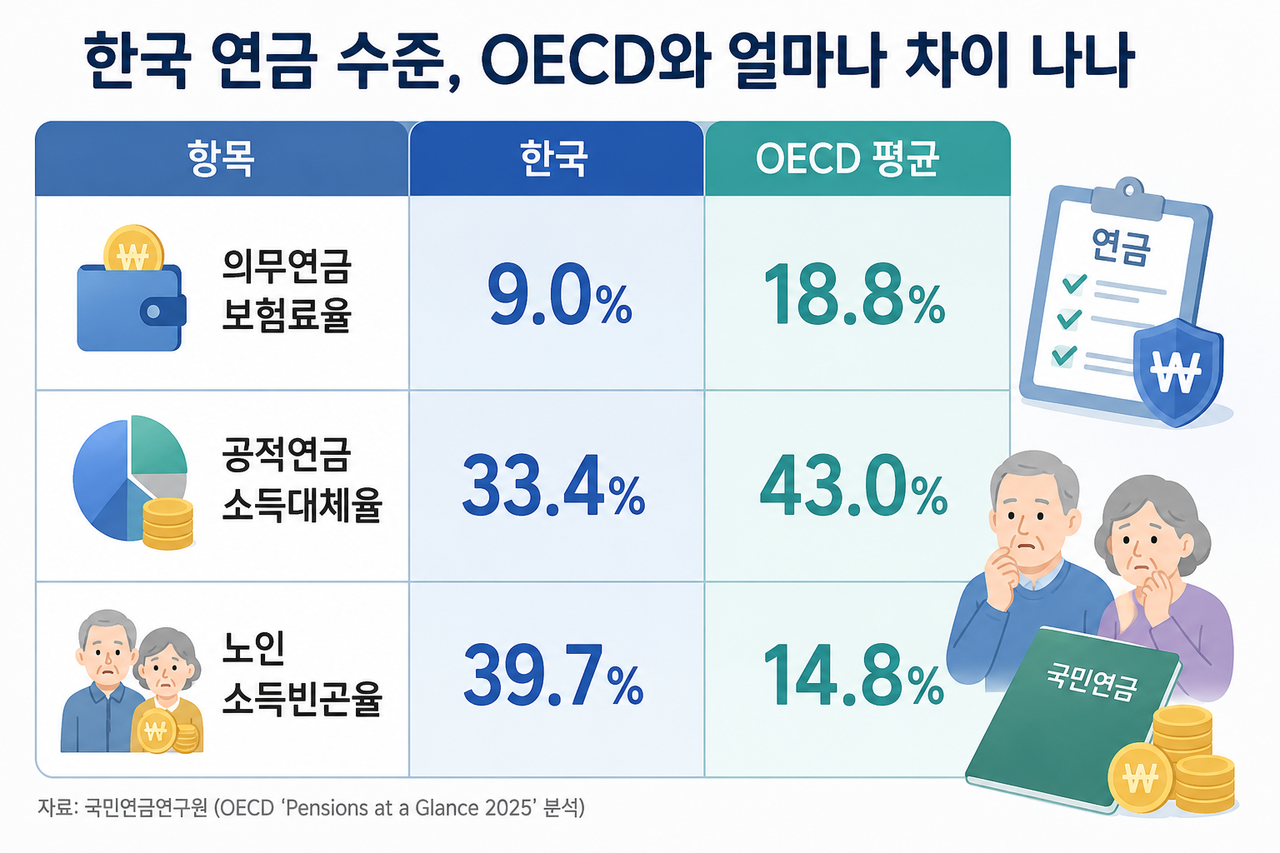
Among individual countries, Italy posted the highest contribution rate at 33.0 percent, while Korea ranked near the bottom, just above Mexico at 8.456 percent.
The low contribution burden translates directly into meager retirement benefits. The public pension income replacement rate for an average-wage worker stands at 33.4 percent, 9.6 percentage points below the OECD average of 43.0 percent. That marks a 2.2-percentage-point improvement from the previous survey, but the gap with the member-country average remains wide.
Because public pensions fail to guarantee sufficient income, elderly Korean households rely heavily on wages rather than benefits. Public transfer income — including public pensions — accounts for just 29.1 percent of elderly household income in Korea, while earned income makes up 49.9 percent. The OECD average runs in the opposite direction: public transfers account for 55.9 percent and earned income for 27.0 percent.
Poverty in old age is also serious. The income poverty rate among Koreans aged 65 and older reached 39.7 percent — about 2.7 times the OECD average of 14.8 percent and the highest among all member states. The rate was particularly high among those 76 and older, at 54.0 percent, and among elderly women, at 45.0 percent, both exceeding the overall average.
The National Pension Research Institute attributed the weakness of the public pension's income-security function to the low contribution rate and the relatively short enrollment periods of many participants.
Last year the government enacted a national pension reform that raised the income replacement rate — based on 40 years of contributions — from 40 percent to 43 percent, and set a gradual increase in the contribution rate from 9 percent to 13 percent over eight years. As a result, the contribution rate rose to 9.5 percent this year.
The reform also extended childbirth credits to first-born children and introduced a program providing up to 12 months of contribution support for low-income self-employed enrollees.
"Major countries abroad are also continuing pension reforms — adjusting the pension eligibility age and expanding work incentives — in response to aging populations," the National Pension Research Institute said. "Korea also needs additional systemic improvements to strengthen retirement income security, alongside the contribution rate increase."
fact0514@heraldcorp.com